
Free Safe Operating Procedure (Laundry Detergent Refill) Template
Download our free Safe Operating Procedure for laundry detergent refills. This customisable DOCX and PDF template helps manage chemical and spill risks.
Free Safe Operating Procedure (Laundry Detergent Refill) Template
DOCX • 126 KB + PDF
Updated Oct 2026
No signup required
Purpose of the Free Safe Operating Procedure (Laundry Detergent Refill) Template
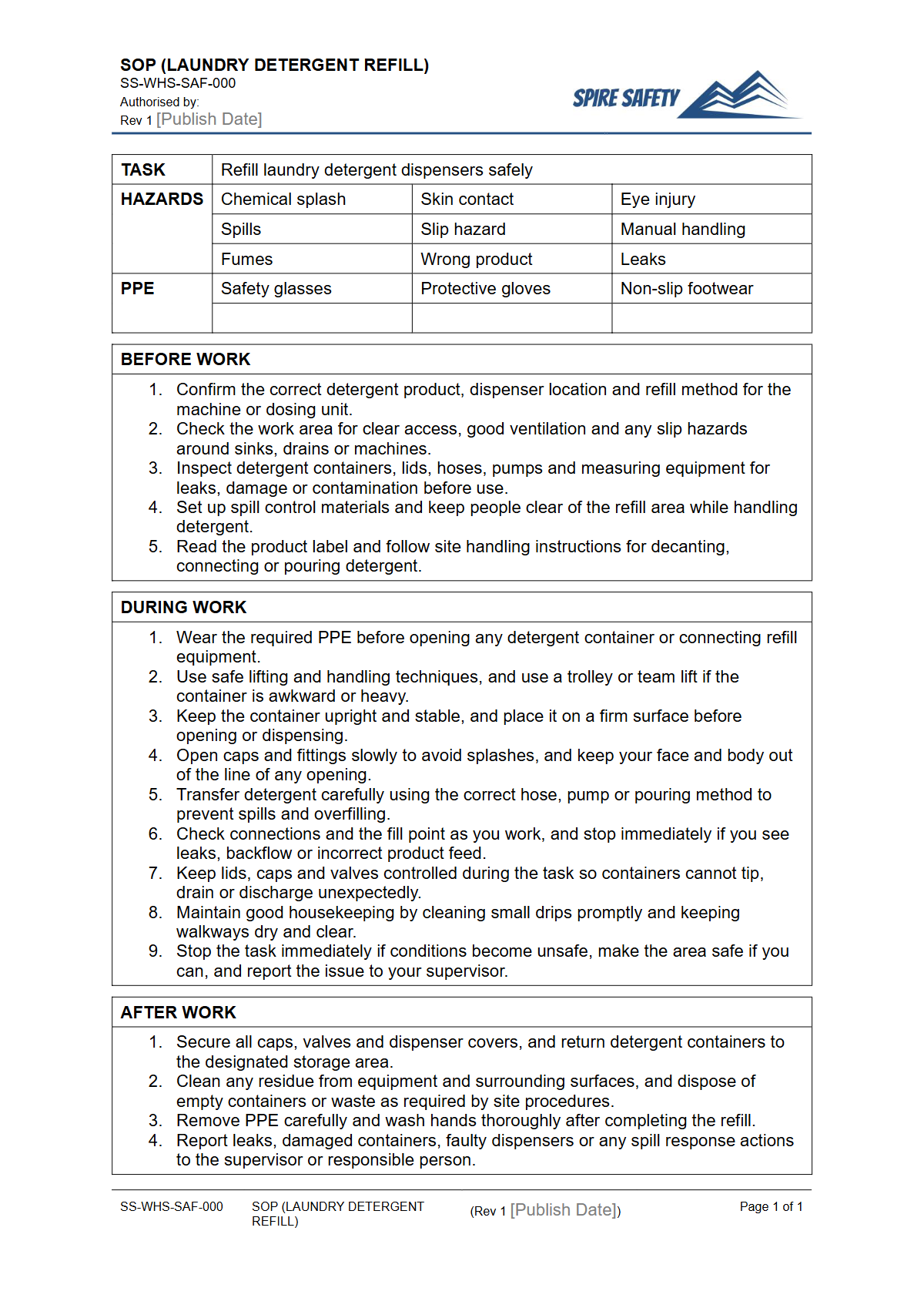
This Free Safe Operating Procedure (Laundry Detergent Refill) Template provides a structured framework for outlining the required steps to safely handle and decant commercial laundry detergents. The task, while seemingly simple, involves several hazards that must be controlled.
These include chemical exposure leading to skin irritation or dermatitis, eye damage from splashes, inhalation of fumes or powders, and slips, trips, and falls from spills. A documented SOP ensures that all workers follow a consistent, safe method every time, reducing the risk of injury.
Implementing clear, task-specific procedures is a fundamental part of demonstrating due diligence and forms a cornerstone of an effective WHS management system. This template helps your organisation meet its duty of care by formally identifying risks and codifying control measures, such as required Personal Protective Equipment (PPE) and emergency responses.
Video walkthrough
How to use the Free Safe Operating Procedure (Laundry Detergent Refill) Template
This Safe Operating Procedure template is provided as a fully editable DOCX file, allowing for extensive customisation, along with a ready-to-print PDF. To use it effectively, you must adapt its contents to the specific context of your workplace.
This involves conducting a risk assessment for the laundry detergent refilling task as it is performed on your site, using your specific equipment and products.
You will need to update the document with details such as the exact name of the chemical products used, the location of Safety Data Sheets (SDS), specific PPE requirements (e.g., nitrile gloves, safety glasses), and step-by-step instructions for the refilling process. Also, include procedures for cleaning up spills and first aid measures relevant to the chemicals in use. If the refill station requires accessing containers stored at height, you may need to reference other procedures, such as our FREE Step Ladder SOP Template.
Please note: This document is a template and not a complete Safe Operating Procedure. It is designed to be a starting point.
We strongly recommend that you customise this template to reflect the unique hazards and control measures relevant to your specific workplace, equipment, and personnel. A generic procedure is not sufficient to ensure safety.
When to use a Safe Operating Procedure
A Safe Operating Procedure for refilling laundry detergent should be used as a primary reference document in several situations. It is essential for training and inducting new employees, ensuring they understand the approved method and associated risks from their first day.
It should also be readily available in the work area for workers to consult before starting the task.
The SOP serves as a valuable tool for supervisors during routine observations to confirm that correct procedures are being followed. Furthermore, it is a key document to review during safety meetings, toolbox talks, and formal incident investigations.
Regularly reviewing the SOP as part of scheduled WHS compliance auditing ensures it remains current and effective, especially if new products or equipment are introduced.
Who should use this Safe Operating Procedure
This procedure is intended for use by several groups within an organisation. Persons Conducting a Business or Undertaking (PCBUs) and management can use it to fulfil their primary duty of care to provide safe systems of work.
Supervisors and team leaders should use the SOP to train workers and monitor their performance against the established safety standard.
The most important users are the workers who actually perform the task of refilling laundry detergents. The SOP gives them clear, unambiguous instructions on how to do their job safely.
WHS Representatives and Safety Committee members will also find the document useful when conducting workplace inspections or contributing to risk management processes. If you need assistance integrating SOPs into your broader safety framework, specialist WHS consulting can provide expert support tailored to your business needs.
This SOP should be used in conjunction with other key documents, such as the chemical's Safety Data Sheet (SDS) and any relevant risk assessments. You can find more procedural templates in our comprehensive free WHS resources library to build out your safety system.
Common mistakes
Common mistakes to avoid
- Using a generic SOP without site-specific customisation.
- Failing to provide or enforce the use of the correct Personal Protective Equipment (PPE).
- Inadequate training on spill containment and cleanup procedures.
- Not making the Safety Data Sheet (SDS) readily accessible to staff.
Legal references
Legal considerations
The following legal requirements may be relevant to this type of work.
- Work Health and Safety Act (Harmonised) — Provides the primary duties for protecting workers and other people from work health and safety risks.
- Work Health and Safety Regulations (Harmonised) — Sets out requirements supporting the management of workplace hazards and risks.
The following codes may be relevant to this type of work.
- Managing WHS Risks Code of Practice — Provides practical guidance on identifying hazards, assessing risks and applying effective controls.
- Work Health and Safety Consultation, Cooperation and Coordination Code of Practice — Provides practical guidance on consulting workers and coordinating with other duty holders.
- Managing the Work Environment and Facilities Code of Practice — Provides practical guidance on safe work environments, workplace facilities and related controls.
Did you know
Chemical Exposure
Even common cleaning chemicals can cause occupational dermatitis, one of the most frequent work-related skin diseases in Australia.
SDS Importance
A Safety Data Sheet (SDS) for your specific laundry detergent provides critical information on hazards, first aid, and handling that must be reflected in your SOP.
FAQ
Frequently asked questions
01What should be included in a SOP for refilling laundry detergent?
02Is laundry detergent considered a hazardous chemical in the workplace?
03How often should a Safe Operating Procedure be reviewed?
04What PPE is required for refilling commercial laundry detergent?
Share this resource
Free Safe Operating Procedure (Laundry Detergent Refill) Template
Browse Categories
How To Use It
- 1Download and open in Word or PDF.
- 2Replace the placeholders with your business details.
- 3Get it reviewed by a WHS specialist before rollout.
Need it customised?
Our WHS consultants can adapt this template to your site, run a gap analysis, or audit what you already have in place.
Book a Free Consultation WHS consulting servicesor call 1300 156 382
Related templates
- Free Safe Operating Procedure (Laundry Folding Station) Template
- Free Safe Operating Procedure (Laundry Press) Template
- Free Safe Operating Procedure (Laundry Sorting) Template
- Free Safe Operating Procedure (Laundry Stain Treatment) Template
- Free Safe Operating Procedure (Laundry Trolley Clean) Template
- Free Safe Operating Procedure (Laundry Washer) Template