
Free Safe Operating Procedure (Laundry Cart Handling) Template
Download our free Safe Operating Procedure (Laundry Cart Handling) template. This customisable DOCX & PDF helps manage manual handling risks. Get yours now.
Free Safe Operating Procedure (Laundry Cart Handling) Template
DOCX • 126 KB + PDF
Updated Oct 2026
No signup required
Purpose of the Free Safe Operating Procedure (Laundry Cart Handling) Template
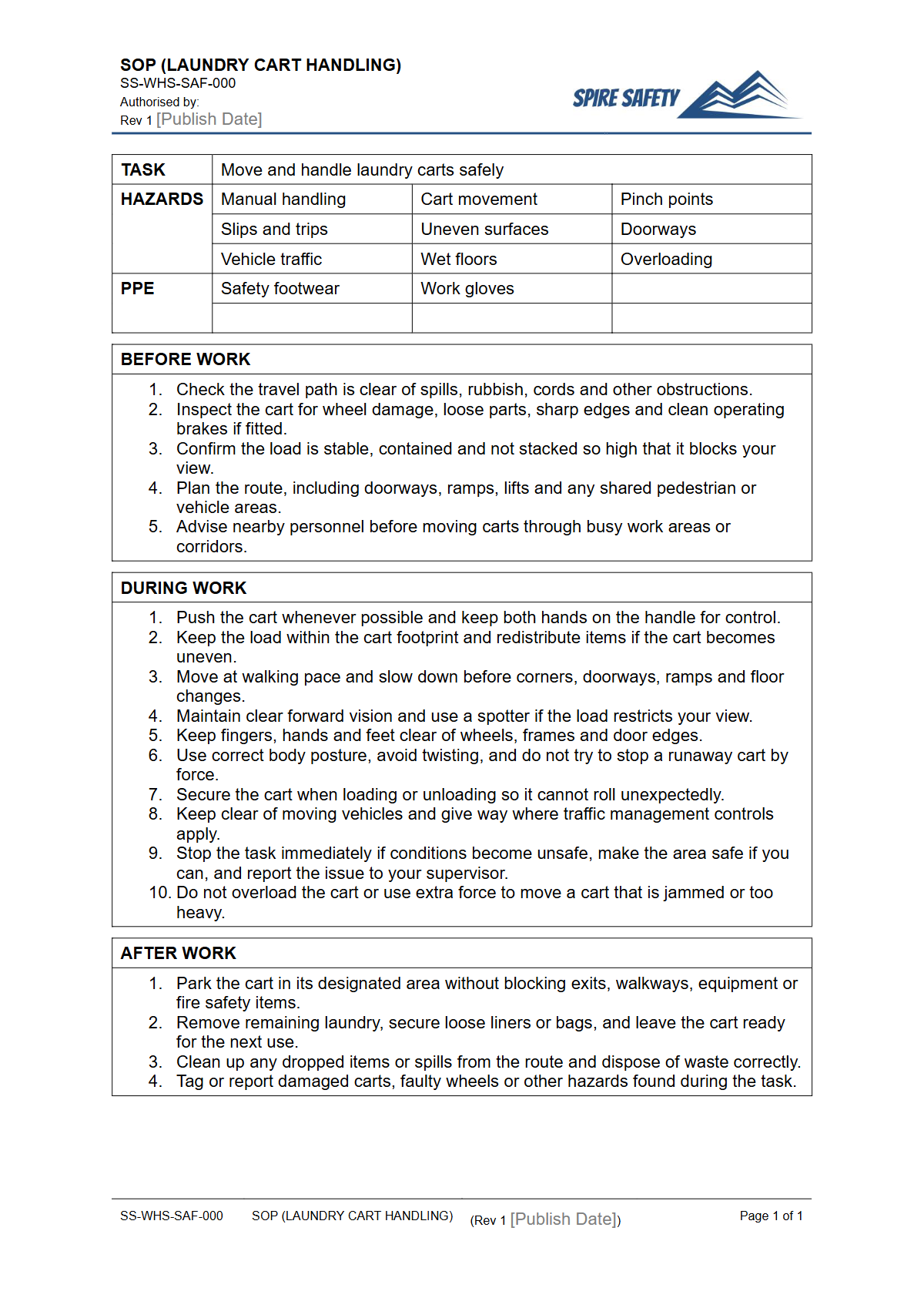
This Free Safe Operating Procedure (Laundry Cart Handling) Template provides a structured framework for documenting the safe methods required to transport laundry carts in workplaces such as hospitals, aged care facilities, hotels, and commercial laundries. The primary goal is to minimise the risk of injury, particularly musculoskeletal disorders (MSDs), which are common in tasks involving pushing, pulling, and manoeuvring heavy, awkward loads.
By outlining clear, step-by-step instructions, this SOP helps standardise safe work practices and provides a crucial training tool for workers.
Implementing a formal procedure helps a Person Conducting a Business or Undertaking (PCBU) meet their primary duty of care under Australian WHS laws. It addresses specific hazards associated with laundry cart handling, including overexertion, awkward postures, strains and sprains, and collisions with people or structures.
This document serves as a foundational component of your broader WHS management systems, demonstrating a commitment to proactive risk management.
Video walkthrough
How to use the Free Safe Operating Procedure (Laundry Cart Handling) Template
This document is a starting point designed to be adapted to your specific operational environment. Download the template in your preferred format (DOCX for easy editing or PDF) and customise it to reflect the unique conditions of your workplace.
Effective customisation involves a collaborative process and a thorough review of your site.
Key steps for customisation include:
- Consultation: Engage with the workers who actually perform the task. Their direct experience is invaluable for identifying practical hazards and effective control measures.
- Site-Specific Details: Incorporate information about your specific equipment (types of carts used), workplace layout (including ramps, doorways, and flooring types), and designated routes.
- Risk Assessment: Reference your existing WHS consulting and risk assessment records for manual tasks to ensure all identified hazards are addressed with appropriate controls.
- Review and Approval: Once customised, have the SOP reviewed and approved by a competent person, such as a WHS manager or supervisor, before it is implemented.
Please note: We have created this Safe Operating Procedure as a template to be customised. You must adapt it to the specific carts, environment, and processes of your organisation.
Compliance with WHS regulations requires that you tailor this document to your unique workplace risks.
When to use a Safe Operating Procedure
A Safe Operating Procedure for laundry cart handling should be used consistently as a core part of your daily operations. It is not a document to be filed away and forgotten.
Use it during worker induction and onboarding to establish safe behaviours from day one. It should also be a central resource for refresher training, especially if an incident or near-miss occurs.
Supervisors can use the SOP as a checklist during safety observations to ensure procedures are being followed correctly. It also serves as an excellent reference tool for workers before they begin the task, reinforcing correct techniques for pushing versus pulling, navigating corners, and using brakes.
Just as you would have a procedure for a specific piece of equipment, a task-based SOP like this one or our FREE Step Ladder SOP Template is essential for managing risks associated with repetitive manual work.
Who should use this Safe Operating Procedure
This Safe Operating Procedure is intended for a range of personnel within an organisation. WHS Managers and Safety Officers will use it to develop, implement, and review safety protocols.
Supervisors and Team Leaders are responsible for training their teams according to the SOP and ensuring its consistent application on the floor.
Most importantly, the workers who handle laundry carts are the primary end-users. The document should be written in clear, simple language and be easily accessible to them at all times.
Using standardised procedures like this can also be beneficial during a WHS compliance auditing process, as it provides clear evidence of a systematic approach to managing a known workplace hazard. The principles of documenting clear procedures are universal across many workplace safety tasks, including those covered in our Safe Operating Procedure (Defibrillator Operation) template.
Ultimately, a well-written SOP helps everyone in the organisation understand their responsibilities for maintaining a safe work environment. It complements other procedural documents you may have, such as our Free Air Compressor SOP Template, by contributing to a comprehensive safety system.
You can explore our entire collection in our free WHS resources library for more templates to support your organisation's safety goals.
Common mistakes
Common mistakes to avoid
- Overloading carts beyond their rated capacity or a worker's physical capability.
- Pulling carts from behind, which obstructs vision and promotes poor posture.
- Failing to conduct pre-use checks for issues like faulty wheels, brakes, or sharp edges.
- Ignoring designated routes or failing to account for pedestrians and other traffic.
Legal references
Legal considerations
The following legal requirements may be relevant to this type of work.
- Work Health and Safety Act (Harmonised) — Provides the primary duties for protecting workers and other people from work health and safety risks.
- Work Health and Safety Regulations (Harmonised) — Sets out requirements supporting the management of workplace hazards and risks.
The following codes may be relevant to this type of work.
- Managing WHS Risks Code of Practice — Provides practical guidance on identifying hazards, assessing risks and applying effective controls.
- Work Health and Safety Consultation, Cooperation and Coordination Code of Practice — Provides practical guidance on consulting workers and coordinating with other duty holders.
- Managing the Work Environment and Facilities Code of Practice — Provides practical guidance on safe work environments, workplace facilities and related controls.
Did you know
Manual Task Injuries
According to Safe Work Australia, work-related musculoskeletal disorders (MSDs) account for a significant portion of serious workers' compensation claims, with hazardous manual tasks being the primary cause.
Cart Maintenance
Poorly maintained wheels are a leading contributor to excessive push/pull forces. A regular maintenance schedule to clean and lubricate castors can dramatically reduce the physical effort required to move a cart.
FAQ
Frequently asked questions
01What are the main hazards of handling laundry carts?
02Is it better to push or pull a laundry cart?
03How do I determine a safe weight limit for a laundry cart?
04How often should training on this Safe Operating Procedure occur?
Share this resource
Free Safe Operating Procedure (Laundry Cart Handling) Template
Browse Categories
How To Use It
- 1Download and open in Word or PDF.
- 2Replace the placeholders with your business details.
- 3Get it reviewed by a WHS specialist before rollout.
Need it customised?
Our WHS consultants can adapt this template to your site, run a gap analysis, or audit what you already have in place.
Book a Free Consultation WHS consulting servicesor call 1300 156 382
Related templates
- Free Safe Operating Procedure (Laundry Chute Use) Template
- Free Safe Operating Procedure (Laundry Detergent Refill) Template
- Free Safe Operating Procedure (Laundry Folding Station) Template
- Free Safe Operating Procedure (Laundry Press) Template
- Free Safe Operating Procedure (Laundry Sorting) Template
- Free Safe Operating Procedure (Laundry Stain Treatment) Template