
Free Safe Operating Procedure (Laundry Chute Use) Template
Download our free Safe Operating Procedure (SOP) for Laundry Chute Use. This DOCX and PDF template helps you outline safety protocols for Australian workplaces.
Free Safe Operating Procedure (Laundry Chute Use) Template
DOCX • 126 KB + PDF
Updated Oct 2026
No signup required
Purpose of the Free Safe Operating Procedure (Laundry Chute Use) Template
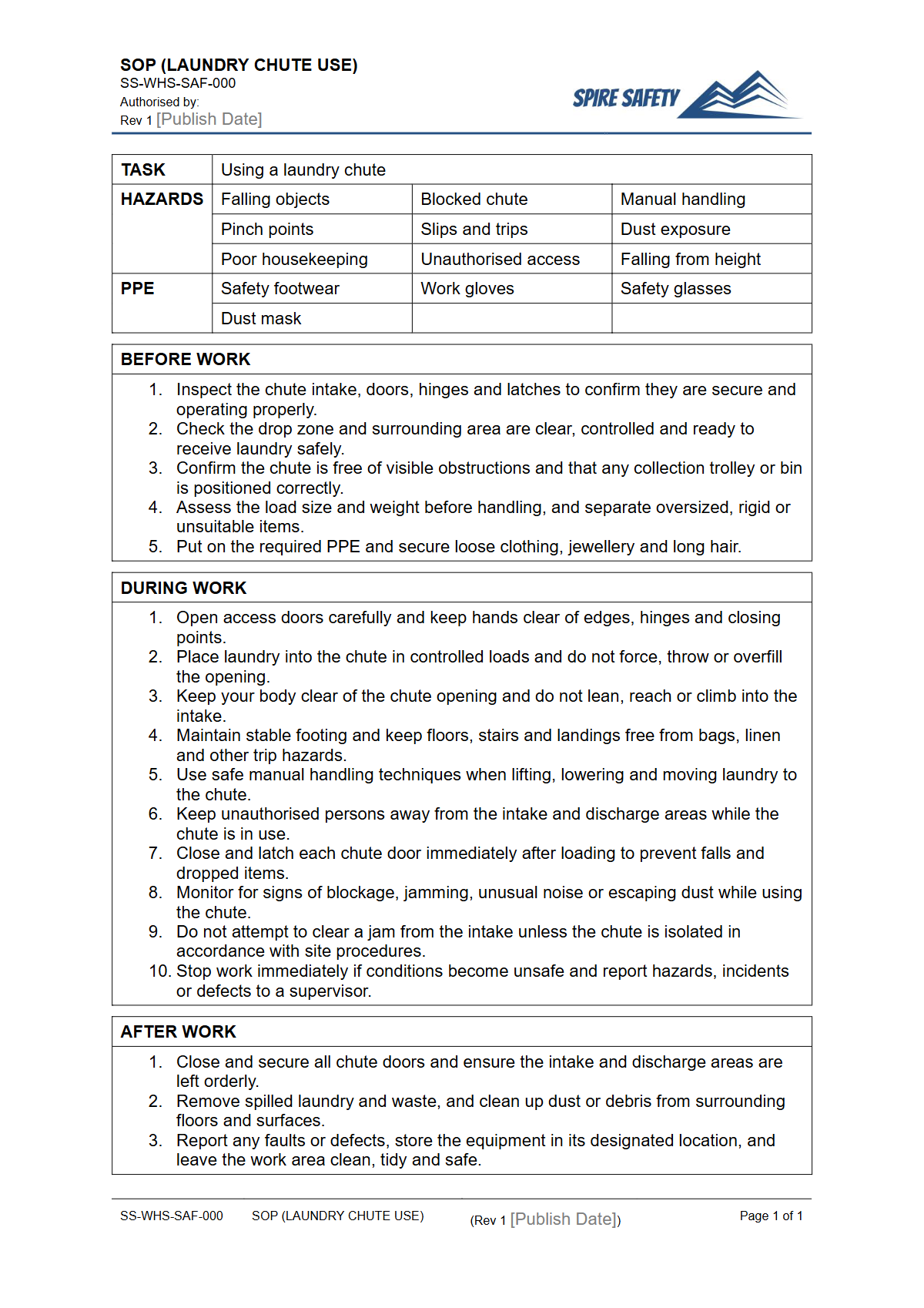
Operating a laundry chute, while seemingly simple, involves risks that can lead to manual handling injuries, falls, or exposure to biological hazards. This Safe Operating Procedure (SOP) for Laundry Chute Use provides a structured starting point for documenting the approved, step-by-step process for safely using laundry chutes in your workplace.
A documented procedure helps standardise operations, reduces the likelihood of incidents, and serves as a critical tool for worker training and induction.
A clear SOP is a fundamental component of ensuring safety and managing risks. By defining pre-operational checks, safe operating steps, and emergency responses, you create a clear framework for all personnel.
This not only protects your workers but also forms a key part of your site's overall safety documentation, demonstrating a proactive approach to risk management. Implementing robust procedures like this is a cornerstone of effective WHS management systems.
Video walkthrough
How to use the Free Safe Operating Procedure (Laundry Chute Use) Template
This template is designed for ease of use and customisation. Simply download the DOCX file and open it in Microsoft Word or a compatible program.
The document is structured with clear headings covering key safety areas: required PPE, pre-operational checks, operational steps, and emergency procedures. You should systematically work through each section, replacing the placeholder text with information specific to your equipment and operational context.
Important: This document is a template only and must be adapted to your specific workplace. We are not WHS consultants, and this template is not a substitute for professional advice.
You must consult with your workers and other relevant stakeholders to ensure the final SOP accurately reflects the specific laundry chute models, associated tasks, and unique hazards present at your site. A competent person should review and approve the final document before implementation.
If you require expert assistance, our team offers professional WHS consulting services to help you develop site-specific documentation.
When to use it
A Safe Operating Procedure for laundry chute use should be a readily accessible document referenced in several situations. It is essential for the induction of new employees who will be required to use the chute, such as housekeeping, laundry, or maintenance staff.
It should also be used for periodic refresher training to ensure established safety standards are maintained over time.
The SOP becomes a critical reference point when planning non-routine tasks, such as clearing a blockage. These situations can introduce new risks, like working at height to access inspection hatches, which may require additional controls like those outlined in our FREE Step Ladder SOP Template. Furthermore, the SOP should be reviewed as part of any incident investigation involving the laundry chute and used as a benchmark during safety inspections or formal WHS compliance auditing.
Who should use it
This SOP is primarily for workers who directly interact with the laundry chute. This includes hotel housekeepers, hospital orderlies, aged care facility staff, and commercial laundry workers.
They must understand and follow the procedure to protect themselves and others from injury. Supervisors and managers should also be thoroughly familiar with the SOP to effectively oversee operations, enforce safety rules, and deliver toolbox talks.
Additionally, WHS and facilities management personnel will use this document as part of their risk management activities. They are often responsible for developing, reviewing, and updating the procedure, as well as investigating any incidents that occur.
In the event of an emergency, all personnel should be aware of the protocols outlined in the SOP, including who to contact and what immediate actions to take. This preparedness can be supported by having clear procedures for other emergencies, such as our Safe Operating Procedure (Defibrillator Operation) template. After customising this template, consider exploring our complete free WHS resources library for other useful documents.
Common mistakes
Common mistakes to avoid
- Overloading the chute, causing blockages and strain on the system.
- Forcibly propping or wedging the chute door open, defeating critical fire safety mechanisms.
- Attempting to clear a blockage without following a safe procedure or using incorrect tools.
- Failing to wear appropriate Personal Protective Equipment (PPE), such as gloves, when handling soiled linen.
Legal references
Legal considerations
The following legal requirements may be relevant to this type of work.
- Work Health and Safety Act (Harmonised) — Provides the primary duties for protecting workers and other people from work health and safety risks.
- Work Health and Safety Regulations (Harmonised) — Sets out requirements supporting the management of workplace hazards and risks.
The following codes may be relevant to this type of work.
- Managing WHS Risks Code of Practice — Provides practical guidance on identifying hazards, assessing risks and applying effective controls.
- Work Health and Safety Consultation, Cooperation and Coordination Code of Practice — Provides practical guidance on consulting workers and coordinating with other duty holders.
- Managing the Work Environment and Facilities Code of Practice — Provides practical guidance on safe work environments, workplace facilities and related controls.
Did you know
Manual Handling Risk
In Australia, the accommodation and food services industry has one of the highest rates of serious workers' compensation claims, with manual handling injuries being a leading cause.
FAQ
Frequently asked questions
01What are the main hazards associated with using a laundry chute?
02Who is responsible for training workers on the laundry chute SOP?
03How often should a laundry chute Safe Operating Procedure be reviewed?
04Can this laundry chute SOP template be used for rubbish or garbage chutes?
Share this resource
Free Safe Operating Procedure (Laundry Chute Use) Template
Browse Categories
How To Use It
- 1Download and open in Word or PDF.
- 2Replace the placeholders with your business details.
- 3Get it reviewed by a WHS specialist before rollout.
Need it customised?
Our WHS consultants can adapt this template to your site, run a gap analysis, or audit what you already have in place.
Book a Free Consultation WHS consulting servicesor call 1300 156 382
Related templates
- Free Safe Operating Procedure (Laundry Detergent Refill) Template
- Free Safe Operating Procedure (Laundry Folding Station) Template
- Free Safe Operating Procedure (Laundry Press) Template
- Free Safe Operating Procedure (Laundry Sorting) Template
- Free Safe Operating Procedure (Laundry Stain Treatment) Template
- Free Safe Operating Procedure (Laundry Trolley Clean) Template