
Free Safe Operating Procedure (Laundry Bag Handling) Template
Download our free Safe Operating Procedure (Laundry Bag Handling) Template.
Free Safe Operating Procedure (Laundry Bag Handling) Template
DOCX • 126 KB + PDF
Updated Oct 2026
No signup required
Purpose of the Free Safe Operating Procedure (Laundry Bag Handling) Template
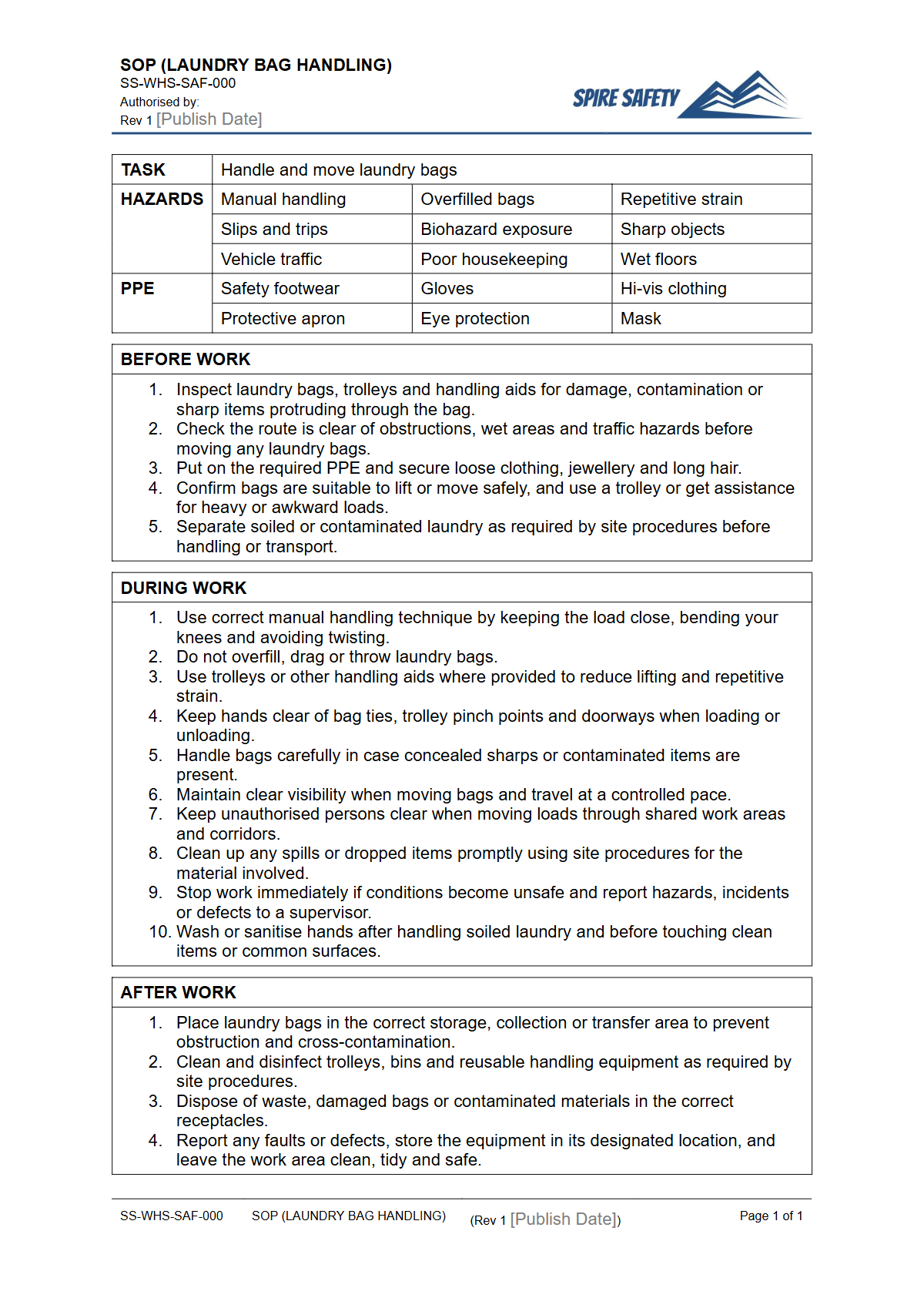
Handling laundry bags, particularly in commercial settings like hotels, hospitals, and industrial laundries, presents significant manual handling risks. This free Safe Operating Procedure (Laundry Bag Handling) Template provides a structured framework for documenting the safest way to perform this common task.
It helps organisations identify hazards such as musculoskeletal injuries from lifting, carrying, and repetitive movements, as well as biological hazards from soiled linen. Implementing a clear SOP promotes consistent, safe work practices among all staff, reducing the likelihood of injuries and ensuring a more efficient workflow.
A documented procedure is a fundamental building block of a proactive safety culture. It serves as a critical component within broader WHS management systems, demonstrating a commitment to controlling identified risks at their source.
This template guides you in outlining key steps, required personal protective equipment (PPE), and emergency responses specific to handling laundry.
Video walkthrough
How to use the Free Safe Operating Procedure (Laundry Bag Handling) Template
This document is a fully editable template provided in both DOCX and PDF formats. To use it effectively, download the file and integrate the specific details of your workplace.
This includes identifying the types of laundry bags used, the environment they are moved through, and the specific equipment available, such as trolleys or chutes.
Important: This is a template only and must be customised to reflect your unique operational risks and control measures. We are not responsible for the outcomes of any document you create from this template.
A generic procedure is not sufficient for compliance; you must conduct a site-specific risk assessment and adapt the content accordingly. If you need assistance with this process, engaging professional WHS consulting services can provide tailored support.
When to use a Laundry Bag Handling SOP
A Safe Operating Procedure for laundry bag handling should be a core part of your daily operations and training programs. It is essential during the induction of new employees to establish safe habits from day one.
It should also be readily available in the work area as a quick reference for all workers before they begin the task.
Furthermore, the SOP is a valuable tool for conducting refresher training, especially if work practices change or new equipment is introduced. The procedure must be reviewed and updated regularly, following any incident or near miss, or as part of scheduled internal safety reviews.
Regular reviews can be integrated into your schedule of WHS compliance auditing to ensure it remains current and effective.
Who should use this Safe Operating Procedure
This SOP template is designed for use by a range of personnel within any organisation where laundry is handled in bulk. This includes:
- Workers and Employees: Staff in housekeeping, laundry services, healthcare, and accommodation who physically perform the task.
- Supervisors and Team Leaders: For training their teams, monitoring safe work practices, and conducting pre-start checks. Supervisors should also ensure procedures for related tasks, such as using equipment to reach stored items, are followed, referencing documents like a step ladder SOP where applicable.
- WHS Managers and Safety Officers: As a tool for risk management, training development, and demonstrating procedural control during safety audits.
Key Elements of a Laundry Handling SOP
A robust SOP for this task should detail several critical stages. The pre-operational check section should require workers to inspect bags for damage and ensure trolleys or transport aids are in good working order.
The main operational steps must break down the process, specifying correct lifting techniques (e.g., bending the knees, keeping the back straight), load limits per bag, and safe methods for pushing or pulling trolleys. It should also specify required PPE, such as gloves and closed-toe shoes.
The procedure should also outline how to handle contingencies. This includes steps for managing spills from soiled linen and the correct emergency response protocol in case of injury.
In critical medical emergencies, having clear instructions and accessible equipment is vital, which may be covered in a separate defibrillator operation SOP. Finally, the SOP should include instructions for post-task clean-up and reporting any issues or hazards observed during the process.
By customising this template to cover these areas, you create a comprehensive guide that significantly improves safety. Feel free to explore our complete free WHS resources library for other templates and guides to support your safety management system.
Common mistakes
Common mistakes to avoid
- Using incorrect lifting techniques, such as bending from the back instead of the knees.
- Overfilling laundry bags beyond a safe, manageable weight.
- Failing to wear appropriate PPE, especially gloves, when handling soiled or contaminated linen.
- Not using available mechanical aids like trolleys or carts for moving heavy loads.
Legal references
Legal considerations
The following legal requirements may be relevant to this type of work.
- Work Health and Safety Act (Harmonised) — Provides the primary duties for protecting workers and other people from work health and safety risks.
- Work Health and Safety Regulations (Harmonised) — Sets out requirements supporting the management of workplace hazards and risks.
The following codes may be relevant to this type of work.
- Managing WHS Risks Code of Practice — Provides practical guidance on identifying hazards, assessing risks and applying effective controls.
- Work Health and Safety Consultation, Cooperation and Coordination Code of Practice — Provides practical guidance on consulting workers and coordinating with other duty holders.
- Managing the Work Environment and Facilities Code of Practice — Provides practical guidance on safe work environments, workplace facilities and related controls.
Did you know
Manual Handling Statistics
According to Safe Work Australia, injuries resulting from manual handling are the most common type of workplace injury, accounting for a significant percentage of all serious workers' compensation claims.
The Weight of Water
Wet laundry can be more than twice as heavy as dry laundry, dramatically increasing the risk of strain and injury if bag weight limits are not properly managed.
FAQ
Frequently asked questions
01What hazards are associated with handling laundry bags?
02How often should a Safe Operating Procedure for laundry bag handling be reviewed?
03Is this SOP template suitable for healthcare and hospitality?
04What training is required for handling laundry bags safely?
Share this resource
Free Safe Operating Procedure (Laundry Bag Handling) Template
Browse Categories
How To Use It
- 1Download and open in Word or PDF.
- 2Replace the placeholders with your business details.
- 3Get it reviewed by a WHS specialist before rollout.
Need it customised?
Our WHS consultants can adapt this template to your site, run a gap analysis, or audit what you already have in place.
Book a Free Consultation WHS consulting servicesor call 1300 156 382
Related templates
- Free Safe Operating Procedure (Laundry Cart Handling) Template
- Free Safe Operating Procedure (Laundry Chute Use) Template
- Free Safe Operating Procedure (Laundry Detergent Refill) Template
- Free Safe Operating Procedure (Laundry Folding Station) Template
- Free Safe Operating Procedure (Laundry Press) Template
- Free Safe Operating Procedure (Laundry Sorting) Template