
Free Safe Operating Procedure (Landscape Fabric Install) Template
Download our free Safe Operating Procedure (Landscape Fabric Install) template to formalise safety protocols for this common landscaping task.
Free Safe Operating Procedure (Landscape Fabric Install) Template
DOCX • 126 KB + PDF
Updated Oct 2026
No signup required
Purpose of the Free Safe Operating Procedure (Landscape Fabric Install) Template
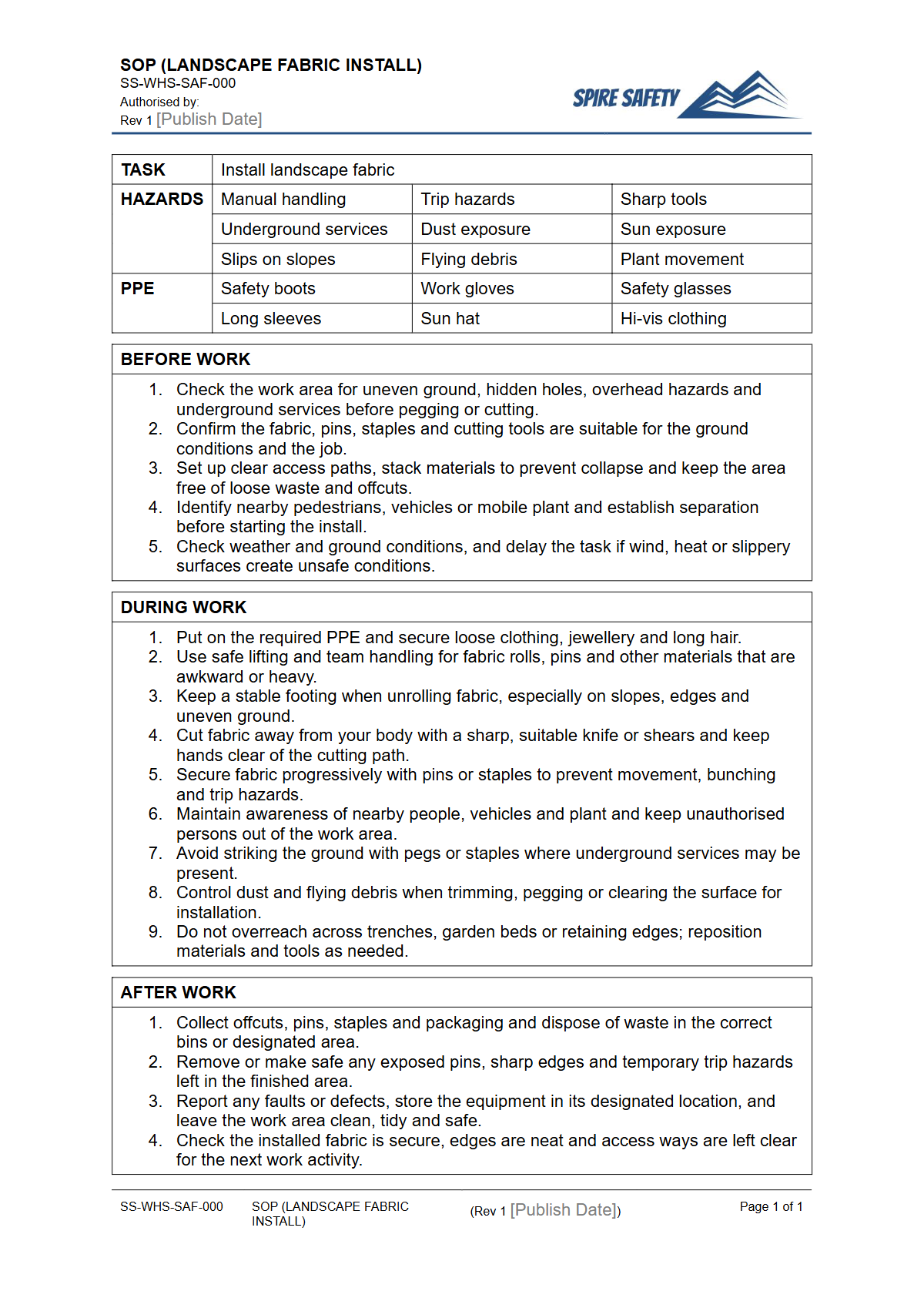
This free Safe Operating Procedure (Landscape Fabric Install) template provides a structured foundation for documenting the safety steps involved in preparing ground and laying weed matting. Using this SOP helps your business manage risks and outline a clear, repeatable process for workers.
It formalises controls for hazards common to landscaping work, such as manual handling injuries from lifting heavy rolls, cuts from trimming tools, and slips, trips, and falls on uneven ground or loose material.
A documented procedure ensures that all workers, regardless of experience level, follow a consistent and safe method for installation. This is crucial for meeting your primary duty of care under WHS legislation.
The process often involves clearing and levelling ground, which may require specific equipment. If mechanical ground preparation is needed, you might also require a procedure like our free Trencher SOP to manage associated risks.
What this Safe Operating Procedure covers:
- Identifying required Personal Protective Equipment (PPE) such as gloves, safety glasses, and steel-capped boots.
- Pre-operational checks of tools and equipment.
- Step-by-step instructions for site preparation, unrolling, cutting, and securing the fabric.
- Guidance on correct manual handling techniques for lifting and moving rolls.
- Waste management and site clean-up procedures.
Video walkthrough
How to use the Free Safe Operating Procedure (Landscape Fabric Install) Template
This document is a template and must be customised to your specific workplace. Download the DOCX file and adapt it to reflect your unique site conditions, the specific type of fabric being used, the tools available, and your company's existing safety protocols.
To be effective, an SOP must be a practical tool used by your team, not just a document filed away. This process is a key component of building robust and comprehensive WHS management systems that protect your workers and your business.
When customising, involve the workers who actually perform the task. Their direct experience is invaluable for identifying practical risks and effective controls.
Ensure you fill in all company-specific details, including emergency contacts and procedures. If you need assistance tailoring this or other documents to your operational needs, consider engaging professional WHS consulting services for expert guidance.
When to use it
This Safe Operating Procedure should be used as a central part of your safety process for all landscaping work involving weed mat installation. It is most effective when integrated into daily operations.
Use it during pre-start or toolbox talks to review the day's tasks and reinforce safety measures. It also serves as an essential training document for new employees or workers unfamiliar with the task, ensuring they understand the approved method from the outset.
The SOP is also a reference point for incident investigations and regular safety reviews. Periodically checking that work is being performed according to the SOP is a core part of due diligence.
This can be formalised through processes like regular WHS compliance auditing to ensure procedures remain current and effective.
Who should use it
This template is designed for anyone responsible for overseeing or performing landscaping tasks. This includes Landscaping Business Owners, Team Leaders, Groundskeepers, and horticultural workers.
A Person Conducting a Business or Undertaking (PCBU) can use this SOP to fulfil their duty to provide and maintain a safe system of work. It provides supervisors with a clear standard to manage work against and gives workers the information they need to perform their jobs safely.
After the fabric is installed, subsequent tasks like spreading mulch or gravel also carry risks. You can standardise these related procedures by adapting documents like our free Spreader SOP for mechanical spreaders. You can find more templates to build out your safety system in our free WHS resources library.
Common mistakes
Common mistakes to avoid
- Not preparing the ground thoroughly, leaving rocks or roots that can tear the fabric.
- Failing to overlap fabric sheets sufficiently, allowing weeds to grow through the gaps.
- Forgetting to secure the edges and seams with pins or staples, causing the fabric to lift over time.
- Using the wrong type of fabric for the specific application (e.g., a non-permeable type in a garden bed).
Legal references
Legal considerations
The following legal requirements may be relevant to this type of work.
- Work Health and Safety Act (Harmonised) — Provides the primary duties for protecting workers and other people from work health and safety risks.
- Work Health and Safety Regulations (Harmonised) — Sets out requirements supporting the management of workplace hazards and risks.
The following codes may be relevant to this type of work.
- Managing WHS Risks Code of Practice — Provides practical guidance on identifying hazards, assessing risks and applying effective controls.
- Work Health and Safety Consultation, Cooperation and Coordination Code of Practice — Provides practical guidance on consulting workers and coordinating with other duty holders.
- Managing the Work Environment and Facilities Code of Practice — Provides practical guidance on safe work environments, workplace facilities and related controls.
Did you know
Woven vs. Non-Woven
Landscape fabrics come in woven and non-woven types. Woven fabrics are strong and ideal for paths or under gravel, while non-woven fabrics allow better water and air permeability, making them suitable for garden beds.
Manual Task Risks
According to Safe Work Australia, manual handling is a leading cause of workplace injury in the agriculture, forestry, and fishing industries, which includes many landscaping tasks. Proper lifting technique is critical.
FAQ
Frequently asked questions
01What are the main hazards when installing landscape fabric?
02Is a Safe Operating Procedure legally required for installing landscape fabric in Australia?
03How often should an SOP for landscape fabric installation be reviewed?
04What PPE is needed for installing landscape fabric?
Share this resource
Free Safe Operating Procedure (Landscape Fabric Install) Template
Browse Categories
How To Use It
- 1Download and open in Word or PDF.
- 2Replace the placeholders with your business details.
- 3Get it reviewed by a WHS specialist before rollout.
Need it customised?
Our WHS consultants can adapt this template to your site, run a gap analysis, or audit what you already have in place.
Book a Free Consultation WHS consulting servicesor call 1300 156 382
Related templates
- Free Safe Operating Procedure (Laser Level) Template
- Free Safe Operating Procedure (Laser Marker) Template
- Free Safe Operating Procedure (Laundry Bag Collection) Template
- Free Safe Operating Procedure (Laundry Bag Handling) Template
- Free Safe Operating Procedure (Laundry Cart Handling) Template
- Free Safe Operating Procedure (Laundry Chute Use) Template