
Free Safe Operating Procedure (Laser Marker) Template
Download our free Safe Operating Procedure (Laser Marker) Template to manage risks associated with laser marking.
Free Safe Operating Procedure (Laser Marker) Template
DOCX • 126 KB + PDF
Updated Oct 2026
No signup required
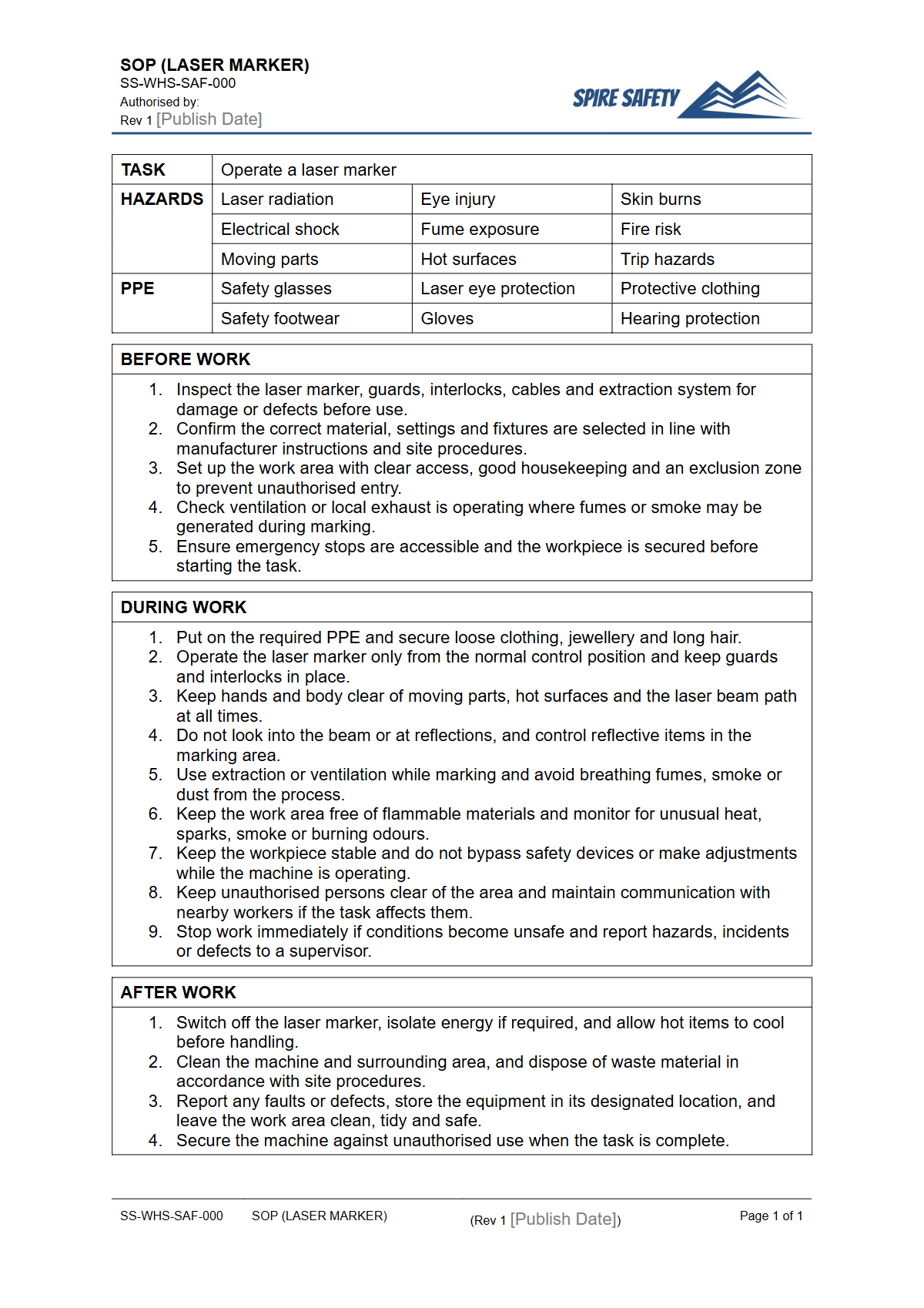
Purpose of the Free Safe Operating Procedure (Laser Marker) Template
Operating a laser marker or engraver introduces specific workplace hazards that must be controlled. This Free Safe Operating Procedure (Laser Marker) Template provides a structured framework for documenting the risks and control measures associated with your equipment.
Using this SOP helps your organisation meet its duty of care by outlining a clear, step-by-step process for safe operation, from pre-start checks to shutdown procedures. It formalises safety requirements, ensuring operators understand the hazards, such as laser radiation exposure, airborne contaminants from vaporised materials, and fire risks.
A well-defined Safe Operating Procedure (SOP) is a fundamental component of a robust safety system. This document serves as a vital training tool for new operators and a consistent reference for experienced personnel.
It helps standardise work practices, reduce the likelihood of incidents, and demonstrate a proactive approach to workplace health and safety management. The template is designed to be adapted to various types of laser marking systems used across industries like manufacturing, fabrication, and signage.
Video walkthrough
How to use the Free Safe Operating Procedure (Laser Marker) Template
This resource is available as a fully editable DOCX file for easy customisation and as a PDF for convenient printing and distribution. To use the template effectively, download the DOCX version and meticulously update each section to align with your specific operational context.
This includes detailing the exact make and model of your laser marker, the types of materials being processed, and the specific controls in place at your facility.
IMPORTANT: This is a template, not a finished document. We have provided a comprehensive starting point, but you must customise it to reflect the unique equipment, materials, processes, and legislative requirements applicable to your workplace.
Generic procedures are insufficient; a site-specific SOP is essential for effective risk management. For other cutting technologies, our FREE Plasma Cutter SOP Template offers a similar structured approach.
When to Use a Laser Marker SOP
A Safe Operating Procedure for a laser marker should be a living document, integrated into the daily workflow and safety culture of your organisation. It should be used in several key situations, including during the induction and training of any new operator before they are authorised to use the equipment.
It serves as the primary reference document for demonstrating competency.
The SOP should also be readily available at the point of use for quick reference by any operator. It is a critical document for supervisors to use when conducting workplace observations or performance reviews to ensure procedures are being followed correctly.
Furthermore, the SOP must be reviewed and updated after any incident or near-miss, when new materials are introduced, when the equipment is modified, or as part of your scheduled WHS compliance auditing activities.
Who Should Use This Procedure
This SOP is intended for several key roles within a workplace. Primarily, it is for the operators of the laser marking equipment, who must follow the specified steps to ensure their safety and the safety of others.
Supervisors and line managers are responsible for enforcing the procedure, providing adequate training, and ensuring operators are competent. Work Health and Safety (WHS) managers or representatives will use this SOP as part of the broader risk management framework, assisting with its development, review, and integration into the overall safety system.
Key Hazards and Controls
Laser markers present several significant hazards that require robust control measures. The most severe is exposure to the laser beam, which can cause permanent eye damage or skin burns.
Controls include ensuring the machine's protective housing is intact, all safety interlocks are functional, and operators use appropriate laser safety glasses rated for the specific wavelength of the laser. Another major hazard is the generation of airborne contaminants or fumes as the laser vaporises the substrate material.
Effective local exhaust ventilation (LEV) is critical, particularly when marking plastics, woods, or coated metals. You may also need to document procedures for other related equipment, such as our FREE CNC Machine SOP (Safe Operating Procedure) Template.
Other risks include fire, especially when marking flammable materials like acrylic or wood. The SOP should detail requirements for having appropriate fire extinguishers nearby and maintaining a clean work area free of combustible debris.
Electrical hazards associated with high-voltage power supplies must also be addressed through proper maintenance, inspection, and lockout/tagout procedures for servicing. An effective SOP details these hazards and links them directly to the required controls.
Integrating the SOP into Your Safety System
A single SOP is only one piece of the puzzle. To be effective, it must be integrated into your organisation's overall WHS management systems. This means linking the procedure to your initial risk assessments, training records, and maintenance logs.
The process of customising this template should be informed by a thorough risk assessment specific to your laser marker and its intended use. Operator training should be based on the finalised SOP, and competency should be verified and documented before work commences.
Regular reviews of the SOP ensure it remains relevant and effective as equipment ages, processes change, and new safety information becomes available. You can explore many other templates in our free WHS resources library to support your safety system.
Common mistakes
Common mistakes to avoid
- Using a generic SOP without customising it for the specific machine, materials, and workplace controls.
- Neglecting or providing inadequate local exhaust ventilation (LEV) to capture hazardous fumes at the source.
- Defeating or bypassing safety interlocks on the machine's enclosure to speed up workflow.
- Using incorrect or unrated safety glasses that do not provide protection against the laser's specific wavelength.
Legal references
Legal considerations
The following legal requirements may be relevant to this type of work.
- Work Health and Safety Act (Harmonised) — Provides the primary duties for protecting workers and other people from work health and safety risks.
- Work Health and Safety Regulations (Harmonised) — Sets out requirements supporting the management of workplace hazards and risks.
The following codes may be relevant to this type of work.
- Managing WHS Risks Code of Practice — Provides practical guidance on identifying hazards, assessing risks and applying effective controls.
- Work Health and Safety Consultation, Cooperation and Coordination Code of Practice — Provides practical guidance on consulting workers and coordinating with other duty holders.
- Managing the Work Environment and Facilities Code of Practice — Provides practical guidance on safe work environments, workplace facilities and related controls.
Did you know
Light Amplification
The word LASER is an acronym for 'Light Amplification by Stimulated Emission of Radiation'. The concept was first described by Albert Einstein in 1917, but the first working laser was not built until 1960.
Marking Methods
Laser 'marking' isn't a single process. It includes engraving (vaporising material), annealing (heating metal to change its colour), and foaming (melting plastics to create gas bubbles), each creating a different finish.
FAQ
Frequently asked questions
01What is the difference between a Safe Work Method Statement (SWMS) and a Safe Operating Procedure (SOP)?
02What class of laser is a typical laser marker?
03Is specific training legally required to operate a laser marker?
04What PPE is needed for laser marking?
Share this resource
Free Safe Operating Procedure (Laser Marker) Template
Browse Categories
How To Use It
- 1Download and open in Word or PDF.
- 2Replace the placeholders with your business details.
- 3Get it reviewed by a WHS specialist before rollout.
Need it customised?
Our WHS consultants can adapt this template to your site, run a gap analysis, or audit what you already have in place.
Book a Free Consultation WHS consulting servicesor call 1300 156 382
Related templates
- Free Safe Operating Procedure (Laundry Bag Collection) Template
- Free Safe Operating Procedure (Laundry Bag Handling) Template
- Free Safe Operating Procedure (Laundry Cart Handling) Template
- Free Safe Operating Procedure (Laundry Chute Use) Template
- Free Safe Operating Procedure (Laundry Detergent Refill) Template
- Free Safe Operating Procedure (Laundry Folding Station) Template