
Free Safe Operating Procedure (Laser Level) Template
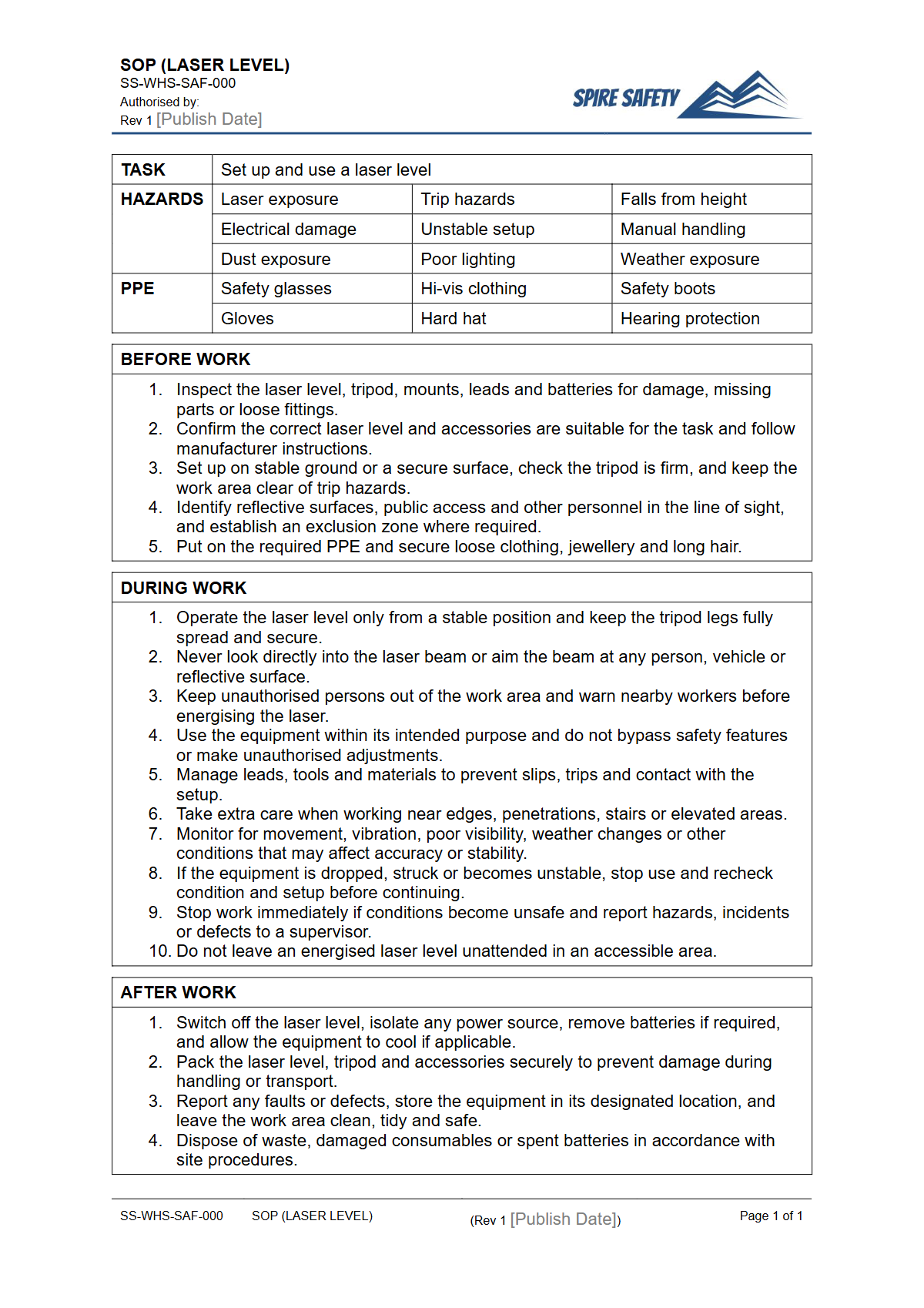
Download our free Safe Operating Procedure (Laser Level) template. This customisable DOCX & PDF provides a clear framework for documenting safe work methods.
Free Safe Operating Procedure (Laser Level) Template
DOCX • 126 KB + PDF
Updated Oct 2026
No signup required
Purpose of the Free Safe Operating Procedure (Laser Level) Template
A laser level is an essential tool for precision work in construction, surveying, and trade applications. However, like any equipment, it presents workplace hazards, primarily related to eye exposure from the laser beam.
This Free Safe Operating Procedure (Laser Level) Template provides a structured framework for documenting the specific steps required to operate this equipment safely. Implementing a clear SOP helps your organisation meet its duty of care, reduce the risk of incidents, and ensure workers understand the expected safety standards and operational steps before they begin work.
Key Elements of a Laser Level SOP
A comprehensive Safe Operating Procedure for a laser level should systematically address the entire work cycle. Our template guides you through documenting key safety information, including:
- Required Personal Protective Equipment (PPE): Specifies necessary gear such as safety glasses, high-visibility clothing, and appropriate footwear.
- Pre-operational Checks: Outlines visual inspections for damage to the device, tripod stability, and battery condition to ensure the equipment is fit for use.
- Step-by-Step Operating Guide: Details the sequence for setting up, calibrating, and using the laser level safely, including measures to prevent accidental beam exposure to others.
- Post-operational Procedures: Covers safe shutdown, cleaning, and storage of the equipment to maintain its condition and readiness for future use.
- Emergency Procedures: Defines the response actions in case of an incident or equipment malfunction.
Video walkthrough
How to use the Free Safe Operating Procedure (Laser Level) Template
This template is designed for ease of use and customisation. After downloading the DOCX or PDF file, you will need to adapt it to the specific context of your workplace.
This involves reviewing each section and adding details relevant to your specific laser level models, work environments, and existing safety protocols. A generic document is not sufficient for compliance; you must ensure the final SOP accurately reflects your operational reality.
Integrating customised SOPs is a fundamental part of developing robust WHS management systems that effectively control risk.
Important: This is a template only. We have provided a structured starting point, but you must consult with your team and customise the document with site-specific information, including the make and model of your equipment, the specific tasks it is used for, and the unique hazards of your work environment.
When to use a Laser Level SOP
A Safe Operating Procedure for a laser level should be a living document within your safety framework. It is used before any work involving the equipment commences to ensure all hazards have been identified and controls are in place.
It serves as a critical training tool for new employees or workers unfamiliar with the specific model being used. The SOP should also be readily available on-site as a reference for workers and supervisors to reinforce correct procedures.
Furthermore, these documents are essential during safety reviews and are often examined as part of a formal WHS compliance auditing process to verify that safe work practices are being followed.
Who should use this SOP
This Safe Operating Procedure is intended for all personnel involved with the use of laser levels. This includes:
- Workers and Operators: To understand and follow the approved, safe method for completing their tasks.
- Supervisors and Team Leaders: To conduct training, induct new team members, and monitor adherence to safety protocols on-site.
- WHS Managers and Advisors: To use as a foundational document for risk assessments, incident investigations, and building a consistent safety culture across the organisation.
The principles of safe equipment use are universal, whether you are using a laser level on a scaffold or a simple platform. For related tasks, you may also find our SOP for step ladders a useful addition to your safety library.
Integrating SOPs into your Safety System
Effective safety management goes beyond a single document. It involves creating an ecosystem of procedures that work together.
For instance, the safe use of a laser level might be one part of a larger project that also involves power tools. Having consistent, clear procedures for all equipment, such as our free Circular Saw SOP template, helps build a comprehensive and understandable safety system for your team.
If you require assistance in developing a complete set of procedures for your operations, our WHS consulting team can provide expert guidance. You can also explore our complete free WHS resources library for more templates and guides.
Common mistakes
Common mistakes to avoid
- Using a laser class that is too powerful for the job or work area.
- Setting up the laser at eye level, increasing the risk of accidental exposure to passersby.
- Failing to secure the tripod or device, leading to falls and damage.
- Not accounting for reflective surfaces like glass, polished metal, or water, which can redirect the beam unpredictably.
Legal references
Legal considerations
The following legal requirements may be relevant to this type of work.
- Work Health and Safety Act (Harmonised) — Provides the primary duties for protecting workers and other people from work health and safety risks.
- Work Health and Safety Regulations (Harmonised) — Sets out requirements supporting the management of workplace hazards and risks.
The following codes may be relevant to this type of work.
- Managing WHS Risks Code of Practice — Provides practical guidance on identifying hazards, assessing risks and applying effective controls.
- Work Health and Safety Consultation, Cooperation and Coordination Code of Practice — Provides practical guidance on consulting workers and coordinating with other duty holders.
- Managing the Work Environment and Facilities Code of Practice — Provides practical guidance on safe work environments, workplace facilities and related controls.
Did you know
Blink Protection
For Class 2 lasers, the human aversion response, or blink reflex (a reaction time of about 0.25 seconds), is generally sufficient to prevent eye damage from accidental exposure.
Green vs. Red Lasers
Green laser beams are up to four times more visible to the human eye than red laser beams of the same power output, making them popular for indoor and bright-light applications.
FAQ
Frequently asked questions
01What are the main hazards of using a laser level?
02Do I need a specific licence to operate a laser level in Australia?
03What is the difference between laser Classes 1, 2, and 3?
04How often should a laser level SOP be reviewed?
Share this resource
Free Safe Operating Procedure (Laser Level) Template
Browse Categories
How To Use It
- 1Download and open in Word or PDF.
- 2Replace the placeholders with your business details.
- 3Get it reviewed by a WHS specialist before rollout.
Need it customised?
Our WHS consultants can adapt this template to your site, run a gap analysis, or audit what you already have in place.
Book a Free Consultation WHS consulting servicesor call 1300 156 382
Related templates
- Free Safe Operating Procedure (Laser Marker) Template
- Free Safe Operating Procedure (Laundry Bag Collection) Template
- Free Safe Operating Procedure (Laundry Bag Handling) Template
- Free Safe Operating Procedure (Laundry Cart Handling) Template
- Free Safe Operating Procedure (Laundry Chute Use) Template
- Free Safe Operating Procedure (Laundry Detergent Refill) Template