
Free Safe Operating Procedure (Laminar Flow Cabinet) Template
Get started with our free Safe Operating Procedure (Laminar Flow Cabinet) template. This resource helps you document processes to protect your work.
Free Safe Operating Procedure (Laminar Flow Cabinet) Template
DOCX • 126 KB + PDF
Updated Oct 2026
No signup required
Purpose of the Free Safe Operating Procedure (Laminar Flow Cabinet) Template
A Safe Operating Procedure (SOP) is a critical document for any workplace that uses specialised equipment. This free Safe Operating Procedure (Laminar Flow Cabinet) Template provides a structured framework for documenting the step-by-step process for safely operating a laminar flow cabinet, also known as a clean bench.
Its primary purpose is to ensure process integrity by creating a particle-free work environment to protect sensitive samples from contamination. While not designed for user protection from hazardous materials (a role for a biological safety cabinet), a clear SOP minimises operational errors and ensures consistent, repeatable results in laboratory, pharmaceutical, and electronics manufacturing settings.
By formally documenting the correct usage, you establish a clear standard for all operators. This helps in training new staff, reinforces safe work habits, and provides a clear reference point to reduce procedural drift.
A well-defined SOP is a cornerstone of a robust quality and safety management system, demonstrating a commitment to controlling risks and maintaining high standards of work. Adopting standardised procedures for all equipment, including an Air Compressor SOP (Safe Operating Procedure) where applicable, contributes to a more organised and safer work environment.
Video walkthrough
How to use the Free Safe Operating Procedure (Laminar Flow Cabinet) Template
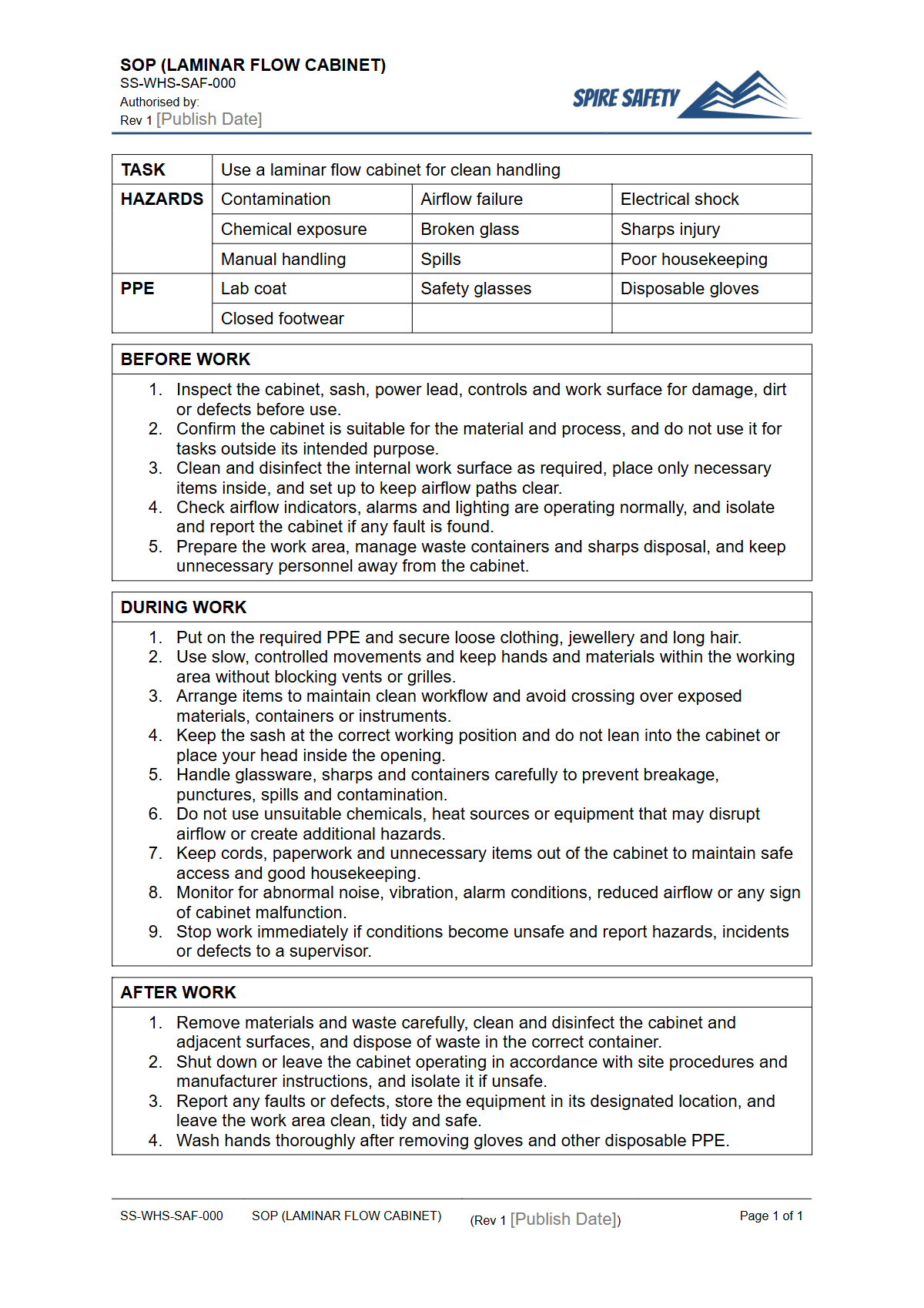
This downloadable document provides a comprehensive starting point, aligned with Australian WHS principles, for creating a site-specific SOP. It is available in both DOCX for easy editing and PDF for straightforward distribution.
To use the template effectively, you must customise it to reflect the specific make and model of the laminar flow cabinet in your facility, the unique tasks performed, and the identified hazards in your work area. Generic procedures are insufficient for ensuring safety and operational effectiveness.
Important: This is a template, not a finished document. We have provided a structured guide, but it is your responsibility to populate it with accurate, site-specific information.
This includes details on PPE, specific cleaning agents, emergency shutdown sequences, and filter maintenance schedules relevant to your organisation. Failing to customise the SOP renders it ineffective and may not meet your WHS obligations.
Integrating this procedure into a comprehensive WHS management system ensures it is properly managed, reviewed, and updated as part of your overall safety framework.
Key Sections to Customise
Our template prompts you to fill out several essential sections:
- Hazard Identification: List all potential hazards associated with the cabinet's operation, such as electrical risks, UV light exposure (if fitted), or ergonomic strains from prolonged use.
- Personal Protective Equipment (PPE): Specify the exact PPE required, such as lab coats, gloves, and safety glasses appropriate for the task.
- Pre-Operational Checks: Detail the mandatory checks before each use, including inspecting the work surface, checking pressure gauges, and confirming the cabinet has been running for the required period to purge contaminants.
- Operating Procedure: Provide a clear, sequential list of instructions for performing the task within the cabinet, emphasising techniques to maintain laminar flow and prevent contamination.
- Post-Operational and Cleaning Procedure: Outline the steps for safely powering down the unit, cleaning the work surface with approved solutions, and preparing it for the next user.
When to use a Laminar Flow Cabinet SOP
A Safe Operating Procedure for a laminar flow cabinet should be a living document, integrated into daily operations. It is not a document to be filed away and forgotten.
It should be used during the induction and training of any new personnel who will operate the equipment. Before starting any work, operators should review the SOP as a pre-start checklist to ensure all safety and operational controls are in place.
The SOP is also an essential reference tool during routine operations to ensure consistency. Furthermore, it serves as a key piece of evidence during safety inspections and WHS compliance audits, demonstrating that your organisation has a formalised process for managing risks associated with the equipment.
Procedures for managing workflows, such as those detailed in a Conveyer System SOP, share this principle of being a constant reference for safe and efficient operations.
Who should use this Safe Operating Procedure
This SOP is intended for a range of personnel within an organisation. The primary users are the operators themselves—the laboratory technicians, researchers, pharmaceutical compounders, or electronics assemblers who work with the cabinet daily.
They rely on the SOP for clear, unambiguous instructions to perform their tasks correctly and safely.
Laboratory managers and supervisors should use the SOP to train their teams and to monitor compliance with established procedures. WHS officers and safety managers will use it as part of their risk management activities, ensuring that controls are documented and communicated effectively.
For particularly complex or high-risk processes, engaging specialist WHS consulting can help ensure your SOPs are robust and practical. If you are looking for more templates, you can browse our complete free WHS resources library for a wide range of documents.
Common mistakes
Common mistakes to avoid
- Confusing a laminar flow cabinet with a biological safety cabinet, providing a false sense of protection when handling hazardous agents.
- Placing items in the cabinet in a way that obstructs airflow, creating turbulence and compromising the sterile field.
- Not allowing the cabinet to run for a sufficient period before starting work to purge contaminants from the workspace.
- Using incorrect cleaning agents that could damage the work surface or degrade the integrity of the cabinet.
Legal references
Legal considerations
The following legal requirements may be relevant to this type of work.
- Work Health and Safety Act (Harmonised) — Provides the primary duties for protecting workers and other people from work health and safety risks.
- Work Health and Safety Regulations (Harmonised) — Sets out requirements supporting the management of workplace hazards and risks.
The following codes may be relevant to this type of work.
- Managing WHS Risks Code of Practice — Provides practical guidance on identifying hazards, assessing risks and applying effective controls.
- Work Health and Safety Consultation, Cooperation and Coordination Code of Practice — Provides practical guidance on consulting workers and coordinating with other duty holders.
- Managing the Work Environment and Facilities Code of Practice — Provides practical guidance on safe work environments, workplace facilities and related controls.
Did you know
The HEPA Standard
The HEPA (High-Efficiency Particulate Air) filters used in laminar flow cabinets are required to remove at least 99.97% of airborne particles 0.3 micrometres (µm) in diameter, the most difficult particle size to filter.
Cleanroom Pioneer
The principle of laminar airflow was developed in the early 1960s by American physicist Willis Whitfield. His invention revolutionised manufacturing and science by making it possible to create ultra-clean environments.
FAQ
Frequently asked questions
01What is the main purpose of a laminar flow cabinet SOP?
02Is a laminar flow cabinet the same as a biological safety cabinet (BSC)?
03How often should an SOP for a laminar flow cabinet be reviewed?
04What key safety checks should be included in a laminar flow cabinet SOP?
Share this resource
Free Safe Operating Procedure (Laminar Flow Cabinet) Template
Browse Categories
How To Use It
- 1Download and open in Word or PDF.
- 2Replace the placeholders with your business details.
- 3Get it reviewed by a WHS specialist before rollout.
Need it customised?
Our WHS consultants can adapt this template to your site, run a gap analysis, or audit what you already have in place.
Book a Free Consultation WHS consulting servicesor call 1300 156 382
Related templates
- Free Safe Operating Procedure (Landfill Face Check) Template
- Free Safe Operating Procedure (Landfill Litter Patrol) Template
- Free Safe Operating Procedure (Landscape Fabric Install) Template
- Free Safe Operating Procedure (Laser Level) Template
- Free Safe Operating Procedure (Laser Marker) Template
- Free Safe Operating Procedure (Laundry Bag Collection) Template