
Free Safe Operating Procedure (Landfill Face Check) Template
Download our free Safe Operating Procedure (Landfill Face Check) template to manage hazards at waste facilities.
Free Safe Operating Procedure (Landfill Face Check) Template
DOCX • 126 KB + PDF
Updated Oct 2026
No signup required
Purpose of the Free Safe Operating Procedure (Landfill Face Check) Template
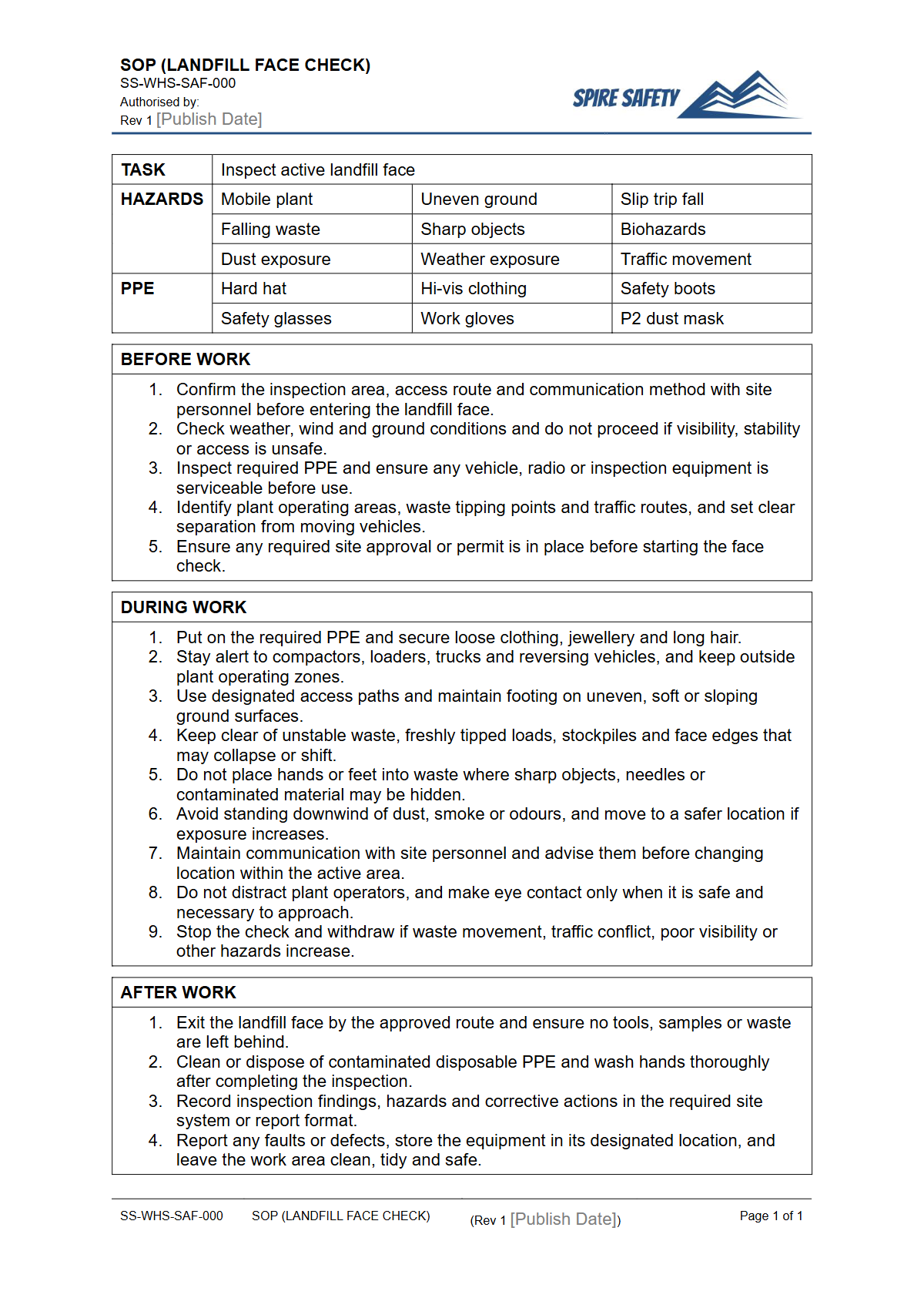
Operating a landfill involves significant risks, particularly at the active tipping face where waste is deposited and compacted. This area is dynamic and potentially unstable, posing hazards from vehicle movement, ground instability, hazardous materials, and airborne contaminants.
The purpose of this Free Safe Operating Procedure (Landfill Face Check) Template is to provide a structured framework for conducting these essential inspections safely and systematically. It guides workers in identifying, assessing, and controlling risks associated with the landfill face, ensuring that operational activities can proceed without endangering personnel.
By documenting the required steps, PPE, and emergency responses, this SOP helps organisations meet their duty of care and maintain a safer working environment.
Key Hazards Addressed
A landfill face check is critical for managing a range of site-specific hazards. This Safe Operating Procedure prompts users to consider controls for:
- Instability of the tipping face, leading to slips or collapses.
- Uncontrolled movement of heavy vehicles and mobile plant.
- Exposure to hazardous substances, including chemical waste, asbestos, and biological agents.
- Fires, both on the surface and subsurface.
- Airborne hazards like dust, landfill gas (methane, carbon dioxide), and odours.
- Physical hazards from protruding objects or unstable waste.
Properly managing these risks is essential for operational continuity and worker safety. A documented procedure ensures that inspections are thorough and consistent, regardless of who performs them.
It also forms a critical part of your site's overall safety management documentation, similar to our free Scraper SOP template, which covers another key piece of landfill equipment.
Video walkthrough
How to use the Free Safe Operating Procedure (Landfill Face Check) Template
This template is provided in both DOCX and PDF formats for your convenience. The DOCX version is fully editable, allowing you to tailor the content to your specific site, equipment, and operational context.
We recommend downloading the DOCX file and adding your company branding, site-specific details, and any unique procedures required by your operations.
Important: This document is a template, not a finished safety document. We have provided a comprehensive starting point aligned with Australian WHS principles, but you must customise it to reflect the specific hazards, control measures, machinery, and personnel at your workplace.
A generic procedure is insufficient for ensuring safety; it must be made relevant to your actual operating conditions. This process of customisation is vital for developing effective and robust WHS management systems.
When to use it
A landfill face check should be integrated into your site's daily operational rhythm. This SOP should be used:
- At the start of each shift: To assess the condition of the face before operations commence.
- Periodically throughout the day: Especially during high-volume tipping periods to monitor for changes.
- After adverse weather events: Following heavy rain or high winds, which can significantly impact face stability.
- During incident investigations: To review if procedural steps were followed or if they need improvement.
- As a training tool: For inducting new operators or refreshing the knowledge of existing staff.
Who should use it
This Safe Operating Procedure is designed for all personnel involved in landfill operations and supervision. Key users include:
- Landfill Plant Operators: Individuals operating dozers, compactors, and other heavy machinery at the tipping face.
- Site Supervisors and Managers: Those responsible for overseeing operations, ensuring procedural adherence, and managing overall site safety.
- Waste Spotters: Workers tasked with directing traffic and identifying non-conforming or hazardous waste.
- WHS/HSE Advisors: Safety professionals responsible for developing, implementing, and reviewing safety procedures.
Personnel must be trained and deemed competent in this procedure before undertaking the task. The process of verification is similar to that required for operating machinery covered in documents like our free Grader SOP template.
Integrating the SOP into Your Safety System
A written procedure is only effective when it's actively used and integrated into your daily work. Ensure this SOP is part of worker inductions, pre-start meetings, and toolbox talks.
It should be readily accessible to all relevant workers at the location where the work is performed. To ensure its ongoing effectiveness and relevance, the procedure should be reviewed regularly as part of your WHS compliance auditing schedule, or whenever there is a change in equipment, processes, or regulations.
Should you require assistance in tailoring this or other documents, consider engaging our specialist WHS consulting services.
By implementing this procedure, you formalise a critical safety check, helping to create a more predictable and controlled work environment. It complements other task-specific documents, such as our FREE Telehandler SOP Template, to build a comprehensive library of work instructions.
You can explore our full range of document templates in our free WHS resources library to further strengthen your safety framework.
Common mistakes
Common mistakes to avoid
- Failing to account for the impact of recent weather (e.g., rain) on ground stability.
- Becoming complacent and treating the check as a tick-box exercise rather than an active hazard assessment.
- Inadequate communication between equipment operators and personnel on the ground.
- Neglecting to wear or inspect Personal Protective Equipment (PPE) suitable for the potential hazards.
Legal references
Legal considerations
The following legal requirements may be relevant to this type of work.
- Work Health and Safety Act (Harmonised) — Provides the primary duties for protecting workers and other people from work health and safety risks.
- Work Health and Safety Regulations (Harmonised) — Sets out requirements supporting the management of workplace hazards and risks.
The following codes may be relevant to this type of work.
- Managing WHS Risks Code of Practice — Provides practical guidance on identifying hazards, assessing risks and applying effective controls.
- Work Health and Safety Consultation, Cooperation and Coordination Code of Practice — Provides practical guidance on consulting workers and coordinating with other duty holders.
- Managing the Work Environment and Facilities Code of Practice — Provides practical guidance on safe work environments, workplace facilities and related controls.
Did you know
Landfill Gas Composition
Landfill gas is typically composed of about 50% methane and 50% carbon dioxide, with trace amounts of other gases. Methane is a potent greenhouse gas and is also flammable, making gas management a critical safety and environmental concern.
Waste Generation
According to the National Waste Report, Australia generates over 75 million tonnes of waste annually. Landfills remain a primary destination for a significant portion of this, highlighting the importance of safe and efficient landfill management practices.
FAQ
Frequently asked questions
01What are the main hazards when checking a landfill face?
02What is the 'active face' of a landfill?
03Why is a written SOP better than verbal instructions for this task?
04How often should a landfill face check SOP be reviewed?
Share this resource
Free Safe Operating Procedure (Landfill Face Check) Template
Browse Categories
How To Use It
- 1Download and open in Word or PDF.
- 2Replace the placeholders with your business details.
- 3Get it reviewed by a WHS specialist before rollout.
Need it customised?
Our WHS consultants can adapt this template to your site, run a gap analysis, or audit what you already have in place.
Book a Free Consultation WHS consulting servicesor call 1300 156 382
Related templates
- Free Safe Operating Procedure (Landfill Litter Patrol) Template
- Free Safe Operating Procedure (Landscape Fabric Install) Template
- Free Safe Operating Procedure (Laser Level) Template
- Free Safe Operating Procedure (Laser Marker) Template
- Free Safe Operating Procedure (Laundry Bag Collection) Template
- Free Safe Operating Procedure (Laundry Bag Handling) Template