
Free Safe Operating Procedure (Label Applicator) Template
Download our free Safe Operating Procedure (Label Applicator) Template to standardise machinery use and manage risks. Get started with our customisable DOCX.
Free Safe Operating Procedure (Label Applicator) Template
DOCX • 126 KB + PDF
Updated Oct 2026
No signup required
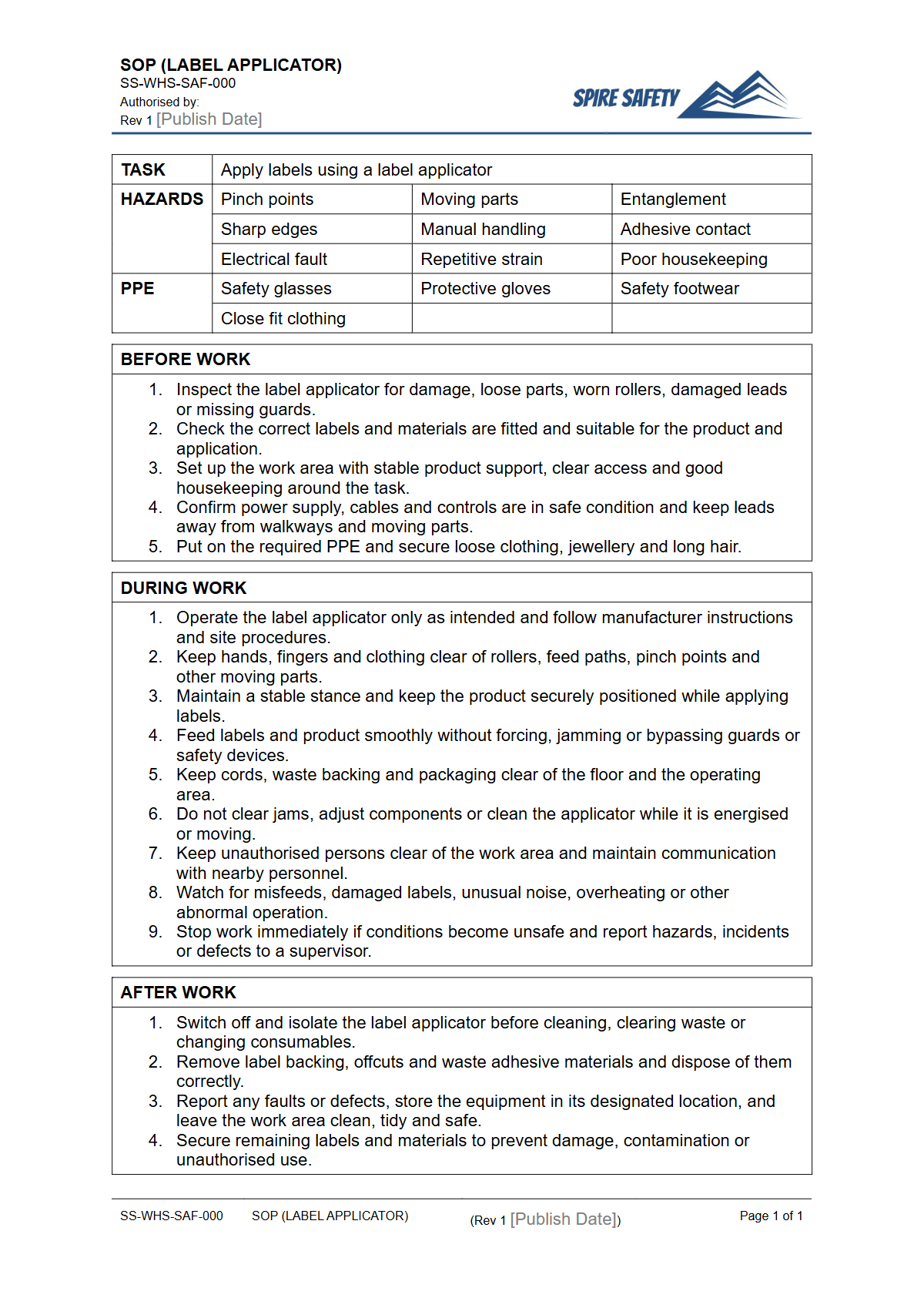
Purpose of the Free Safe Operating Procedure (Label Applicator) Template
Operating machinery like a label applicator introduces specific workplace hazards, including mechanical risks from moving parts, ergonomic strains, and electrical dangers. This free Safe Operating Procedure (Label Applicator) Template provides a structured framework for documenting the safest way to perform tasks associated with this equipment.
By formally outlining the steps for setup, operation, cleaning, and shutdown, you can standardise work practices, minimise the risk of injury, and ensure operational consistency.
A documented SOP is a critical tool for worker training and competency verification. It forms a key part of your safety management system, demonstrating a commitment to proactively managing risks.
Integrating clear, task-specific procedures helps build a robust safety culture and supports your organisation's compliance with Australian WHS obligations. These procedures should be part of broader comprehensive WHS management systems that govern all operational activities.
Video walkthrough
How to use the Free Safe Operating Procedure (Label Applicator) Template
This template is designed as a starting point. To make it effective, you must adapt it to the specific equipment and operational context of your workplace.
Generic procedures are insufficient for managing site-specific risks.
Follow these steps to implement the SOP effectively:
- Download and Review: Download the DOCX file and familiarise yourself with its sections.
- Consult and Customise: Work with machine operators, supervisors, and maintenance personnel who use the label applicator daily. Their input is essential for creating a practical and accurate procedure. Identify the specific make and model of your machine and detail its unique controls, guards, and emergency stops.
- Conduct a Risk Assessment: Use a risk assessment process to identify all potential hazards associated with the machine’s lifecycle, from installation to decommissioning. Ensure the controls listed in the SOP are adequate for the identified risks.
- Detail Procedures: Clearly document the step-by-step process for pre-start checks, normal operation, troubleshooting common faults, clearing jams, cleaning, and lockout/tagout (LOTO) for maintenance. Specify the required Personal Protective Equipment (PPE).
- Approve and Train: Once finalised, the SOP should be officially approved by management. All relevant workers must be trained on the procedure, and records of this training should be kept. Consider engaging external experts for WHS compliance auditing to verify the effectiveness of your documented procedures.
Note: We have drafted this document to be a strong starting point, but you must customise it for the specific make, model, and configuration of the label applicator in your workplace. A generic procedure does not provide adequate risk control.
When to use a Label Applicator SOP
A Safe Operating Procedure for a label applicator should be used consistently as a reference and training guide. It is most critical during key operational moments, including worker induction and task-specific training.
Before an operator is authorised to use the equipment, they should read, understand, and be assessed on their knowledge of the SOP.
The SOP should also be consulted when planning maintenance or cleaning tasks to ensure correct isolation and shutdown protocols are followed. Following any incident, near miss, or change in the equipment or process, the SOP must be reviewed and updated to reflect new learnings or risks. In many production environments, label applicators work in sequence with other machinery, so it's vital to have documented procedures for all related equipment, such as the process outlined in our free Conveyer System SOP.
Who should use this SOP
This SOP is intended for several key groups within an organisation:
- Machine Operators: As the primary users, operators must follow the SOP to ensure they perform their tasks safely and consistently.
- Supervisors and Team Leaders: They are responsible for ensuring operators are trained on and adhere to the SOP. They use it as a tool for monitoring, coaching, and enforcing safe work practices.
- Maintenance Personnel: This group refers to the SOP, particularly the lockout/tagout sections, to ensure the machine is safely de-energised before they begin maintenance or repair work.
- WHS Managers and Personnel: They use the SOP as evidence of risk management, a component of the overall safety system, and a basis for incident investigation and workplace inspections.
For organisations that use compressed air for cleaning or pneumatic functions in their machinery, it is also beneficial to have documented procedures for auxiliary equipment. You can use our Free Air Compressor SOP as a reference.
If your team needs help developing or implementing these documents, our professional WHS consulting services can provide expert guidance.
By ensuring all relevant personnel understand and use the SOP, you create a more coordinated and safety-conscious approach to machine operation. To discover more templates and guides, browse our complete free WHS resources library.
Common mistakes
Common mistakes to avoid
- Using the generic template without customising it for the specific machine model and workplace.
- Failing to adequately train all operators on the contents of the finalised SOP.
- Neglecting to include specific lockout/tagout (LOTO) procedures for cleaning and maintenance tasks.
- Forgetting to review and update the SOP after a near miss, incident, or change in equipment.
Legal references
Legal considerations
The following legal requirements may be relevant to this type of work.
- Work Health and Safety Act (Harmonised) — Provides the primary duties for protecting workers and other people from work health and safety risks.
- Work Health and Safety Regulations (Harmonised) — Sets out requirements supporting the management of workplace hazards and risks.
The following codes may be relevant to this type of work.
- Managing WHS Risks Code of Practice — Provides practical guidance on identifying hazards, assessing risks and applying effective controls.
- Work Health and Safety Consultation, Cooperation and Coordination Code of Practice — Provides practical guidance on consulting workers and coordinating with other duty holders.
- Managing the Work Environment and Facilities Code of Practice — Provides practical guidance on safe work environments, workplace facilities and related controls.
Did you know
Nip Point Dangers
Nip points, created where two or more moving parts rotate in opposite directions (like the rollers on a label applicator), are one of the most common causes of serious hand and finger injuries in manufacturing.
Ergonomic Risk
Repetitive tasks, such as manually loading heavy label rolls or consistently placing products onto a conveyor, can lead to musculoskeletal disorders (MSDs) over time. Job rotation and ergonomic design are key controls.
FAQ
Frequently asked questions
01What are the main hazards of a label applicator?
02How often should a Safe Operating Procedure for a label applicator be reviewed?
03Is training required in addition to an SOP document?
04What should be included in a pre-start check for a label applicator?
Share this resource
Free Safe Operating Procedure (Label Applicator) Template
Browse Categories
How To Use It
- 1Download and open in Word or PDF.
- 2Replace the placeholders with your business details.
- 3Get it reviewed by a WHS specialist before rollout.
Need it customised?
Our WHS consultants can adapt this template to your site, run a gap analysis, or audit what you already have in place.
Book a Free Consultation WHS consulting servicesor call 1300 156 382
Related templates
- Free Safe Operating Procedure (Lake Edge Cleanup) Template
- Free Safe Operating Procedure (Laminar Flow Cabinet) Template
- Free Safe Operating Procedure (Landfill Face Check) Template
- Free Safe Operating Procedure (Landfill Litter Patrol) Template
- Free Safe Operating Procedure (Landscape Fabric Install) Template
- Free Safe Operating Procedure (Laser Level) Template