
Free Safe Operating Procedure (Knitting Machine) Template
Standardise the safe use of knitting machines in your workplace with our structured SOP template. Download this customisable DOCX to get started.
Free Safe Operating Procedure (Knitting Machine) Template
DOCX • 126 KB + PDF
Updated Oct 2026
No signup required
Purpose of the Free Safe Operating Procedure (Knitting Machine) Template
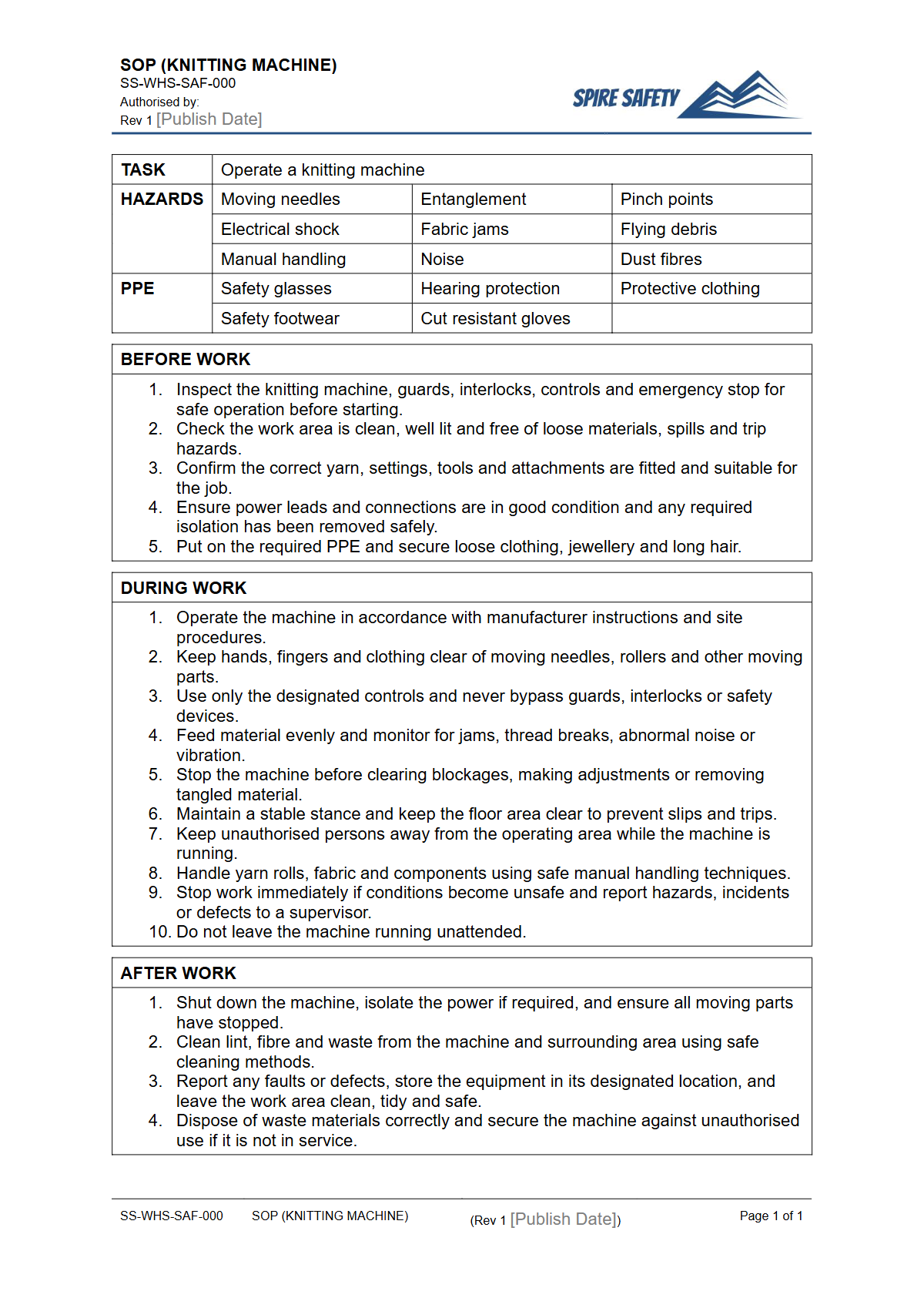
The primary purpose of this Safe Operating Procedure for knitting machines is to provide a clear, step-by-step guide for operators. It standardises the work method, ensuring that every task—from pre-start checks to shutdown—is performed consistently and safely.
A well-drafted SOP identifies potential hazards such as entanglement in moving parts, needlestick injuries, electrical faults, and ergonomic strains. It then specifies the control measures required to eliminate or minimise these risks. This document serves as a critical training tool for new employees and a reference for experienced operators, forming a key component of your overall WHS management system.
Video walkthrough
How to use the Free Safe Operating Procedure (Knitting Machine) Template
This template is a starting point designed for customisation. To make it effective, you must adapt it to the specific knitting machines and operational context of your workplace.
- Review and Customise: Download the DOCX file and walk through each section. Replace the placeholder text with details specific to your machinery, including brand, model, and unique features.
- Add Site-Specific Details: Incorporate information about your workshop layout, emergency stop locations, and specific environmental factors. Detail the required Personal Protective Equipment (PPE), such as safety glasses or gloves, based on your own risk assessment.
- Consult with Workers: Engage the operators who use the machines daily. Their firsthand experience is invaluable for identifying practical hazards and effective controls. This consultation is a key requirement under WHS legislation.
- Approve and Train: Once finalised, the SOP should be formally approved by a supervisor or manager. All relevant personnel must be trained on its contents, with records kept of this training.
Please note: We have provided this template as a guide. You must customise it to reflect the specific hazards and control measures relevant to your individual workplace, equipment, and processes.
It is not a complete solution and does not remove your obligation to conduct a thorough risk assessment.
When to use a Safe Operating Procedure
An SOP for a knitting machine should be used as a primary reference document in several key situations. It should be the central document for inducting and training new operators, ensuring they understand the approved method of work from day one.
It serves as a vital tool for refresher training to prevent complacency among experienced staff. The SOP should also be reviewed and referenced during incident investigations to determine if procedural failures contributed to the event. For other plant that may require documented procedures, consider our Free Air Compressor SOP Template.
Who should use this procedure
This SOP is intended for a range of personnel within an organisation.
- Machine Operators: The primary users, who must follow the procedure for every task to ensure their own safety and the safety of others.
- Supervisors and Team Leaders: Responsible for enforcing the SOP, providing training, and ensuring compliance on the workshop floor. They may also lead SOP reviews and updates.
- WHS Managers/Officers: Use the SOP as evidence of risk management, a basis for audits, and a tool for promoting a positive safety culture. A comprehensive suite of SOPs is often reviewed during a WHS compliance audit.
- Maintenance Personnel: While specific maintenance tasks may require their own separate procedures or permits to work, this SOP provides essential information on safe shutdown, isolation, and lockout/tagout (LOTO) requirements before maintenance can begin.
For machinery with blades that may be present in the same facility, our FREE Circular Saw SOP Template offers another example of task-specific guidance. Integrating this SOP into your safety framework helps demonstrate a systematic approach to risk management.
If you manage a large textile facility, you may also have automated material handling systems that require similar documentation. In that case, our FREE Conveyer System SOP Template can provide a useful starting point for those assets.
This document is one of many tools available to help you build a safer workplace. For more templates, checklists, and guides covering a wide range of tasks and hazards, browse our complete free WHS resources library.
Common mistakes
Common mistakes to avoid
- Failing to perform pre-start checks on safety guards, interlocks, and emergency stops.
- Attempting to clear jams or re-thread yarn without correctly isolating and de-energising the machine.
- Wearing loose-fitting clothing, long unsecured hair, or jewellery that can become entangled in moving parts.
- Assuming knowledge from one machine model transfers directly to another without specific training.
Legal references
Legal considerations
The following legal requirements may be relevant to this type of work.
- Work Health and Safety Act (Harmonised) — Provides the primary duties for protecting workers and other people from work health and safety risks.
- Work Health and Safety Regulations (Harmonised) — Sets out requirements supporting the management of workplace hazards and risks.
The following codes may be relevant to this type of work.
- Managing WHS Risks Code of Practice — Provides practical guidance on identifying hazards, assessing risks and applying effective controls.
- Work Health and Safety Consultation, Cooperation and Coordination Code of Practice — Provides practical guidance on consulting workers and coordinating with other duty holders.
- Managing the Work Environment and Facilities Code of Practice — Provides practical guidance on safe work environments, workplace facilities and related controls.
Did you know
Automated Entanglement
Modern industrial knitting machines can have thousands of needles moving at high speed. Entanglement of hair, clothing, or jewellery is a primary hazard, making strict adherence to procedures and the use of guards critical.
Beyond the Factory
While associated with large textile mills, smaller computer-controlled knitting machines are increasingly used in design studios, research labs, and educational institutions, each requiring its own specific safety protocols.
FAQ
Frequently asked questions
01What should be included in a knitting machine SOP?
02Who is responsible for writing a Safe Operating Procedure for a knitting machine?
03How often should a knitting machine SOP be reviewed?
04Is a Safe Operating Procedure legally required for knitting machines in Australia?
Share this resource
Free Safe Operating Procedure (Knitting Machine) Template
Browse Categories
How To Use It
- 1Download and open in Word or PDF.
- 2Replace the placeholders with your business details.
- 3Get it reviewed by a WHS specialist before rollout.
Need it customised?
Our WHS consultants can adapt this template to your site, run a gap analysis, or audit what you already have in place.
Book a Free Consultation WHS consulting servicesor call 1300 156 382
Related templates
- Free Safe Operating Procedure (Label Applicator) Template
- Free Safe Operating Procedure (Lake Edge Cleanup) Template
- Free Safe Operating Procedure (Laminar Flow Cabinet) Template
- Free Safe Operating Procedure (Landfill Face Check) Template
- Free Safe Operating Procedure (Landfill Litter Patrol) Template
- Free Safe Operating Procedure (Landscape Fabric Install) Template