
Free Safe Operating Procedure (Knife Sharpening) Template
Effectively manage the risks of knife sharpening with our free Safe Operating Procedure template. Download your customisable DOCX and PDF to get started.
Free Safe Operating Procedure (Knife Sharpening) Template
DOCX • 126 KB + PDF
Updated Oct 2026
No signup required
Purpose of the Free Safe Operating Procedure (Knife Sharpening) Template
Working with knives is an inherent risk in many industries, from hospitality to food processing. A dull knife requires more force to use, increasing the likelihood of slips and serious lacerations.
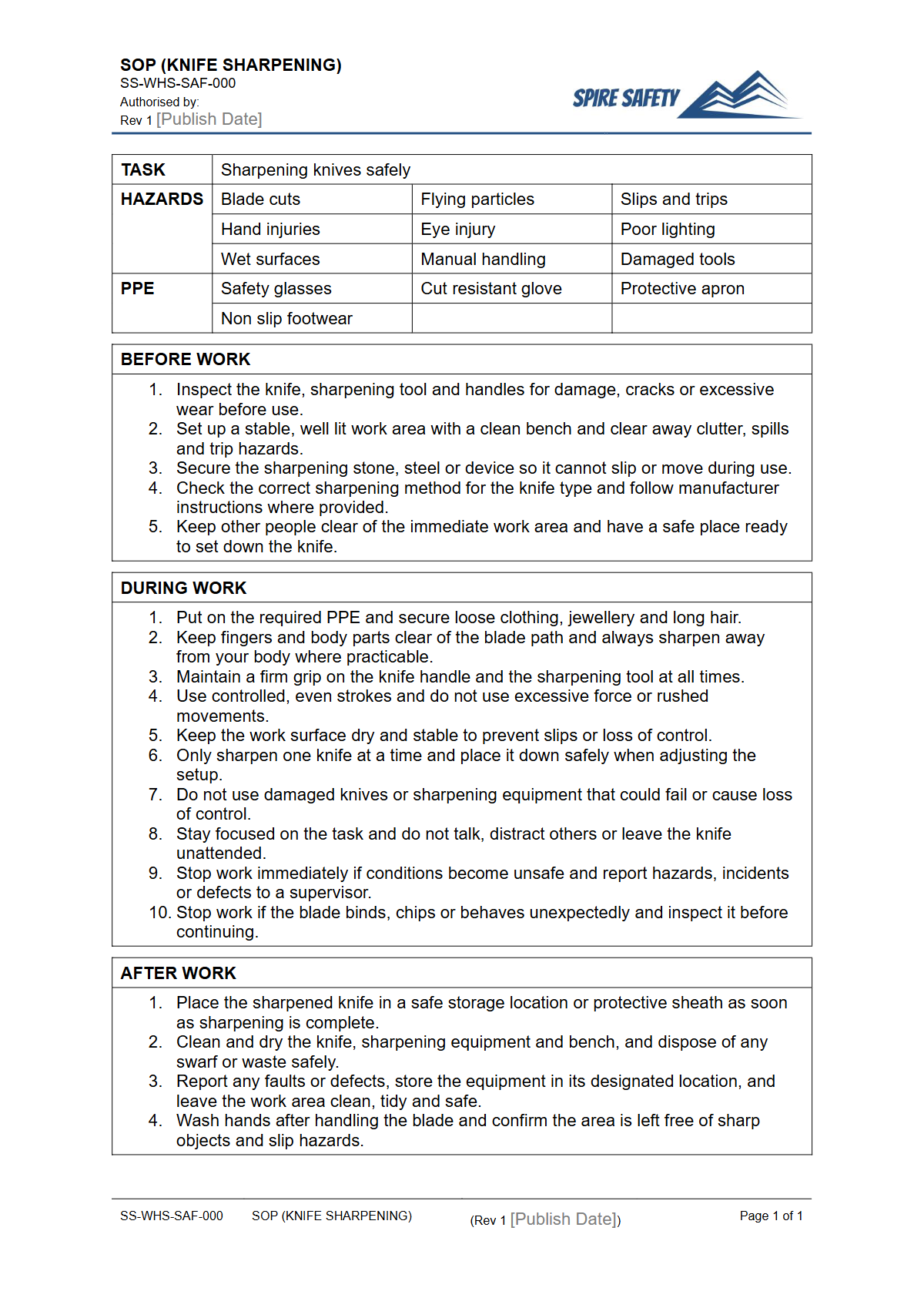
This Free Safe Operating Procedure (Knife Sharpening) Template provides a structured framework for businesses to document a consistent, safe method for this common but hazardous task. Its primary purpose is to minimise the risk of injury by outlining clear, step-by-step instructions for workers to follow.
A documented SOP serves as a critical training tool for new employees and a reliable reference for experienced staff. It formalises expectations around personal protective equipment (PPE), workspace setup, sharpening technique, and cleaning.
Integrating clear SOPs into your daily operations is a fundamental aspect of creating robust WHS management systems, demonstrating a commitment to proactive risk management and worker safety.
Video walkthrough
How to use the Free Safe Operating Procedure (Knife Sharpening) Template
This resource is provided in both DOCX and PDF formats for your convenience. The DOCX file is fully editable, allowing you to adapt the content to match the specific context of your operations.
It is designed as a starting point, pre-filled with common steps and safety considerations aligned with Australian WHS principles. You should review, add, and remove content to reflect your unique equipment (e.g., sharpening steels, whetstones, or mechanical sharpeners) and work environment.
Important: This is a template, not a finished document. To make it effective, we strongly advise you to conduct a specific risk assessment for knife sharpening in your workplace.
The findings of your risk assessment should be used to customise this SOP. You must ensure the final document accurately reflects your site-specific procedures, responsibilities, and control measures.
Consulting your team during this process can help identify practical challenges and create a more effective procedure.
When to use this Safe Operating Procedure
This Safe Operating Procedure should be the standard reference for every knife sharpening task performed in the workplace. It should be readily accessible to all workers who may be required to sharpen knives, whether they do it daily or infrequently.
It is particularly crucial during employee induction and training, ensuring that new team members learn the correct, safe method from the very beginning. It also serves as an excellent resource for refresher training or toolbox talks, helping to reinforce safe behaviour and prevent complacency.
Many workplaces that handle knives also have other high-risk equipment. Documenting processes for all hazardous tasks is essential, which is why we also provide a Safe Operating Procedure for deep fryer use, helping you build a comprehensive safety library for your kitchen or facility.
Who should use it
This SOP is intended for use by any worker tasked with sharpening knives, including chefs, kitchen hands, butchers, apprentices, and food processing operators. Supervisors and managers should also use this document to ensure they are providing adequate training and supervision.
It provides a clear benchmark against which worker competency can be assessed and verified. For a Person Conducting a Business or Undertaking (PCBU), having and enforcing such procedures is a key part of meeting primary duties of care under WHS law.
The principles of documenting safe procedures for sharp or high-speed equipment extend beyond the kitchen. In a workshop environment, similar documentation is vital for tools that present a cutting or amputation hazard.
A FREE Circular Saw SOP Template follows the same logic of breaking down a hazardous task into manageable, safe steps.
Key Elements of a Safe Knife Sharpening Process
A comprehensive knife sharpening SOP should always cover these core areas:
- Pre-operational Checks: Instructions to inspect the knife and sharpening equipment for any damage or defects before starting.
- Work Area Preparation: Requirements to ensure the sharpening station is clean, dry, stable, and free from clutter to prevent slips or trips.
- Personal Protective Equipment (PPE): Clearly specify the mandatory PPE, which should always include appropriate cut-resistant gloves and safety glasses.
- Sharpening Technique: A step-by-step guide on the correct technique, such as maintaining a consistent angle and always moving the blade away from the body.
- Post-Task Cleanup: Procedures for safely cleaning the knife, the sharpening equipment, and the work area, including disposal of any metal filings.
Periodically reviewing the effectiveness of your SOPs is a critical part of maintaining safety standards. An independent review can identify gaps you might have missed, making a WHS compliance audit a valuable tool for continuous improvement. If you need expert assistance in developing or refining your safety documentation, our WHS consulting team can provide tailored support. For more templates and safety guides, explore our complete free WHS resources library.
Common mistakes
Common mistakes to avoid
- Failing to wear appropriate PPE, especially cut-resistant gloves on the non-dominant hand.
- Using an inconsistent or incorrect sharpening angle, which can damage the blade's edge.
- Attempting to sharpen in a wet, unstable, or cluttered work area.
- Not properly securing the sharpening stone or device, allowing it to move during use.
Legal references
Legal considerations
The following legal requirements may be relevant to this type of work.
- Work Health and Safety Act (Harmonised) — Provides the primary duties for protecting workers and other people from work health and safety risks.
- Work Health and Safety Regulations (Harmonised) — Sets out requirements supporting the management of workplace hazards and risks.
The following codes may be relevant to this type of work.
- Managing WHS Risks Code of Practice — Provides practical guidance on identifying hazards, assessing risks and applying effective controls.
- Work Health and Safety Consultation, Cooperation and Coordination Code of Practice — Provides practical guidance on consulting workers and coordinating with other duty holders.
- Managing the Work Environment and Facilities Code of Practice — Provides practical guidance on safe work environments, workplace facilities and related controls.
Did you know
Dull is Dangerous
A dull knife is statistically more dangerous than a sharp one. It requires more pressure to cut, which dramatically increases the chance of the blade slipping and causing a severe injury.
The Importance of the Angle
The angle at which a knife is sharpened is critical. Most kitchen knives use an angle of 15-20 degrees per side; maintaining this consistently is key to achieving a sharp, durable edge.
FAQ
Frequently asked questions
01What should be included in a knife sharpening SOP?
02Are cut-resistant gloves mandatory for sharpening knives in Australia?
03How often should a knife sharpening procedure be reviewed?
04Can this template be used for automated knife sharpening machines?
Share this resource
Free Safe Operating Procedure (Knife Sharpening) Template
Browse Categories
How To Use It
- 1Download and open in Word or PDF.
- 2Replace the placeholders with your business details.
- 3Get it reviewed by a WHS specialist before rollout.
Need it customised?
Our WHS consultants can adapt this template to your site, run a gap analysis, or audit what you already have in place.
Book a Free Consultation WHS consulting servicesor call 1300 156 382
Related templates
- Free Safe Operating Procedure (Knitting Machine) Template
- Free Safe Operating Procedure (Label Applicator) Template
- Free Safe Operating Procedure (Lake Edge Cleanup) Template
- Free Safe Operating Procedure (Laminar Flow Cabinet) Template
- Free Safe Operating Procedure (Landfill Face Check) Template
- Free Safe Operating Procedure (Landfill Litter Patrol) Template