
Free Safe Operating Procedure (Kitchen Trolley Use) Template
Streamline your kitchen safety with our free Safe Operating Procedure for kitchen trolley use. Download the customisable DOCX or PDF template today.
Free Safe Operating Procedure (Kitchen Trolley Use) Template
DOCX • 126 KB + PDF
Updated Oct 2026
No signup required
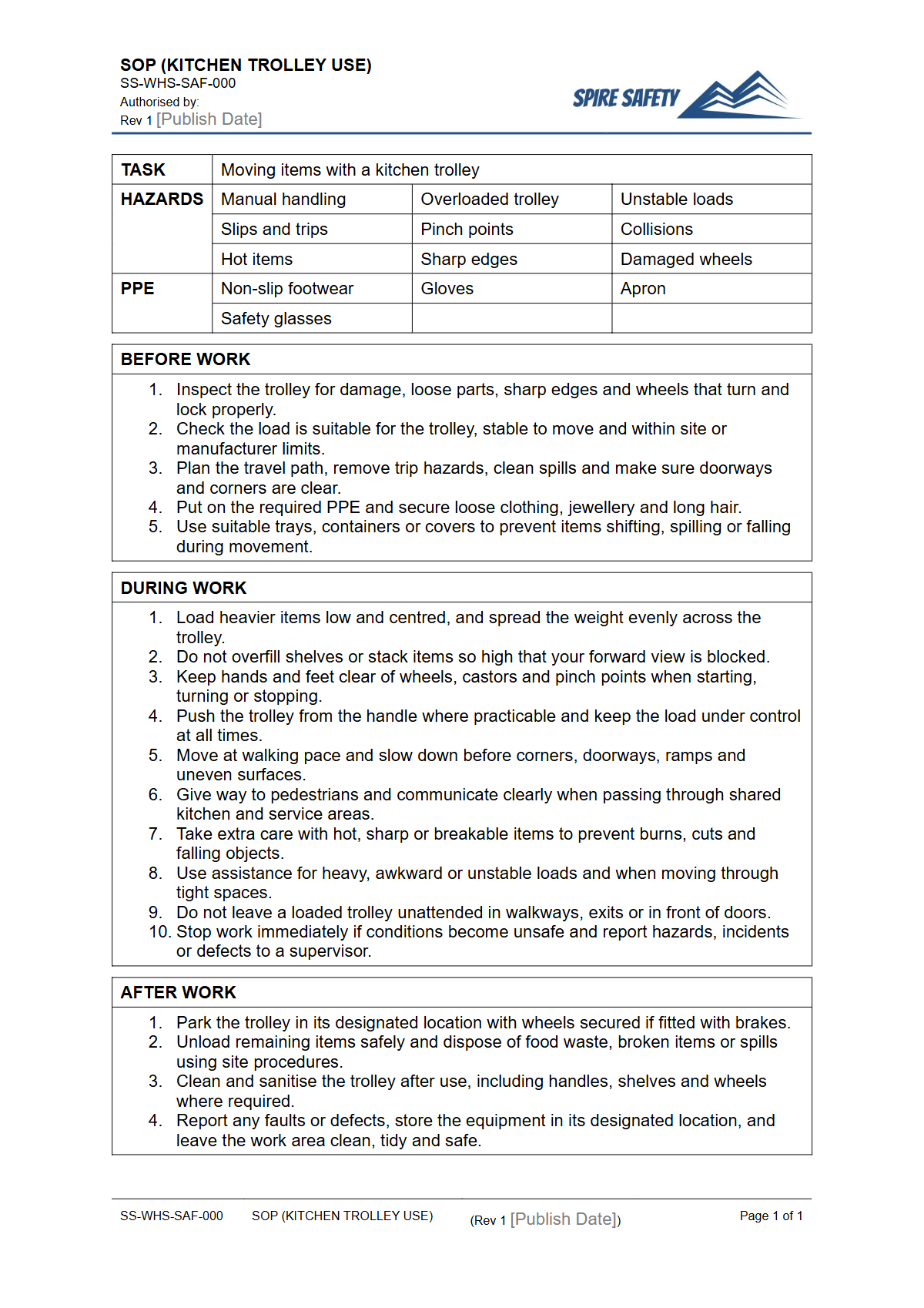
Purpose of the Free Safe Operating Procedure (Kitchen Trolley Use) Template
Even simple equipment like a kitchen trolley can introduce significant risks if not managed correctly. This Free Safe Operating Procedure (Kitchen Trolley Use) Template provides a structured framework for documenting the safe use of trolleys in commercial kitchens, hospitality venues, and healthcare settings.
Its primary purpose is to help organisations minimise the risk of workplace injuries, such as musculoskeletal disorders from pushing heavy loads, slips and trips from poor placement, and collisions in busy environments. By establishing clear, step-by-step instructions, this Safe Operating Procedure helps ensure all workers understand the expected standards for inspection, loading, movement, and storage of kitchen trolleys.
A documented procedure is a key component in demonstrating proactive risk management. It standardises training, provides a clear benchmark for performance, and forms an essential part of a compliant and effective safety system.
Implementing this SOP helps create a safer environment for staff and visitors by addressing hazards before they cause an incident. This is a fundamental part of building comprehensive WHS management systems that protect your people and your business.
Video walkthrough
How to use the Free Safe Operating Procedure (Kitchen Trolley Use) Template
This document is a template and must be customised to reflect the specific circumstances of your workplace. Download the DOCX file and adapt it by consulting with your workers and considering your unique operational risks.
You will need to insert your company name, ABN, and review dates. Most importantly, you must edit the procedure to include details specific to your site, such as the types of trolleys used, the surfaces they are used on (e.g., non-slip floors, ramps, lifts), specific load limits, and designated parking areas.
Note: We have provided a solid foundation based on Australian WHS principles, but it is your responsibility to ensure the final document is accurate and sufficient for your workplace risks. We recommend conducting a risk assessment on the task before finalising the procedure.
This process is crucial for identifying all potential hazards. For other common kitchen tasks, you might also find our Free Safe Operating Procedure (Deep Fryer - Standard Operation) template useful.
When to use this Safe Operating Procedure
A Safe Operating Procedure for kitchen trolley use should be a living document, integrated into your daily operations. It is most effective when used for inducting and training new kitchen staff, ensuring they learn the correct methods from their first day.
It also serves as a valuable tool for regular refresher training sessions to reinforce safe behaviour and address any bad habits that may have developed. Furthermore, the SOP should be reviewed and potentially updated following any incident, near miss, or change in the work environment (such as the introduction of new equipment or a change in kitchen layout). It is also a critical piece of evidence during safety inspections and formal assessments like WHS compliance auditing.
Who should use this Safe Operating Procedure
This Safe Operating Procedure is intended for all persons conducting a business or undertaking (PCBUs) where kitchen trolleys are used. This includes cafes, restaurants, hotels, hospitals, aged care facilities, and catering companies. Specifically, it should be used by:
- Workers: Kitchen hands, chefs, porters, and cleaning staff who physically use the trolleys must be trained in and follow the procedure.
- Supervisors and Managers: They are responsible for ensuring staff are trained, the SOP is followed, and the trolleys are properly maintained. They also lead consultation during the customisation of the procedure.
- WHS Managers and Representatives: They use the SOP as part of the broader safety management system, for risk assessments, incident investigations, and promoting a culture of safety.
Properly implemented, an SOP empowers everyone in the workplace to take responsibility for safety. If your organisation needs broader support in defining safety roles and responsibilities, our WHS consulting services can provide expert guidance.
SOPs for other types of moving equipment, such as the FREE Conveyer System SOP, can also help expand your safety documentation.
You can find this and many other helpful documents in our complete free WHS resources library, designed to support Australian businesses in managing workplace safety.
Common mistakes
Common mistakes to avoid
- Overloading trolleys beyond their specified weight capacity.
- Failing to inspect trolley wheels, brakes, and frames before each use.
- Leaving trolleys unattended in walkways, creating trip hazards.
- Attempting to move a trolley with an obstructed view of the path ahead.
Legal references
Legal considerations
The following legal requirements may be relevant to this type of work.
- Work Health and Safety Act (Harmonised) — Provides the primary duties for protecting workers and other people from work health and safety risks.
- Work Health and Safety Regulations (Harmonised) — Sets out requirements supporting the management of workplace hazards and risks.
The following codes may be relevant to this type of work.
- Managing WHS Risks Code of Practice — Provides practical guidance on identifying hazards, assessing risks and applying effective controls.
- Work Health and Safety Consultation, Cooperation and Coordination Code of Practice — Provides practical guidance on consulting workers and coordinating with other duty holders.
- Managing the Work Environment and Facilities Code of Practice — Provides practical guidance on safe work environments, workplace facilities and related controls.
Did you know
Manual Tasks Risk
Hazardous manual tasks, including pushing and pulling heavily laden trolleys, are a leading cause of workplace injuries in Australia. They account for a significant portion of serious workers' compensation claims each year.
The 'Push, Don't Pull' Rule
It is generally safer to push a trolley rather than pull it. Pushing allows you to use your body weight more effectively, adopt a better posture, and maintain a clearer view of the path ahead, reducing the risk of collisions and strain.
FAQ
Frequently asked questions
01Is a Safe Operating Procedure for a kitchen trolley legally required in Australia?
02What are the main hazards of using kitchen trolleys?
03How often should we train staff on this kitchen trolley SOP?
04Can I just print this template and use it immediately?
Share this resource
Free Safe Operating Procedure (Kitchen Trolley Use) Template
Browse Categories
How To Use It
- 1Download and open in Word or PDF.
- 2Replace the placeholders with your business details.
- 3Get it reviewed by a WHS specialist before rollout.
Need it customised?
Our WHS consultants can adapt this template to your site, run a gap analysis, or audit what you already have in place.
Book a Free Consultation WHS consulting servicesor call 1300 156 382
Related templates
- Free Safe Operating Procedure (Knife Handling) Template
- Free Safe Operating Procedure (Knife Sharpening) Template
- Free Safe Operating Procedure (Knitting Machine) Template
- Free Safe Operating Procedure (Label Applicator) Template
- Free Safe Operating Procedure (Lake Edge Cleanup) Template
- Free Safe Operating Procedure (Laminar Flow Cabinet) Template