
Free Safe Operating Procedure (Kitchen Floor Cleaning) Template
Prevent slips and falls in your commercial kitchen with a clear process for floor cleaning. Download our free Safe Operating Procedure template to get started.
Free Safe Operating Procedure (Kitchen Floor Cleaning) Template
DOCX • 126 KB + PDF
Updated Oct 2026
No signup required
Purpose of the Free Safe Operating Procedure (Kitchen Floor Cleaning) Template
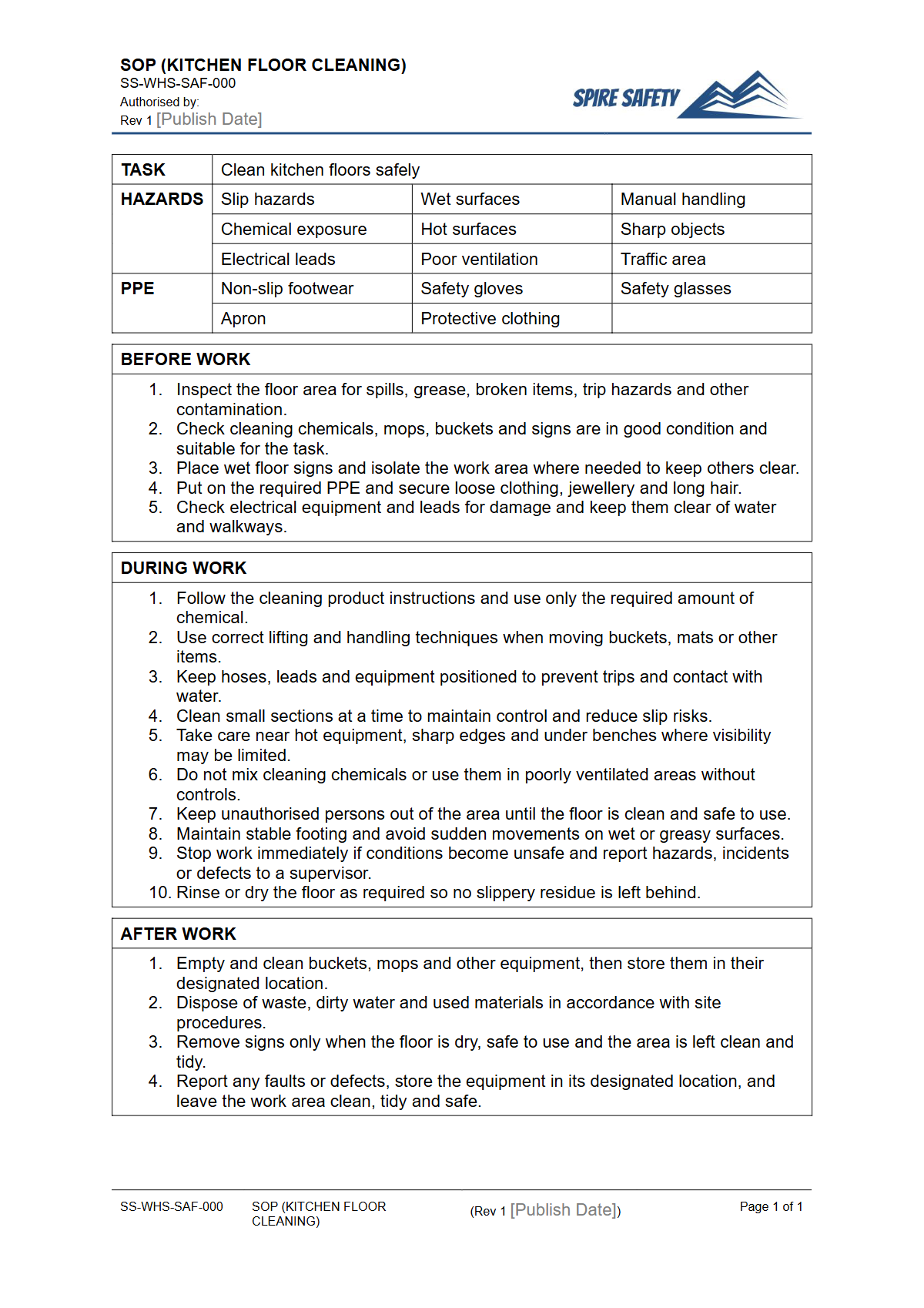
Slips, trips, and falls are a leading cause of injury in the hospitality industry, with wet and greasy kitchen floors being a primary hazard. This Free Safe Operating Procedure (Kitchen Floor Cleaning) Template provides a structured starting point for developing a formal, documented process for your workplace.
Implementing a clear SOP helps standardise cleaning methods, ensuring every worker performs the task safely and effectively, regardless of their experience level. It is a critical tool for training new staff, conducting refresher training, and demonstrating due diligence in managing workplace risks.
A well-defined SOP for cleaning kitchen floors forms a crucial part of your overall safety framework. It helps your organisation meet its duties under WHS legislation by systematically identifying hazards (like slippery surfaces, incorrect chemical use, and manual handling risks) and implementing specific control measures.
Documenting these procedures is a foundational element of building robust WHS management systems that protect your workers and your business.
Video walkthrough
How to use the Free Safe Operating Procedure (Kitchen Floor Cleaning) Template
This resource is available as a fully editable DOCX file and a ready-to-print PDF. Simply download the template and integrate it into your safety management system.
A Safe Operating Procedure is not a 'set and forget' document. To be effective, it must accurately reflect the specific environment and tasks at your worksite.
We strongly recommend you customise this template to detail the unique chemicals, equipment, layout, and floor surfaces of your kitchen.
Key Sections to Customise
Pay close attention to the following sections to ensure the SOP is relevant to your operations:
- Hazards & Risks: Go beyond generic slip hazards. Consider risks specific to your kitchen, such as chemical exposure from your chosen degreaser, trip hazards from hoses, or ergonomic risks from mopping techniques.
- Personal Protective Equipment (PPE): List the exact PPE required, such as non-slip, closed-toe footwear, specific types of gloves (e.g., nitrile, rubber), and safety glasses or goggles if there is a splash risk.
- Step-by-Step Procedure: This is the core of the SOP. Break down the task into a logical sequence, from preparing the area (e.g., placing 'wet floor' signs) and mixing chemicals, to the application method (e.g., mopping direction) and final rinse.
- Emergency Procedures: Detail the immediate steps to take in case of a chemical spill, splash to the eyes, or a slip-and-fall incident. Include the location of safety data sheets (SDS), eyewash stations, and first aid kits.
By customising these areas, you transform the template into a useful tool that actively manages risk. For other common kitchen tasks, you may need a specific Safe Operating Procedure for deep fryer operation to manage risks associated with hot oil.
When to use a Safe Operating Procedure for Kitchen Floor Cleaning
This SOP should be applied consistently during all kitchen floor cleaning activities. This includes end-of-service daily cleaning, periodic deep cleans, and responding to spills.
Using the procedure for every clean ensures a consistent standard of safety and hygiene. It also serves as a critical reference document during staff induction and periodic competency assessments, providing a clear benchmark for correct performance. For larger areas or more intensive cleaning, your process might involve machinery, requiring a dedicated SOP for floor scrubber operation.
Who should use this Safe Operating Procedure
This SOP is designed for use by all personnel involved in or responsible for kitchen hygiene and safety. This includes:
- Kitchen Hands and Cleaning Staff: The primary users who will follow the step-by-step instructions to perform the cleaning task safely.
- Chefs and Cooks: Who may be required to clean their stations or respond to spills during service.
- Supervisors and Managers: Who are responsible for training staff, enforcing the procedure, and ensuring resources like PPE and correct chemicals are available.
Management should use the SOP as a tool for workplace inspections and incident investigations. Regular reviews of the procedure's effectiveness are a key part of the safety lifecycle and can be supported by periodic WHS compliance auditing to identify any gaps or areas for improvement.
If you need assistance developing or reviewing your workplace-specific documents, our team provides expert WHS consulting to help align your procedures with best practice. You can also browse our extensive free WHS resources library for more templates and guides.
Common mistakes
Common mistakes to avoid
- Using the wrong cleaning chemical or an incorrect dilution, damaging the floor or creating a new slip hazard.
- Failing to use 'wet floor' signs, or removing them before the floor is completely dry.
- Not cleaning up spills immediately, increasing the risk of a slip-and-fall incident.
- Improperly rinsing away detergent, which can leave a sticky and slippery residue.
Legal references
Legal considerations
The following legal requirements may be relevant to this type of work.
- Work Health and Safety Act (Harmonised) — Provides the primary duties for protecting workers and other people from work health and safety risks.
- Work Health and Safety Regulations (Harmonised) — Sets out requirements supporting the management of workplace hazards and risks.
The following codes may be relevant to this type of work.
- Managing WHS Risks Code of Practice — Provides practical guidance on identifying hazards, assessing risks and applying effective controls.
- Work Health and Safety Consultation, Cooperation and Coordination Code of Practice — Provides practical guidance on consulting workers and coordinating with other duty holders.
- Managing the Work Environment and Facilities Code of Practice — Provides practical guidance on safe work environments, workplace facilities and related controls.
Did you know
Slips, Trips, and Falls
Slips, trips, and falls are the second most common cause of serious workers' compensation claims in Australia, and a major hazard in the hospitality industry due to wet and greasy floors.
FAQ
Frequently asked questions
01What should be included in an SOP for cleaning kitchen floors?
02How often should kitchen floor cleaning procedures be reviewed?
03Are 'wet floor' signs legally required in Australia?
04What's the difference between cleaning and sanitising a kitchen floor?
Share this resource
Free Safe Operating Procedure (Kitchen Floor Cleaning) Template
Browse Categories
How To Use It
- 1Download and open in Word or PDF.
- 2Replace the placeholders with your business details.
- 3Get it reviewed by a WHS specialist before rollout.
Need it customised?
Our WHS consultants can adapt this template to your site, run a gap analysis, or audit what you already have in place.
Book a Free Consultation WHS consulting servicesor call 1300 156 382
Related templates
- Free Safe Operating Procedure (Kitchen Trolley Use) Template
- Free Safe Operating Procedure (Knife Handling) Template
- Free Safe Operating Procedure (Knife Sharpening) Template
- Free Safe Operating Procedure (Knitting Machine) Template
- Free Safe Operating Procedure (Label Applicator) Template
- Free Safe Operating Procedure (Lake Edge Cleanup) Template