
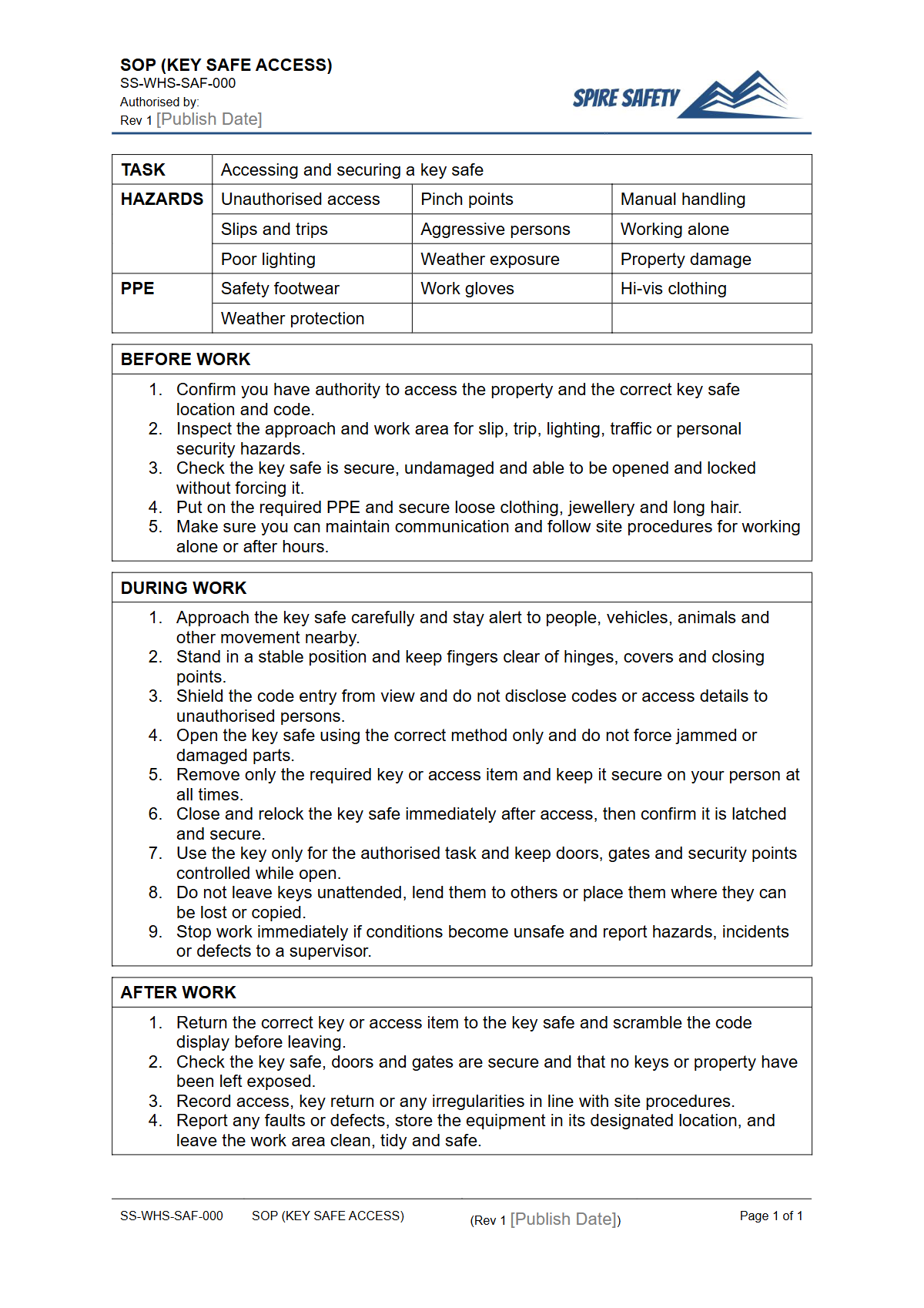
Free Safe Operating Procedure (Key Safe Access) Template
Manage property and equipment access safely with our free Safe Operating Procedure template for key safes. Download your customisable DOCX and PDF today.
Free Safe Operating Procedure (Key Safe Access) Template
DOCX • 126 KB + PDF
Updated Oct 2026
No signup required
Purpose of the Free Safe Operating Procedure (Key Safe Access) Template
Controlling access to keys is a critical component of workplace safety and security. This Free Safe Operating Procedure (Key Safe Access) Template provides a structured framework for managing this process, helping to ensure only authorised personnel can access specific areas, vehicles, or equipment.
Implementing a clear SOP reduces the risks of unauthorised use, damage, theft, and potential safety incidents. It establishes clear lines of accountability, documents key movements, and provides a consistent process for all workers and contractors to follow.
A well-defined procedure for key safe access is a simple yet powerful administrative control measure. It helps your organisation maintain a secure and organised work environment by standardising how keys are issued, tracked, and returned.
This SOP serves as a foundational document within broader WHS management systems, demonstrating a proactive approach to managing operational risks associated with property and asset access.
Video walkthrough
How to use the Free Safe Operating Procedure (Key Safe Access) Template
This template is designed as a starting point, providing a professional format and key sections based on Australian WHS principles. To use it effectively, download the DOCX file and adapt it to your specific operational needs.
IMPORTANT: This document is a template only. We've provided a solid foundation, but you must customise it to reflect the specific key safes, access protocols, personnel, and risks unique to your workplace.
Generic procedures are insufficient; site-specific details are essential for effective risk control.
Your customisation process should include:
- Identifying all key safes and the specific keys they contain (e.g., vehicle keys, plant keys, facility master keys).
- Assigning clear responsibilities to personnel for managing codes, auditing logs, and enforcing the procedure.
- Detailing the step-by-step process for a worker to request, sign out, use, and return a key.
- Defining the protocol for changing access codes and communicating these changes securely.
- Outlining emergency procedures for lost keys or a malfunctioning safe.
Consultation with your team is vital. Involve supervisors and workers who will use the key safe daily to ensure the procedure is practical and addresses real-world scenarios.
This collaborative approach is crucial when developing any procedural document, including something as specific as a FREE Telehandler SOP Template where key control is the first step in safe operation.
When to use this SOP
A formal procedure for key safe access is essential in any environment where restricted access is necessary to maintain safety and security. Key situations include:
- Contractor and Visitor Management: Providing temporary, controlled access to specific site areas without handing over master keys.
- Plant and Equipment Operation: Managing keys for vehicles, mobile plant, and machinery to ensure only trained and authorised operators can use them.
- Restricted Area Access: Securing keys for server rooms, chemical stores, electrical switch rooms, or areas containing confidential information.
- Multi-site Operations: Standardising key management practices across different locations or projects.
- After-Hours Access: Creating a formal process for staff or emergency teams who require access outside of standard operating hours.
The existence and proper use of this procedure can be a key point of verification during a safety review or WHS compliance auditing program.
Who should use it
Different roles within an organisation have distinct responsibilities related to the Key Safe Access SOP:
- Workers and Operators: All personnel who need to access keys must understand and strictly follow the procedure for signing them in and out, reporting any issues immediately, and returning keys promptly after use.
- Site Supervisors and Managers: These leaders are responsible for implementing and enforcing the SOP, training their teams, managing access codes as per the procedure, and investigating any breaches or lost keys.
- WHS or Safety Officers: This role typically oversees the procedure's effectiveness, conducts periodic reviews and audits of the key log, and ensures it integrates with other safety documents like a Free Air Compressor SOP (Safe Operating Procedure) Template for associated workshop tools.
- Security Personnel: Where applicable, security teams may be tasked with monitoring the key safe's physical location and responding to any unauthorised access attempts or alerts.
If your organisation requires expert help in customising this SOP or integrating it into your wider safety framework, our WHS consulting services can provide tailored support. For more templates covering a range of equipment and tasks, from a FREE Circular Saw SOP (Safe Operating Procedure) Template to complex plant, please explore our full free WHS resources library.
Common mistakes
Common mistakes to avoid
- Using the factory default code or an easily guessable combination (like '1234').
- Failing to maintain a diligent and accurate log of all key movements.
- Placing the key safe in a highly visible, poorly lit, or unsecured location.
- Not regularly auditing the safe's contents against the log to identify missing keys.
Legal references
Legal considerations
The following legal requirements may be relevant to this type of work.
- Work Health and Safety Act (Harmonised) — Provides the primary duties for protecting workers and other people from work health and safety risks.
- Work Health and Safety Regulations (Harmonised) — Sets out requirements supporting the management of workplace hazards and risks.
The following codes may be relevant to this type of work.
- Managing WHS Risks Code of Practice — Provides practical guidance on identifying hazards, assessing risks and applying effective controls.
- Work Health and Safety Consultation, Cooperation and Coordination Code of Practice — Provides practical guidance on consulting workers and coordinating with other duty holders.
- Managing the Work Environment and Facilities Code of Practice — Provides practical guidance on safe work environments, workplace facilities and related controls.
Did you know
A Long History
The concept of the key safe dates back over a century, with early mechanical 'puzzle boxes' and combination locks being used to secure valuable items. Modern key safes apply these same principles for streamlined access control in commercial and residential settings.
FAQ
Frequently asked questions
01What information should be recorded in a key safe access log?
02Is a digital key management system better than a physical key safe SOP?
03How often should the code for a key safe be changed?
04What happens if a key is not returned to the safe as required?
Share this resource
Free Safe Operating Procedure (Key Safe Access) Template
Browse Categories
How To Use It
- 1Download and open in Word or PDF.
- 2Replace the placeholders with your business details.
- 3Get it reviewed by a WHS specialist before rollout.
Need it customised?
Our WHS consultants can adapt this template to your site, run a gap analysis, or audit what you already have in place.
Book a Free Consultation WHS consulting servicesor call 1300 156 382
Related templates
- Free Safe Operating Procedure (Kitchen Bench Cleaning) Template
- Free Safe Operating Procedure (Kitchen Exhaust Clean) Template
- Free Safe Operating Procedure (Kitchen Floor Cleaning) Template
- Free Safe Operating Procedure (Kitchen Trolley Use) Template
- Free Safe Operating Procedure (Knife Handling) Template
- Free Safe Operating Procedure (Knife Sharpening) Template