
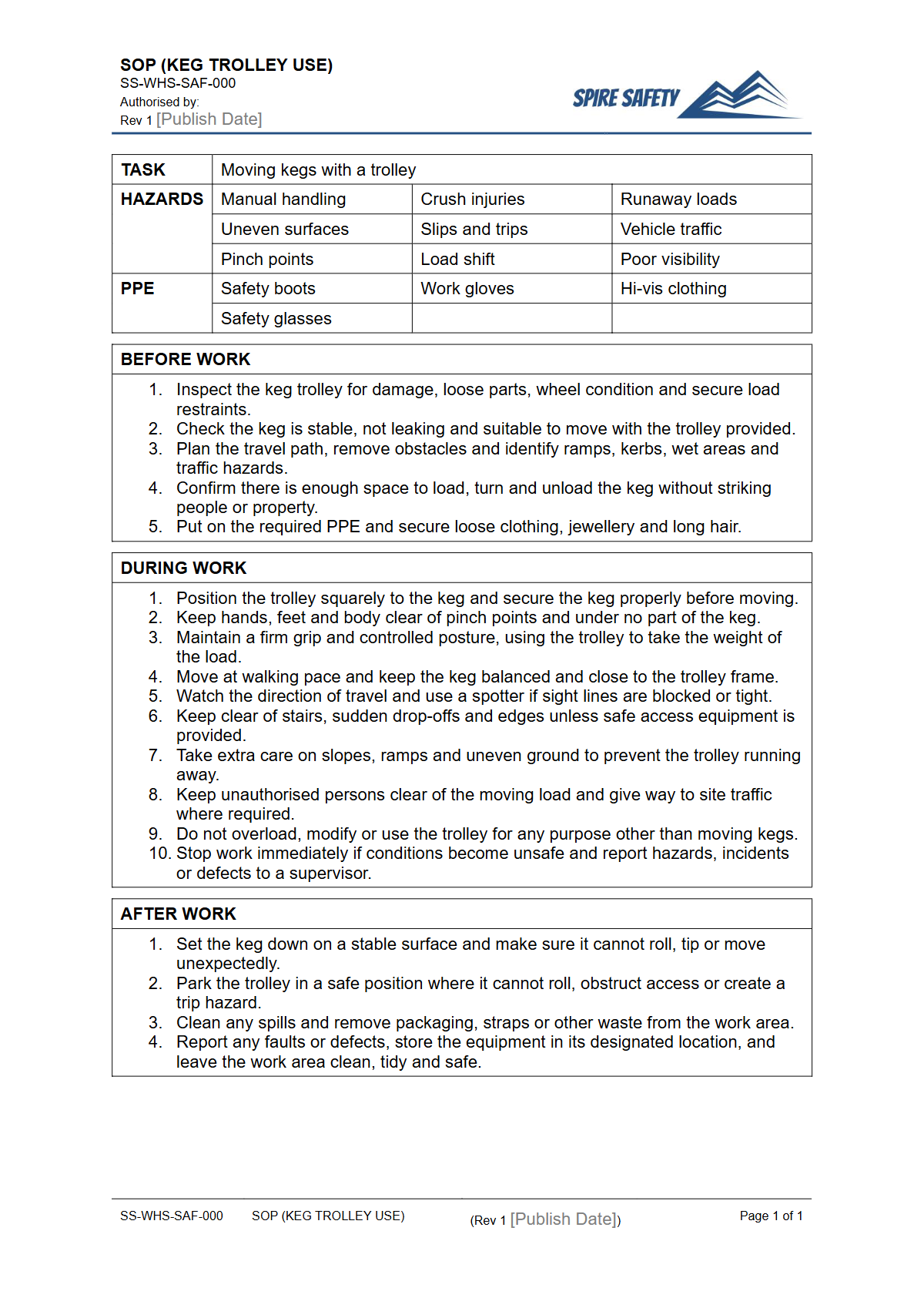
Free Safe Operating Procedure (Keg Trolley Use) Template
Download our free Safe Operating Procedure (Keg Trolley Use) template to formalise safe work practices. This customisable DOCX and PDF helps manage risks.
Free Safe Operating Procedure (Keg Trolley Use) Template
DOCX • 126 KB + PDF
Updated Oct 2026
No signup required
Purpose of the Free Safe Operating Procedure (Keg Trolley Use) Template
Moving kegs, whether in a cool room, cellar, or delivery area, presents significant manual handling risks. This free Safe Operating Procedure (Keg Trolley Use) template provides a structured starting point for documenting the required steps to safely operate keg trolleys in your workplace.
Its purpose is to minimise the risk of injury, particularly musculoskeletal disorders (MSDs), by establishing a clear, repeatable, and safe method for this common task. Formalising this process helps meet your duties as a PCBU, provides a clear training tool for workers, and promotes a consistent approach to safety across your organisation.
Video walkthrough
How to use the Free Safe Operating Procedure (Keg Trolley Use) Template
This document is a template and must be adapted to your specific operational needs. Download the DOCX or PDF and begin by reviewing each section.
You should consult with workers and supervisors who regularly perform the task. Customise the content to reflect the exact type of keg trolley you use, the typical keg sizes (e.g., 50L, 20L), the specific environmental conditions like flooring and ramps, and any other site-specific hazards.
For it to be an effective control measure, the final SOP must be a true reflection of the work being performed at your site. A generic procedure that doesn't match your reality will be ineffective.
Important Customisation Note
This template provides a foundation based on Australian WHS principles. However, compliance depends on how you complete and implement it.
To do this effectively, we recommend a competent person reviews and customises the document to reflect your specific equipment, environment, and processes. If you lack in-house expertise, engaging external WHS consulting services can provide the necessary guidance to ensure your procedures are robust and practical.
Key Hazards in Keg Trolley Use
Using a keg trolley might seem simple, but it involves several significant hazards that this SOP aims to control. The primary risk is musculoskeletal injury from pushing, pulling, and manoeuvring heavy, awkward loads.
A full 50-litre keg can weigh over 60 kilograms. Other hazards include slips, trips, and falls on wet or uneven surfaces, crush injuries to hands and feet if a keg is dropped or the trolley overturns, and collisions with people or structures in confined spaces like cool rooms and cellars.
This SOP is a critical administrative control for these risks, just as a Free Safe Operating Procedure (Deep Fryer - Standard Operation) template is for managing risks in a commercial kitchen.
When to Use the Safe Operating Procedure
A Safe Operating Procedure is not a document to be filed away and forgotten. It should be actively used as a key part of your safety management system.
Use the completed Keg Trolley SOP during worker inductions for new staff in hospitality or logistics roles. It should be the basis for task-specific training and regular refresher training.
It's also a valuable tool for pre-start meetings or toolbox talks to reinforce correct procedures. After any incident or near miss involving a keg trolley, the SOP should be reviewed as part of the investigation to determine if the procedure was followed and if it needs improvement.
Who Should Use It
This SOP is intended for any Person Conducting a Business or Undertaking (PCBU) where kegs are handled. This includes pubs, bars, restaurants, clubs, breweries, bottle shops, and event management companies.
Managers and supervisors are responsible for implementing the procedure, providing training, and ensuring it is followed. Workers who are required to move kegs are the primary end-users; they must be trained on the SOP and understand their responsibility to follow the procedure to protect themselves and others.
It is also relevant for other general plant that poses a manual handling or operational risk, similar to how a Free Air Compressor SOP (Safe Operating Procedure) Template would be used in a workshop setting.
Integrating the SOP into Your WHS System
A single SOP is a component of a much larger safety framework. To be truly effective, this procedure must be integrated into your overall WHS management systems. This means it should be referenced in your risk register, linked to your training records, and included in your internal audit schedule.
Regular reviews ensure the SOP remains current with any changes in equipment, environment, or regulations. Having a cohesive system ensures that safety controls are consistently applied and continuously improved, rather than existing as isolated documents.
For larger distribution centres, these principles also apply to more complex equipment like those covered in a Conveyer System SOP (Safe Operating Procedure) Template, demonstrating how procedures scale with complexity.
Review and Improvement
Continuous improvement is a core tenet of effective WHS management. Your Keg Trolley SOP should be scheduled for regular review, typically every 1-2 years, or more frequently if circumstances change.
A review is mandatory after an incident, when new or different types of trolleys or kegs are introduced, or if legislative changes occur. This process can be verified through a systematic check of your safety documents and practices, often as part of a formal WHS compliance auditing program, to ensure ongoing effectiveness and identify opportunities for improvement. For more templates and safety documents, you can browse our complete free WHS resources library.
Common mistakes
Common mistakes to avoid
- Using a generic template without customising it for your specific trolleys, keg sizes, and environment.
- Failing to adequately train workers on the finalised SOP and confirm their understanding.
- Not enforcing the procedure, allowing workers to revert to unsafe, ad-hoc methods.
- Neglecting to review and update the SOP after an incident or when workplace conditions change.
Legal references
Legal considerations
The following legal requirements may be relevant to this type of work.
- Work Health and Safety Act (Harmonised) — Provides the primary duties for protecting workers and other people from work health and safety risks.
- Work Health and Safety Regulations (Harmonised) — Sets out requirements supporting the management of workplace hazards and risks.
The following codes may be relevant to this type of work.
- Managing WHS Risks Code of Practice — Provides practical guidance on identifying hazards, assessing risks and applying effective controls.
- Work Health and Safety Consultation, Cooperation and Coordination Code of Practice — Provides practical guidance on consulting workers and coordinating with other duty holders.
- Managing the Work Environment and Facilities Code of Practice — Provides practical guidance on safe work environments, workplace facilities and related controls.
Did you know
Keg Weight
A standard 50-litre (13.2 gallon) keg of beer weighs approximately 61 kilograms when full, making it a significant manual handling hazard.
Manual Handling Statistics
According to Safe Work Australia, injuries resulting from manual handling are one of the most common causes of serious workers' compensation claims across the country.
FAQ
Frequently asked questions
01What is a Safe Operating Procedure for a keg trolley?
02Is using a keg trolley a high-risk activity?
03Who is responsible for creating and implementing this SOP?
04How often should we review our Keg Trolley SOP?
Share this resource
Free Safe Operating Procedure (Keg Trolley Use) Template
Browse Categories
How To Use It
- 1Download and open in Word or PDF.
- 2Replace the placeholders with your business details.
- 3Get it reviewed by a WHS specialist before rollout.
Need it customised?
Our WHS consultants can adapt this template to your site, run a gap analysis, or audit what you already have in place.
Book a Free Consultation WHS consulting servicesor call 1300 156 382
Related templates
- Free Safe Operating Procedure (Kennel Waste Cleanup) Template
- Free Safe Operating Procedure (Kerb Saw) Template
- Free Safe Operating Procedure (Kerbside Cleanup) Template
- Free Safe Operating Procedure (Key Safe Access) Template
- Free Safe Operating Procedure (Kitchen Bench Cleaning) Template
- Free Safe Operating Procedure (Kitchen Exhaust Clean) Template