
Free Safe Operating Procedure (Kerb Saw) Template
Develop a clear process for safely operating kerb saws with our structured template. Download your free Safe Operating Procedure (Kerb Saw) Template today.
Free Safe Operating Procedure (Kerb Saw) Template
DOCX • 126 KB + PDF
Updated Oct 2026
No signup required
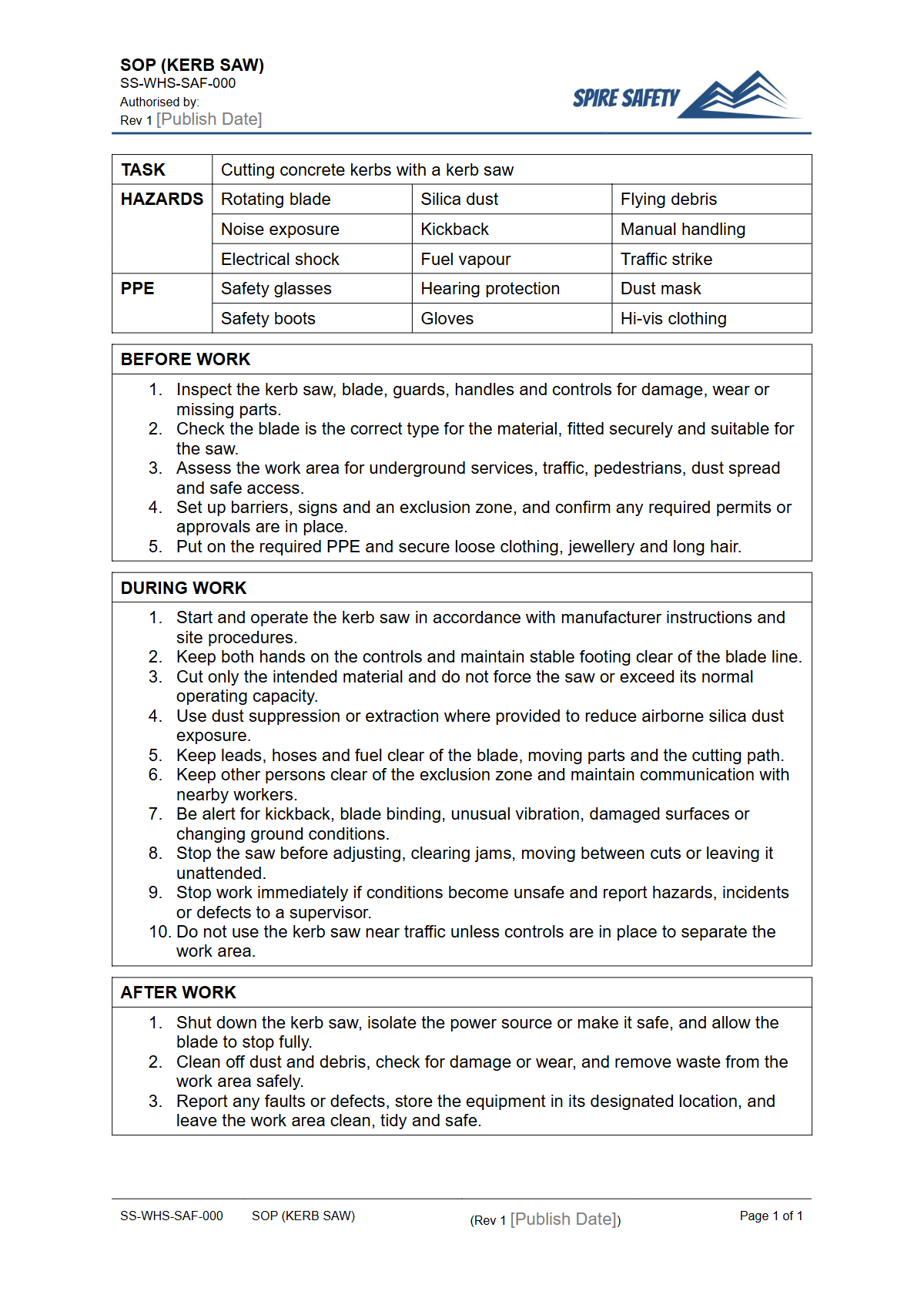
Purpose of the Free Safe Operating Procedure (Kerb Saw) Template
A kerb saw, also known as a concrete cut-off saw, is a powerful and effective tool for roadwork, construction, and landscaping. However, its operation introduces significant risks, including severe cuts, kickback, exposure to silica dust, and noise.
This Free Safe Operating Procedure (Kerb Saw) Template provides a structured starting point for documenting a safe system of work for your specific workplace. Using an SOP helps to standardise your process, ensure all critical safety steps are followed, and provide a clear reference for worker training and supervision.
Documenting your process ensures that every operator, regardless of experience level, follows a consistent, pre-approved method that addresses identified hazards. It forms a crucial part of your overall safety management, demonstrating due diligence in providing a safe working environment.
Similar to how you would define processes for other high-risk tools, such as with a Free Circular Saw SOP Template, a specific procedure for kerb saws is essential for managing unique operational risks.
Video walkthrough
How to use the Free Safe Operating Procedure (Kerb Saw) Template
Our template is provided in both DOCX and PDF formats for your convenience. The DOCX file is fully editable, allowing you to tailor it directly to your operational needs. To effectively implement this Safe Operating Procedure, follow these steps:
- Consultation: Engage with the workers who actually operate the kerb saws. Their hands-on experience is invaluable for identifying practical hazards and effective controls.
- Risk Assessment: Conduct a specific risk assessment for kerb saw operations in your work environment. Consider the types of materials being cut, the location (e.g., public spaces, uneven ground), and environmental factors like weather and lighting.
- Customisation: Populate the template with the specific details from your risk assessment. This includes the exact make and model of the saw, required Personal Protective Equipment (PPE), pre-start checks, step-by-step cutting instructions, and emergency shutdown procedures.
- Approval: Once customised, the SOP should be reviewed and approved by a competent person, such as a supervisor or WHS manager, before being issued for use.
Please note: This template is a starting point. We have developed it to be aligned with Australian WHS frameworks, but you must customise it to reflect the specific equipment, environment, and risks in your workplace.
A generic document is not sufficient for compliance or safety.
When to use a Kerb Saw SOP
A Safe Operating Procedure for a kerb saw should be a living document that is used actively within your organisation. It is not a set-and-forget tool. The SOP should be used:
- As a primary training document for new or inexperienced operators.
- For refresher training sessions with existing team members.
- As a reference guide for operators before they begin a task.
- During pre-start meetings or toolbox talks to review specific risks.
- As a benchmark document during performance reviews or workplace inspections.
The SOP should be formally reviewed and, if necessary, updated annually, after any incident or near-miss, or when a new model of kerb saw is introduced. Regular reviews are a key component of effective safety systems and are often a focus of any formal WHS compliance auditing.
Who should use this SOP
This document is designed for use by several key roles within a business to ensure a comprehensive approach to safety:
- Persons Conducting a Business or Undertaking (PCBUs): To meet their primary duty of care to provide and maintain safe systems of work.
- Managers and Supervisors: To train workers, enforce safe work practices, and conduct workplace inspections.
- WHS Professionals: To integrate the procedure into the broader WHS management systems and use it as part of risk management and incident investigation processes.
- Workers: To understand and follow the approved safe method for operating the kerb saw, ensuring their own safety and that of others around them.
For similar ground-working tasks, a comparable procedural document like a free Trencher SOP Template can provide a useful reference for structuring your safety documentation. Using consistent formats across different equipment helps improve familiarity and adherence. You can find more templates like this in our complete free WHS resources library.
Common mistakes
Common mistakes to avoid
- Using a dry cutting method without adequate dust suppression or extraction.
- Applying excessive force to the saw instead of letting the blade do the work.
- Operating the saw with a damaged, incorrect, or improperly fitted blade.
- Failing to inspect the work area for underground services before starting a cut.
Legal references
Legal considerations
The following legal requirements may be relevant to this type of work.
- Work Health and Safety Act (Harmonised) — Provides the primary duties for protecting workers and other people from work health and safety risks.
- Work Health and Safety Regulations (Harmonised) — Sets out requirements supporting the management of workplace hazards and risks.
The following codes may be relevant to this type of work.
- Managing WHS Risks Code of Practice — Provides practical guidance on identifying hazards, assessing risks and applying effective controls.
- Work Health and Safety Consultation, Cooperation and Coordination Code of Practice — Provides practical guidance on consulting workers and coordinating with other duty holders.
- Managing the Work Environment and Facilities Code of Practice — Provides practical guidance on safe work environments, workplace facilities and related controls.
Did you know
Silica Dust Risk
Cutting concrete kerbs generates respirable crystalline silica (RCS), a hazardous dust invisible to the naked eye. Inhaling RCS can lead to serious and fatal lung diseases like silicosis. Wet cutting methods are a primary engineering control to suppress the dust at its source.
Kickback Zone
Kickback is a sudden, violent reaction where the saw is thrown back towards the operator. It most often occurs when the upper quadrant of the blade's leading edge contacts a solid object or is pinched in the cut.
FAQ
Frequently asked questions
01What are the main hazards when using a kerb saw?
02Is an SOP legally required for a kerb saw in Australia?
03What PPE is required for operating a kerb saw?
04How often should a kerb saw SOP be reviewed?
Share this resource
Free Safe Operating Procedure (Kerb Saw) Template
Browse Categories
How To Use It
- 1Download and open in Word or PDF.
- 2Replace the placeholders with your business details.
- 3Get it reviewed by a WHS specialist before rollout.
Need it customised?
Our WHS consultants can adapt this template to your site, run a gap analysis, or audit what you already have in place.
Book a Free Consultation WHS consulting servicesor call 1300 156 382
Related templates
- Free Safe Operating Procedure (Kerbside Cleanup) Template
- Free Safe Operating Procedure (Key Safe Access) Template
- Free Safe Operating Procedure (Kitchen Bench Cleaning) Template
- Free Safe Operating Procedure (Kitchen Exhaust Clean) Template
- Free Safe Operating Procedure (Kitchen Floor Cleaning) Template
- Free Safe Operating Procedure (Kitchen Trolley Use) Template