
Free Safe Operating Procedure (Jump Starting Vehicles) Template
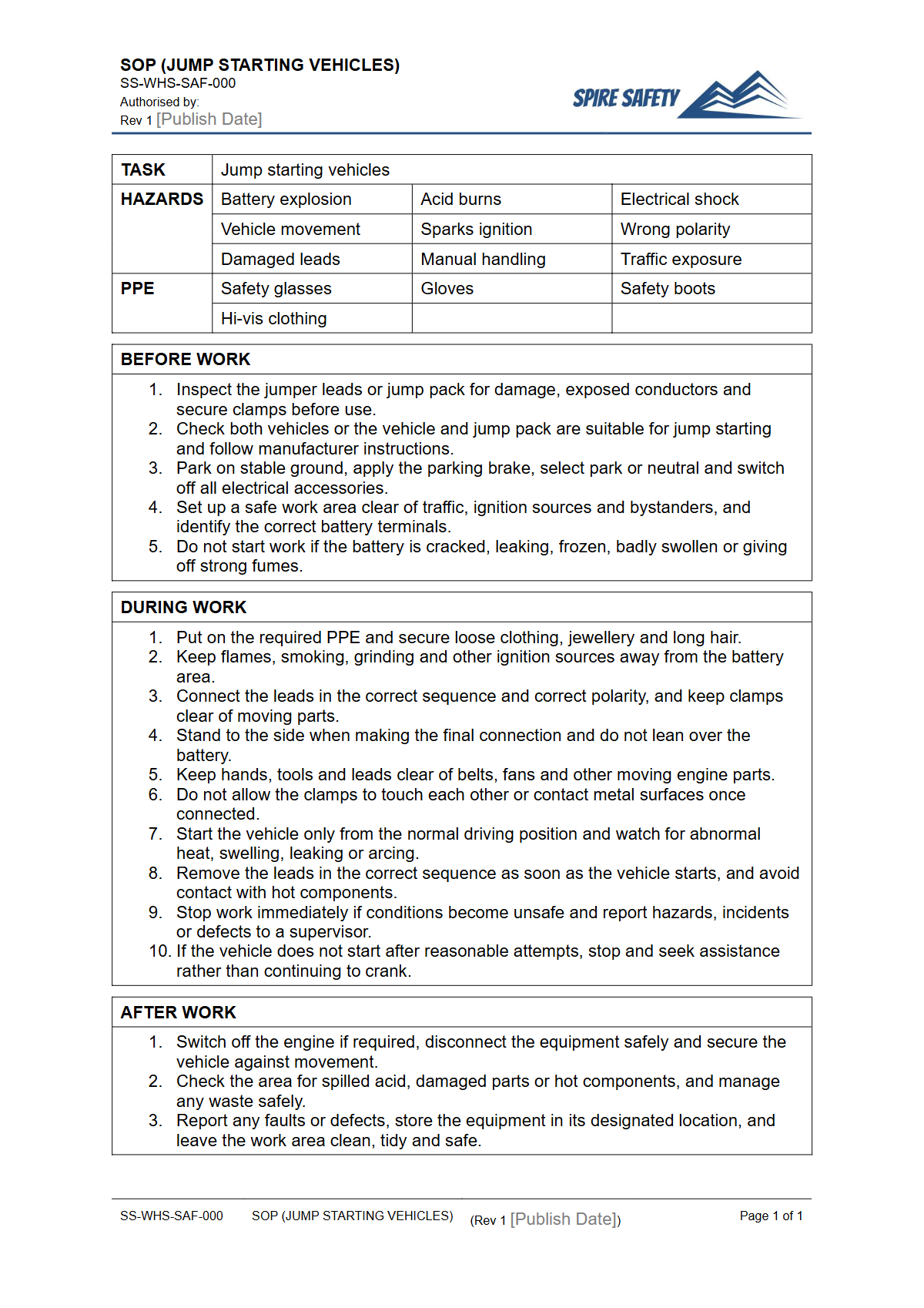
Download our Free Safe Operating Procedure (Jump Starting Vehicles) Template to formalise safety steps for this common but hazardous task. Get your DOCX now.
Free Safe Operating Procedure (Jump Starting Vehicles) Template
DOCX • 126 KB + PDF
Updated Oct 2026
No signup required
Purpose of the Free Safe Operating Procedure (Jump Starting Vehicles) Template
Jump starting a vehicle seems simple, but it carries significant risks, including electric shock, battery explosions, and damage to vehicle electronics. Implementing a formal Safe Operating Procedure (SOP) is a crucial step in managing these hazards.
Our Free Safe Operating Procedure (Jump Starting Vehicles) Template provides a structured framework for documenting the required steps, safety controls, and personal protective equipment (PPE) needed to perform this task safely and consistently across your organisation.
Using this template helps you standardise your process, ensuring every worker follows a tested and safe method. It serves as a key document for worker training, inductions, and competency assessments.
Documenting your procedures is a fundamental part of building and maintaining robust WHS management systems, demonstrating your commitment to providing a safe work environment.
Video walkthrough
How to use the Free Safe Operating Procedure (Jump Starting Vehicles) Template
This document is provided in a fully editable DOCX format, designed to be adapted to your specific workplace needs. After downloading, you must review and customise each section to align with your unique operational context.
This includes listing the specific types of vehicles and plant, battery types (e.g., lead-acid, AGM), jumper leads or booster packs used, and the environmental conditions at your site.
For example, the specific steps and safety checks for a light vehicle will differ from those required for heavy machinery, as detailed in our FREE Telehandler SOP Template. Your customisation should detail these differences clearly.
Please note: We have provided this template as a starting point. You must customise it to reflect the specific hazards, risks, and control measures relevant to your workplace. A generic procedure is not sufficient for ensuring safety or meeting your WHS obligations. It must be made site-specific.
When to use this Safe Operating Procedure
This Safe Operating Procedure should be readily available and referenced any time a worker needs to jump start a vehicle with a flat battery. This applies to a wide range of situations, including company cars in a car park, light commercial vans, heavy vehicles, or mobile plant on a worksite.
The SOP should be included in vehicle pre-start checklists or as part of a breakdown response kit. It is a proactive tool used to guide behaviour before and during the task, not just a document to be filed away. The principle of documenting safe procedures for plant applies broadly, as seen in resources like the FREE Grader SOP (Safe Operating Procedure) Template.
Who should use this Safe Operating Procedure
This SOP is intended for all personnel who may be required or authorised to jump start a vehicle as part of their work. This includes fleet vehicle operators, maintenance staff, workshop mechanics, mobile plant operators, and field service technicians.
Supervisors and managers should also be familiar with the procedure to ensure it is being followed correctly. Supervisors can use the completed SOP as a tool for training, inductions, and performance checks, which can be verified during a formal WHS compliance auditing process.
Ensuring that only trained and competent individuals perform the task is a critical control measure outlined within the procedure itself. Similar structured procedures are vital for all workplace equipment, including items covered in our Free Air Compressor SOP (Safe Operating Procedure) Template.
By customising and implementing this SOP, you create a clear and actionable safety resource for your team. You can find more templates to support your safety management system in our free WHS resources library, covering a wide range of tasks and equipment.
Common mistakes
Common mistakes to avoid
- Connecting the jumper leads in the wrong sequence, risking sparks and electrical damage.
- Allowing the metal clamps of the positive and negative leads to touch each other while connected to a battery.
- Attempting to jump start a frozen, cracked, or visibly leaking battery.
- Failing to wear appropriate personal protective equipment (PPE), especially safety glasses.
Legal references
Legal considerations
The following legal requirements may be relevant to this type of work.
- Work Health and Safety Act (Harmonised) — Provides the primary duties for protecting workers and other people from work health and safety risks.
- Work Health and Safety Regulations (Harmonised) — Sets out requirements supporting the management of workplace hazards and risks.
The following codes may be relevant to this type of work.
- Managing WHS Risks Code of Practice — Provides practical guidance on identifying hazards, assessing risks and applying effective controls.
- Work Health and Safety Consultation, Cooperation and Coordination Code of Practice — Provides practical guidance on consulting workers and coordinating with other duty holders.
- Managing the Work Environment and Facilities Code of Practice — Provides practical guidance on safe work environments, workplace facilities and related controls.
Did you know
Hydrogen Hazard
A standard lead-acid car battery can release explosive hydrogen gas while charging or discharging. A single spark from connecting a jumper lead incorrectly is enough to ignite this gas and cause a dangerous battery explosion.
Voltage Matters
Always ensure both vehicles have the same system voltage, which is typically 12V for cars and light vehicles. Accidentally connecting a 12V system to a 24V system (found in many trucks) can cause catastrophic damage to the 12V vehicle's electrical components.
FAQ
Frequently asked questions
01What personal protective equipment (PPE) is required for jump starting a vehicle?
02What is the correct order for connecting jumper leads?
03Why shouldn't you connect the final jumper lead to the dead battery's negative terminal?
04Can you jump start a modern car with sensitive electronics?
Share this resource
Free Safe Operating Procedure (Jump Starting Vehicles) Template
Browse Categories
How To Use It
- 1Download and open in Word or PDF.
- 2Replace the placeholders with your business details.
- 3Get it reviewed by a WHS specialist before rollout.
Need it customised?
Our WHS consultants can adapt this template to your site, run a gap analysis, or audit what you already have in place.
Book a Free Consultation WHS consulting servicesor call 1300 156 382
Related templates
- Free Safe Operating Procedure (Kayak Operation) Template
- Free Safe Operating Procedure (Keg Coupler Change) Template
- Free Safe Operating Procedure (Keg Handling) Template
- Free Safe Operating Procedure (Keg Trolley Use) Template
- Free Safe Operating Procedure (Kennel Waste Cleanup) Template
- Free Safe Operating Procedure (Kerb Saw) Template