
Free Safe Operating Procedure (Keg Coupler Change) Template
Download our free Safe Operating Procedure (Keg Coupler Change) template to standardise this common hospitality task. Customise the DOCX or PDF today.
Free Safe Operating Procedure (Keg Coupler Change) Template
DOCX • 126 KB + PDF
Updated Oct 2026
No signup required
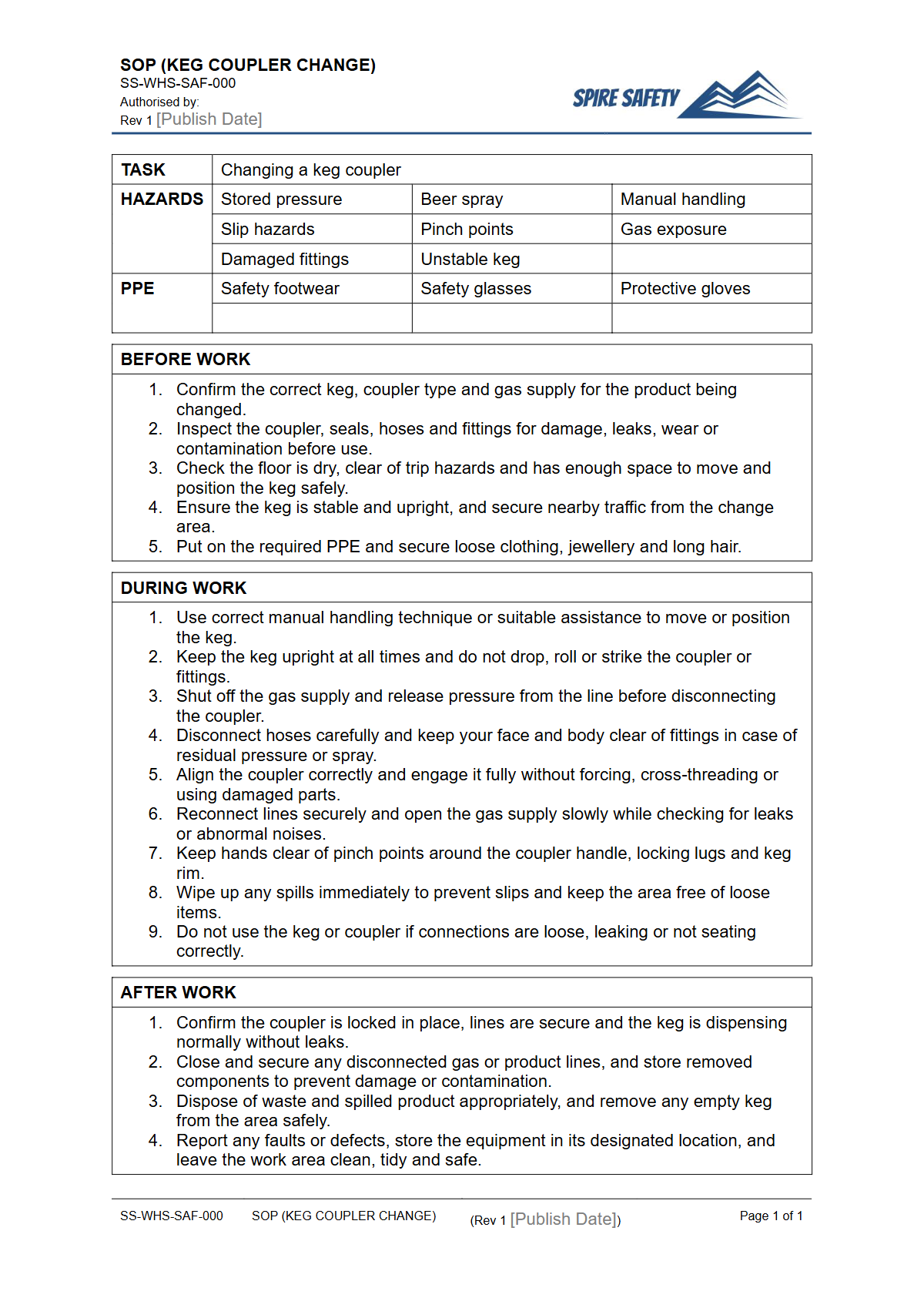
Purpose of the Free Safe Operating Procedure (Keg Coupler Change) Template
Changing a keg is a routine task in many hospitality venues, but it involves specific hazards that must be managed. This Free Safe Operating Procedure (Keg Coupler Change) Template provides a structured framework for documenting the safest way to perform this task.
It helps your organisation control risks associated with pressurised gas (CO2 or Nitrogen), hazardous manual tasks from lifting kegs, and potential slips from beer spillage. By implementing a clear SOP, you establish a consistent, safe method for all staff, reducing the likelihood of injury or equipment damage.
A documented procedure is a cornerstone of a proactive safety culture. It serves as a vital training tool and demonstrates a commitment to meeting Work Health and Safety (WHS) obligations.
Standardising this process is just as important as managing other common workplace equipment; for instance, a busy kitchen would use a Safe Operating Procedure for a deep fryer to manage risks like burns and fires. This template helps apply that same level of diligence to your beverage dispensing system.
Video walkthrough
How to use the Free Safe Operating Procedure (Keg Coupler Change) Template
This template is designed as a starting point. To make it effective, you must adapt it to the specific equipment, layout, and environment of your workplace.
Download the DOCX file and update the content to reflect your unique keg system, types of couplers, gas supply setup, and designated keg storage areas. Include details specific to your venue, such as the location of gas isolation valves and PPE storage.
We strongly recommend a Person Conducting a Business or Undertaking (PCBU) consults with workers who regularly perform the task. Their direct experience is invaluable for identifying practical steps and potential issues.
Once customised, the SOP should be integrated into your broader WHS management systems, used for training new staff, and made easily accessible to all relevant personnel, typically in the bar or cool room area.
A Note on Customisation
This document is a template and not a complete Safe Operating Procedure. It is essential that you customise it to reflect the specific hazards, equipment, and controls in your workplace.
We are not responsible for any incidents that may occur from the use of this template. Your final SOP should be reviewed and approved by a competent person within your organisation.
When to use it
A Safe Operating Procedure for changing a keg coupler should be used consistently as the standard for performing the task. It is particularly critical in several situations:
- Induction and Training: Use the SOP as the primary training document for new employees to ensure they learn the correct, safe method from day one.
- Refresher Training: Periodically review the SOP with experienced staff to reinforce safe practices and prevent complacency.
- After an Incident or Near-Miss: If an incident involving a keg change occurs, the SOP should be reviewed and updated as part of the investigation to prevent recurrence.
- Audits and Inspections: The SOP serves as evidence of a formalised safe system of work during internal or external safety audits. Checking for adherence should be part of any routine WHS compliance audit.
Who should use it
This procedure is intended for any worker tasked with changing kegs. This typically includes:
- Bar Staff and Cellar Workers: The primary users who perform the task daily.
- Supervisors and Venue Managers: Responsible for ensuring staff are trained on the SOP and follow it correctly. They also oversee its review and maintenance.
- WHS Representatives and Officers: Use the SOP as a benchmark for workplace inspections and risk assessments.
Developing and implementing robust SOPs can be complex. If you lack in-house expertise, seeking professional WHS consulting can help ensure your procedures are practical, effective, and aligned with industry best practice.
Similarly, other pressurised systems in a venue may benefit from a standardised procedure, such as documented steps in an Air Compressor SOP if one is used for line cleaning.
By clearly defining the process, you empower all workers with the knowledge to perform their duties safely and efficiently. You can find more templates like this one in our comprehensive free WHS resources library, covering a wide range of tasks and equipment.
Common mistakes
Common mistakes to avoid
- Forgetting to turn off the gas supply before disconnecting the coupler.
- Failing to engage the coupler handle fully, leading to a poor seal and gas leaks.
- Lifting kegs with improper manual handling techniques, causing back or shoulder strain.
- Not checking for gas and beer leaks with a leak detection solution or by listening after reconnecting.
Legal references
Legal considerations
The following legal requirements may be relevant to this type of work.
- Work Health and Safety Act (Harmonised) — Provides the primary duties for protecting workers and other people from work health and safety risks.
- Work Health and Safety Regulations (Harmonised) — Sets out requirements supporting the management of workplace hazards and risks.
The following codes may be relevant to this type of work.
- Managing WHS Risks Code of Practice — Provides practical guidance on identifying hazards, assessing risks and applying effective controls.
- Work Health and Safety Consultation, Cooperation and Coordination Code of Practice — Provides practical guidance on consulting workers and coordinating with other duty holders.
- Managing the Work Environment and Facilities Code of Practice — Provides practical guidance on safe work environments, workplace facilities and related controls.
Did you know
Not All Couplers Are Created Equal
There are several different types of keg couplers (e.g., A-type, D-type, S-type, G-type). Using the wrong coupler for a keg can damage the equipment and prevent a proper seal, leading to gas leaks and flat beer.
The Invisible Hazard
CO2 and Nitrogen, the gases used to dispense beer, are asphyxiants. A significant leak in a poorly ventilated cool room or cellar can displace oxygen and create a life-threatening atmosphere.
FAQ
Frequently asked questions
01What are the main hazards when changing a keg coupler?
02Does this SOP cover cleaning the beer lines?
03How often should staff be trained on changing a keg coupler?
04Is a Safe Operating Procedure a legal requirement in Australia for changing kegs?
Share this resource
Free Safe Operating Procedure (Keg Coupler Change) Template
Browse Categories
How To Use It
- 1Download and open in Word or PDF.
- 2Replace the placeholders with your business details.
- 3Get it reviewed by a WHS specialist before rollout.
Need it customised?
Our WHS consultants can adapt this template to your site, run a gap analysis, or audit what you already have in place.
Book a Free Consultation WHS consulting servicesor call 1300 156 382
Related templates
- Free Safe Operating Procedure (Keg Handling) Template
- Free Safe Operating Procedure (Keg Trolley Use) Template
- Free Safe Operating Procedure (Kennel Waste Cleanup) Template
- Free Safe Operating Procedure (Kerb Saw) Template
- Free Safe Operating Procedure (Kerbside Cleanup) Template
- Free Safe Operating Procedure (Key Safe Access) Template