
Free Safe Operating Procedure (Kayak Operation) Template
Standardise your water-based activities with our free Safe Operating Procedure for Kayak Operation. This template helps you outline critical safety steps.
Free Safe Operating Procedure (Kayak Operation) Template
DOCX • 126 KB + PDF
Updated Oct 2026
No signup required
Purpose of the Free Safe Operating Procedure (Kayak Operation) Template
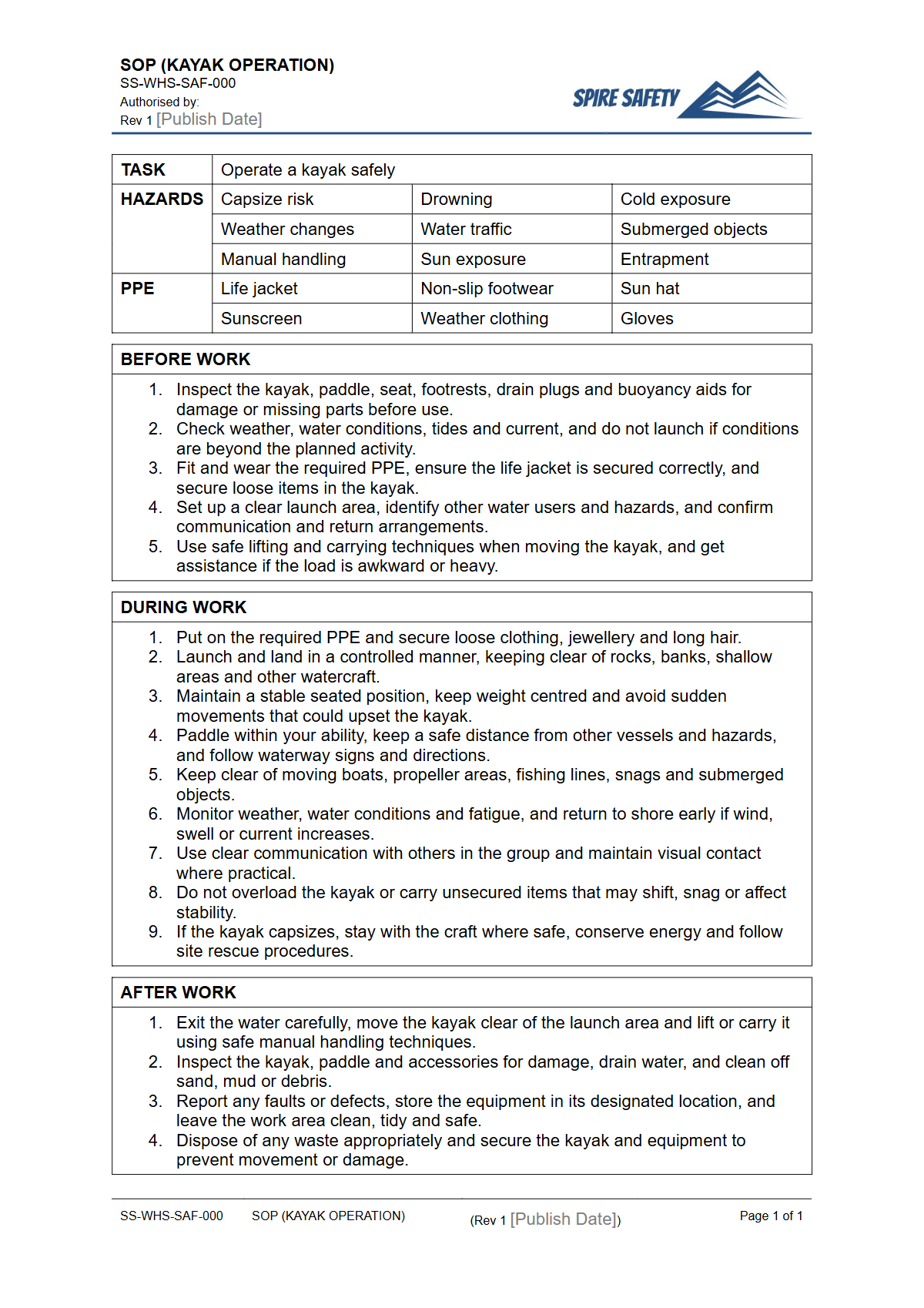
This Free Safe Operating Procedure (Kayak Operation) Template provides a comprehensive framework for businesses to document and standardise the safe use of kayaks for recreational and commercial activities. For tour operators, rental companies, and outdoor education providers, having a clear SOP is essential for managing health and safety risks.
It helps to ensure all workers and participants understand the potential hazards—such as drowning, capsizing, hypothermia, and environmental dangers—and the control measures in place to prevent incidents. A documented procedure promotes consistent safe behaviour and forms a critical component of your overall WHS management systems, demonstrating a commitment to workplace safety.
Video walkthrough
How to use the Free Safe Operating Procedure (Kayak Operation) Template
Download the template in your preferred format (DOCX for easy editing or PDF) and adapt it to your specific operational context. The document is structured based on Australian WHS principles and provides headings and prompts for you to complete.
It is crucial to remember that this is a template, not a finished document. We have provided a structured starting point, but you must customise it to reflect the specific kayak models you use, local water conditions, participant skill levels, and your organisation's emergency response plan.
If you require assistance in tailoring the document to your unique risks, consider engaging professional WHS consulting services.
Key Elements of a Kayak Operation SOP
A robust Safe Operating Procedure for kayaking should be detailed and easy to follow. Our template guides you through several critical sections to ensure comprehensive coverage of the task.
Pre-Operational Checks
Before any kayak enters the water, a series of checks is mandatory. This includes a thorough inspection of the kayak's hull for integrity, rudder or skeg functionality, and seat and hatch security.
All safety equipment must be checked, including personal flotation devices (PFDs), bailers, tow lines, and communication devices like waterproof radios or phones. Finally, the guide or supervisor must check the latest weather forecasts and assess the current water and tide conditions to ensure they are safe for the planned activity. The principle of pre-operational inspection is fundamental to workplace safety, applying just as much to outdoor equipment as it does to workshop tools covered in a FREE Circular Saw SOP.
Safe Operation
This section outlines the step-by-step process for conducting the activity safely. It should cover procedures for launching and landing, correct paddling techniques, maintaining group cohesion and safe distances between kayaks, and communication protocols to be used on the water.
It should also specify rules regarding interaction with wildlife, other vessels, and navigating specific local hazards like strong currents, submerged objects, or restricted areas.
Post-Operational Tasks
After the activity, procedures must be followed for safely returning to shore and managing equipment. This includes cleaning the kayaks and gear to prevent the spread of aquatic pests, conducting post-use inspections to identify any damage or wear, and reporting any issues for repair.
Proper storage of kayaks and associated equipment should also be detailed to prevent damage and ensure they are ready for the next use. The structure of a good SOP remains consistent, whether you are documenting outdoor activities or the use of heavy machinery detailed in our FREE Telehandler SOP.
Emergency Procedures
This is arguably the most critical part of the SOP. It must clearly define the actions to be taken in various emergency scenarios.
This includes procedures for a capsize (both self-rescue and assisted rescue), responding to a medical event, dealing with a lost or separated participant, and reacting to sudden adverse weather. It must list emergency contact details and specify the location and use of first aid and rescue equipment. Documenting emergency responses is a vital WHS practice, and the formal process is a shared best practice, whether for a kayak tour or for an industrial incident outlined in an Free Air Compressor SOP.
When to Use a Kayak Operation SOP
A Safe Operating Procedure for Kayak Operation should be used to plan and execute any work-related kayaking activity. It should be a core document for inducting and training new guides or staff.
It must also be readily accessible to all relevant personnel and reviewed before the start of each tour or rental session, particularly the sections concerning weather and environmental conditions. The SOP serves as a checklist and a guide to ensure no safety-critical step is missed.
Who Should Use It
This SOP is intended for use by Persons Conducting a Business or Undertaking (PCBUs) to fulfil their primary duty of care. Managers and supervisors are responsible for implementing the SOP, providing adequate training, and ensuring it is followed.
Workers, such as tour guides and rental staff, must understand and adhere to the procedures outlined in the document. Regular reviews of its effectiveness can be supported by formal safety assessments, such as WHS compliance auditing, to ensure it remains current and effective in controlling risks.
Common mistakes
Common mistakes to avoid
- Failing to check and document weather and water conditions before every trip.
- Using a generic SOP without customising it for specific locations, kayak models, and staff.
- Neglecting to regularly inspect Personal Flotation Devices (PFDs) and other safety gear for damage or expiry.
- Assuming all participants have the same skill and fitness level without a pre-activity briefing or assessment.
Legal references
Legal considerations
The following legal requirements may be relevant to this type of work.
- Work Health and Safety Act (Harmonised) — Provides the primary duties for protecting workers and other people from work health and safety risks.
- Work Health and Safety Regulations (Harmonised) — Sets out requirements supporting the management of workplace hazards and risks.
The following codes may be relevant to this type of work.
- Managing WHS Risks Code of Practice — Provides practical guidance on identifying hazards, assessing risks and applying effective controls.
- Work Health and Safety Consultation, Cooperation and Coordination Code of Practice — Provides practical guidance on consulting workers and coordinating with other duty holders.
- Managing the Work Environment and Facilities Code of Practice — Provides practical guidance on safe work environments, workplace facilities and related controls.
Did you know
PFD Importance
According to Royal Life Saving Australia, 40% of drowning deaths among adults involve drugs or alcohol, and a significant number of boating-related fatalities involve people not wearing a lifejacket. An SOP reinforces the mandatory use of PFDs.
The Buddy System
A fundamental risk control in water activities is the 'buddy system'. An SOP should always formalise this process, ensuring no one ever paddles alone and that procedures are in place for maintaining visual contact and performing regular headcounts.
FAQ
Frequently asked questions
01Is a Safe Operating Procedure legally required for kayak hire in Australia?
02What should be included in the emergency procedures section of a kayak SOP?
03How often should a kayak operation SOP be reviewed?
04Can this template be used for other small watercraft like canoes or stand-up paddleboards?
Share this resource
Free Safe Operating Procedure (Kayak Operation) Template
Browse Categories
How To Use It
- 1Download and open in Word or PDF.
- 2Replace the placeholders with your business details.
- 3Get it reviewed by a WHS specialist before rollout.
Need it customised?
Our WHS consultants can adapt this template to your site, run a gap analysis, or audit what you already have in place.
Book a Free Consultation WHS consulting servicesor call 1300 156 382
Related templates
- Free Safe Operating Procedure (Keg Coupler Change) Template
- Free Safe Operating Procedure (Keg Handling) Template
- Free Safe Operating Procedure (Keg Trolley Use) Template
- Free Safe Operating Procedure (Kennel Waste Cleanup) Template
- Free Safe Operating Procedure (Kerb Saw) Template
- Free Safe Operating Procedure (Kerbside Cleanup) Template