
Free Safe Operating Procedure (Jigsaw) Template
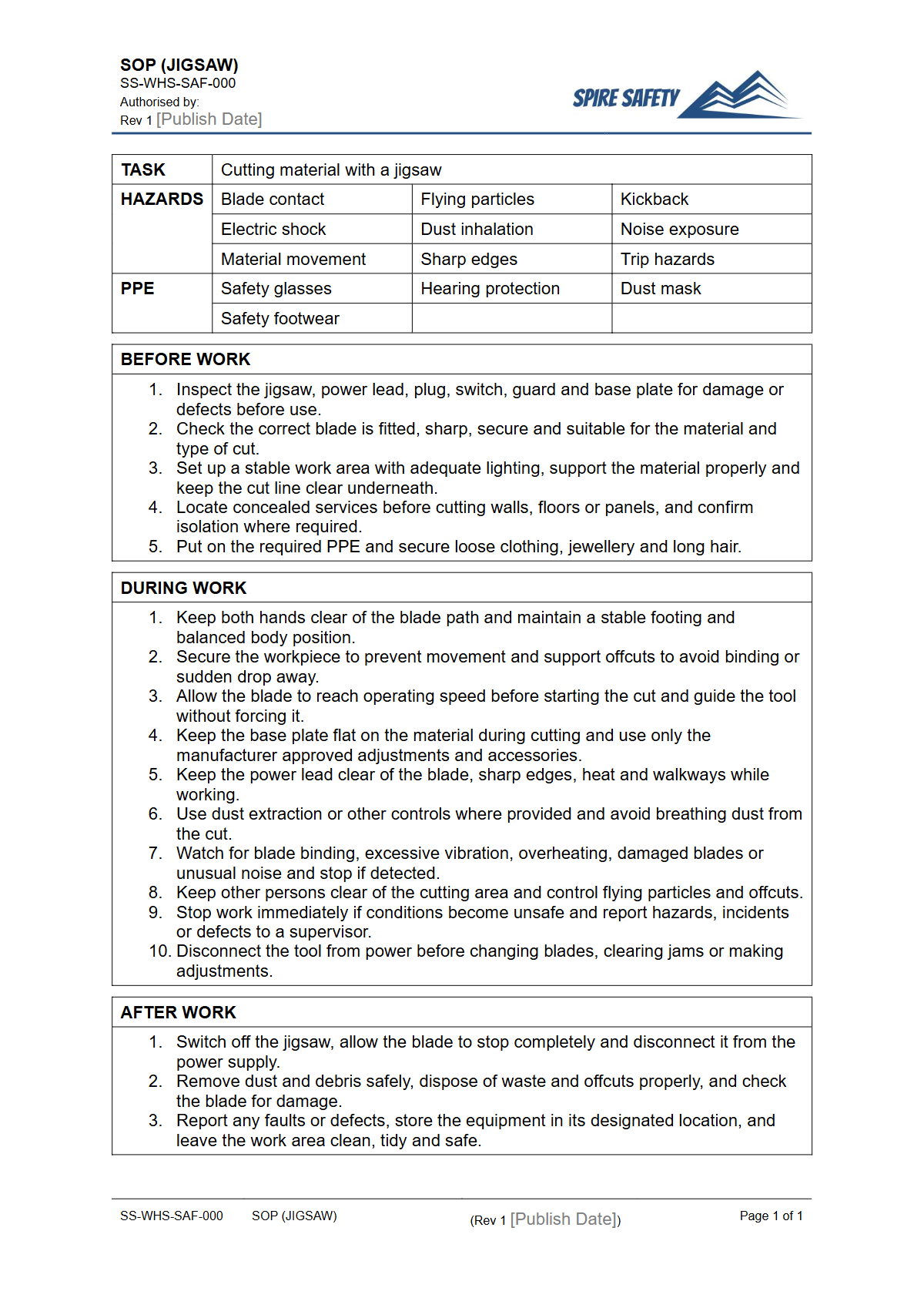
Standardise your workshop safety with our customisable jigsaw SOP. This template helps you document key risks and controls. Download your free DOCX today.
Free Safe Operating Procedure (Jigsaw) Template
DOCX • 126 KB + PDF
Updated Oct 2026
No signup required
Purpose of the Free Safe Operating Procedure (Jigsaw) Template
Using power tools like jigsaws introduces significant risks into the workplace, including cuts, lacerations, electric shock, and dust inhalation. This Free Safe Operating Procedure (Jigsaw) Template provides a structured framework to help your organisation document the safest way to perform tasks using this equipment.
A Safe Operating Procedure (SOP), also known as a Safe Work Procedure (SWP), is a fundamental administrative control measure that details step-by-step instructions for operating machinery safely. It formalises pre-start checks, operational steps, and shutdown procedures to minimise risk to operators and others.
The primary purpose of this template is to assist Persons Conducting a Business or Undertaking (PCBUs) in meeting their duty of care. By documenting hazards and control measures, you create a clear, auditable record of your risk management process.
Implementing robust SOPs is a critical component of developing effective and comprehensive WHS management systems, demonstrating a proactive approach to workplace safety and compliance.
Video walkthrough
How to use the Free Safe Operating Procedure (Jigsaw) Template
Our template, available in both DOCX and PDF formats, is designed for easy customisation. After downloading, you should adapt the document to suit the specific context of your workplace.
This involves identifying the unique hazards associated with your jigsaw models, the materials being cut, and the environment where the work is performed.
Follow these steps:
- Download: Choose the DOCX version for easy editing or the PDF for straightforward printing.
- Customise: Populate the template with site-specific information. This includes your company name, the specific make and model of the jigsaw, and details of the tasks it is used for.
- Consult: Involve your workers in the drafting process. They have hands-on experience and can provide invaluable insights into the practical risks and most effective controls.
- Approve: Have the final document reviewed and approved by a manager or safety officer.
- Train: Ensure all relevant workers are trained on the contents of the new SOP before they operate the jigsaw. Keep a record of this training.
IMPORTANT: This is a template only. We have provided a structured starting point aligned with Australian WHS principles, but you must customise it to reflect the specific equipment, tasks, and environment in your workplace.
Generic procedures are insufficient; a site-specific SOP is essential for effective risk management. For comparison, you can see how procedures differ for other tools by reviewing our free circular saw SOP.
When to use it
A jigsaw SOP should be a living document integrated into your daily operations. It is not a 'set and forget' tool. It should be used:
- As a primary training document for new employees, apprentices, or contractors before they are authorised to use a jigsaw.
- During routine safety talks or toolbox meetings to refresh workers' knowledge.
- As a reference guide for operators to consult before starting a non-routine or complex task.
- As part of the investigation process following an incident or near miss involving a jigsaw.
- During safety audits to verify that safe work practices are being followed on the floor. Regular WHS compliance auditing can help identify gaps between documented procedures and actual practice.
Who should use it
Safety is a shared responsibility, and different roles within an organisation will interact with the SOP in different ways:
- Workers/Operators: The primary users. They must understand and follow the SOP for every task involving the jigsaw to protect themselves and their colleagues.
- Supervisors and Managers: Responsible for ensuring workers are trained on the SOP and adhere to it. They must enforce the procedures and lead by example.
- Safety Officers/WHS Professionals: Responsible for developing, reviewing, and updating the SOP in consultation with workers. They ensure it remains current and aligned with regulations and best practice. Many workshops have multiple tool-specific procedures, such as an Air Compressor SOP, which WHS personnel must manage.
- PCBUs: Ultimately responsible for providing a safe system of work, which includes ensuring that effective SOPs are developed, implemented, and maintained across the organisation.
For organisations that require further assistance in developing a suite of documents tailored to their specific operational risks, engaging specialist WHS consulting services can provide expert guidance and support. You can also explore our extensive free WHS resources library for other useful templates.
Common mistakes
Common mistakes to avoid
- Using a generic template without customising it for your specific jigsaw model and work environment.
- Failing to consult with the workers who actually use the equipment during the drafting and review process.
- Treating the SOP as a document for compliance only, without providing practical training and supervision.
- Not scheduling regular reviews, leaving the procedure outdated and irrelevant to current practices.
Legal references
Legal considerations
The following legal requirements may be relevant to this type of work.
- Work Health and Safety Act (Harmonised) — Provides the primary duties for protecting workers and other people from work health and safety risks.
- Work Health and Safety Regulations (Harmonised) — Sets out requirements supporting the management of workplace hazards and risks.
The following codes may be relevant to this type of work.
- Managing WHS Risks Code of Practice — Provides practical guidance on identifying hazards, assessing risks and applying effective controls.
- Work Health and Safety Consultation, Cooperation and Coordination Code of Practice — Provides practical guidance on consulting workers and coordinating with other duty holders.
- Managing the Work Environment and Facilities Code of Practice — Provides practical guidance on safe work environments, workplace facilities and related controls.
Did you know
The Jigsaw's Origin
The jigsaw was invented in 1946 by Albert Kaufmann, an engineer at Scintilla AG in Switzerland. He replaced the needle in his wife's sewing machine with a blade, creating the prototype for the modern portable jigsaw.
FAQ
Frequently asked questions
01What must be included in a Safe Operating Procedure for a jigsaw?
02How often should a jigsaw SOP be reviewed?
03Is training required after creating a jigsaw SOP?
04Who is responsible for enforcing a jigsaw SOP at work?
Share this resource
Free Safe Operating Procedure (Jigsaw) Template
Browse Categories
How To Use It
- 1Download and open in Word or PDF.
- 2Replace the placeholders with your business details.
- 3Get it reviewed by a WHS specialist before rollout.
Need it customised?
Our WHS consultants can adapt this template to your site, run a gap analysis, or audit what you already have in place.
Book a Free Consultation WHS consulting servicesor call 1300 156 382
Related templates
- Free Safe Operating Procedure (Juice Extractor) Template
- Free Safe Operating Procedure (Jump Starting Vehicles) Template
- Free Safe Operating Procedure (Kayak Operation) Template
- Free Safe Operating Procedure (Keg Coupler Change) Template
- Free Safe Operating Procedure (Keg Handling) Template
- Free Safe Operating Procedure (Keg Trolley Use) Template