
Free Safe Operating Procedure (Juice Extractor) Template
Establish clear safety guidelines for operating a commercial juice extractor with our detailed template. Download your free Safe Operating Procedure today.
Free Safe Operating Procedure (Juice Extractor) Template
DOCX • 126 KB + PDF
Updated Oct 2026
No signup required
Purpose of the Free Safe Operating Procedure (Juice Extractor) Template
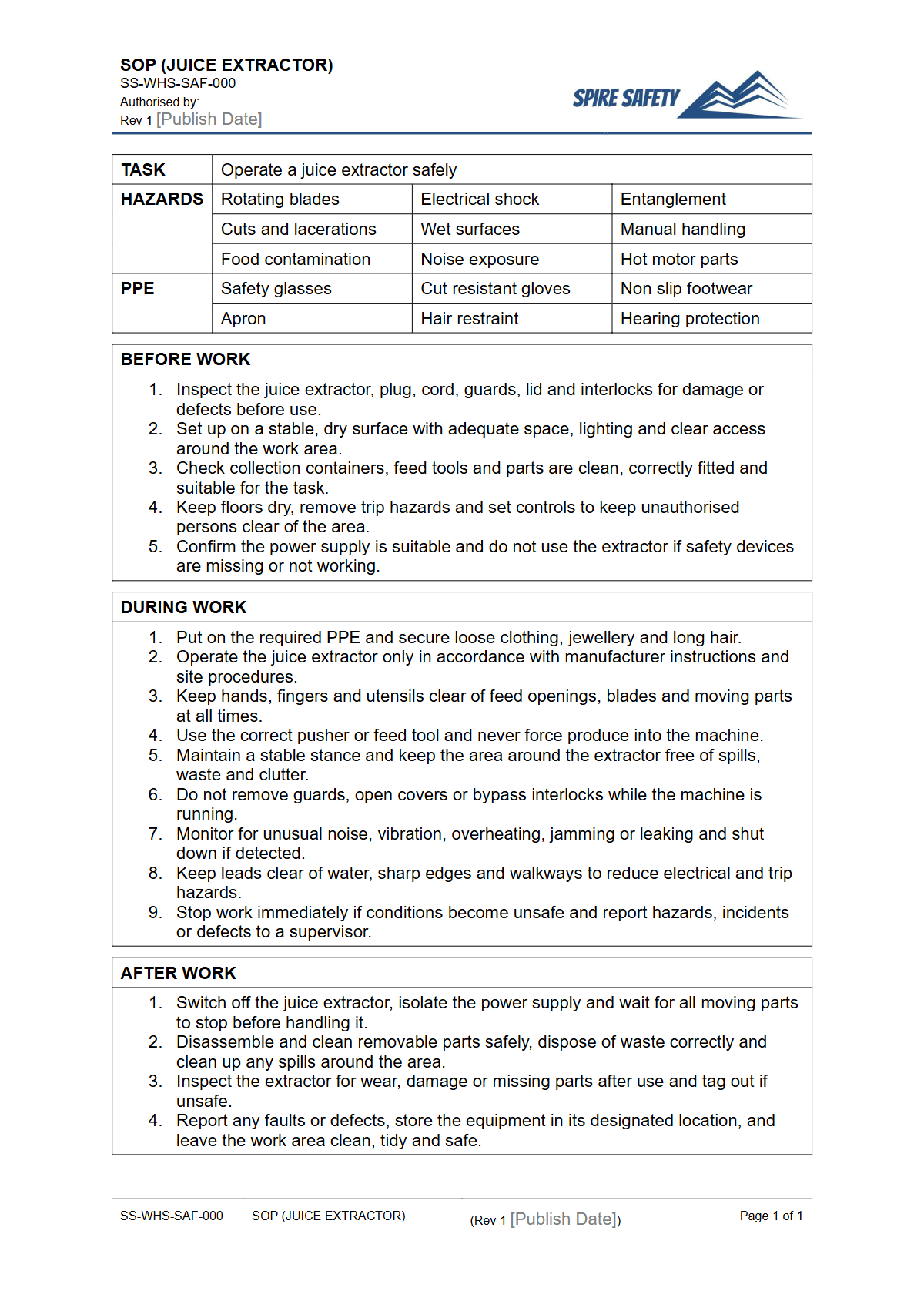
Operating a commercial juice extractor involves significant risks, including sharp blades, high-speed moving parts, and electrical hazards. This Free Safe Operating Procedure (Juice Extractor) Template provides a structured framework for documenting the safest way to perform this task.
A documented SOP is a critical administrative control measure that helps your organisation meet its primary duty of care under Australian WHS laws. It standardises your process, minimises operational risks, and forms an essential part of worker training and induction.
By clearly outlining pre-operational checks, step-by-step operating instructions, and cleaning procedures, this template helps prevent injuries like cuts, amputations, and electric shock. It also addresses associated hazards such as slips and falls from spills, ensuring a comprehensive approach to safety.
Similar to other high-risk kitchen equipment, a documented process is essential; for instance, you might also require a Free Safe Operating Procedure (Deep Fryer) Template for other tasks in your kitchen.
Video walkthrough
How to use the Free Safe Operating Procedure (Juice Extractor) Template
This resource is available as a fully editable DOCX file and a print-ready PDF. The DOCX version is designed for easy customisation, allowing you to add your company branding and modify the content to suit your specific needs.
The template includes sections for identifying responsibilities, listing required Personal Protective Equipment (PPE), detailing emergency procedures, and outlining the sequential steps for safe use, cleaning, and maintenance.
It is crucial to remember that this document is a template, not a finished procedure. You must customise it to reflect the specific juice extractor models, workplace environment, and established processes in your business.
We recommend conducting a risk assessment and involving the workers who operate the equipment in a consultation process to ensure the final SOP is practical and effective. Integrating this SOP into your broader WHS management systems ensures a consistent and systematic approach to safety across all operations.
Customisation Steps:
- Review and Edit: Go through each section and adapt the content to match your machine's make and model.
- Add Site-Specific Details: Include details about your specific work area, such as the location of emergency stops and first aid kits.
- Consult with Workers: Involve your team to get their feedback. They often have valuable insights into the practical realities of the task.
- Train All Users: Once finalised, use the SOP as a basis for training all relevant employees. Ensure they sign off to acknowledge they have read and understood the procedure.
When to use a Juice Extractor Safe Operating Procedure
A Safe Operating Procedure for a juice extractor should be a living document, actively used within your daily operations. It is not a document to be filed away and forgotten.
It should be readily accessible to all operators near the equipment's location.
Key times to use the SOP include:
- New Worker Induction: As a core part of training new staff before they are permitted to operate the machine.
- Refresher Training: For periodic training sessions to reinforce safe work habits and introduce any procedural updates.
- Pre-Start Checks: As a daily checklist to ensure the machine is safe to use before operation begins.
- Incident Investigation: As a reference point to determine if procedural breaches contributed to an accident or near-miss.
In larger food processing settings where juice extractors are part of an automated line, you may also need a FREE Conveyer System SOP to manage associated risks.
Who should use this SOP
This Safe Operating Procedure template is intended for use by anyone responsible for health and safety in a commercial food preparation environment. This includes:
- Persons Conducting a Business or Undertaking (PCBUs): Business owners, directors, and managers who hold the primary duty of care for worker safety.
- Health and Safety Representatives (HSRs): As a tool to consult with management and workers on improving safety standards.
- Supervisors and Team Leaders: To train workers and monitor compliance with safe work practices.
- Workers: The end-users who must follow the procedure to ensure their own safety and the safety of others.
Regular checks are vital to confirm staff are following the SOP correctly, often forming a key part of internal or external WHS compliance auditing. If you need assistance tailoring this document or developing a wider safety framework, our WHS consulting services can provide expert guidance. For more templates to manage workplace safety, explore our complete free WHS resources library.
Common mistakes
Common mistakes to avoid
- Bypassing safety interlocks or guards to speed up operation.
- Using incorrect tools (like fingers or knives) to push produce into the chute instead of the provided plunger.
- Failing to properly de-energise and lock out the machine before cleaning or clearing a blockage.
- Neglecting to clean up spills promptly, creating slip and fall hazards for everyone in the area.
Legal references
Legal considerations
The following legal requirements may be relevant to this type of work.
- Work Health and Safety Act (Harmonised) — Provides the primary duties for protecting workers and other people from work health and safety risks.
- Work Health and Safety Regulations (Harmonised) — Sets out requirements supporting the management of workplace hazards and risks.
The following codes may be relevant to this type of work.
- Managing WHS Risks Code of Practice — Provides practical guidance on identifying hazards, assessing risks and applying effective controls.
- Work Health and Safety Consultation, Cooperation and Coordination Code of Practice — Provides practical guidance on consulting workers and coordinating with other duty holders.
- Managing the Work Environment and Facilities Code of Practice — Provides practical guidance on safe work environments, workplace facilities and related controls.
Did you know
Blade Speed
The blades in some commercial centrifugal juice extractors can spin at over 10,000 RPM, posing a significant amputation risk if safety guards are bypassed or faulty.
Cleaning is a High-Risk Task
A significant number of injuries involving food processing equipment occur during cleaning and maintenance when machines are not properly isolated from their energy source (locked out).
FAQ
Frequently asked questions
01What are the main hazards of a commercial juice extractor?
02How often should a Safe Operating Procedure for a juice extractor be reviewed?
03Is training on the SOP a legal requirement in Australia?
04Can I use this template for my blender or other kitchen appliances?
Share this resource
Free Safe Operating Procedure (Juice Extractor) Template
Browse Categories
How To Use It
- 1Download and open in Word or PDF.
- 2Replace the placeholders with your business details.
- 3Get it reviewed by a WHS specialist before rollout.
Need it customised?
Our WHS consultants can adapt this template to your site, run a gap analysis, or audit what you already have in place.
Book a Free Consultation WHS consulting servicesor call 1300 156 382
Related templates
- Free Safe Operating Procedure (Jump Starting Vehicles) Template
- Free Safe Operating Procedure (Kayak Operation) Template
- Free Safe Operating Procedure (Keg Coupler Change) Template
- Free Safe Operating Procedure (Keg Handling) Template
- Free Safe Operating Procedure (Keg Trolley Use) Template
- Free Safe Operating Procedure (Kennel Waste Cleanup) Template