
Free Safe Operating Procedure (Jet Bridge Cleaning) Template
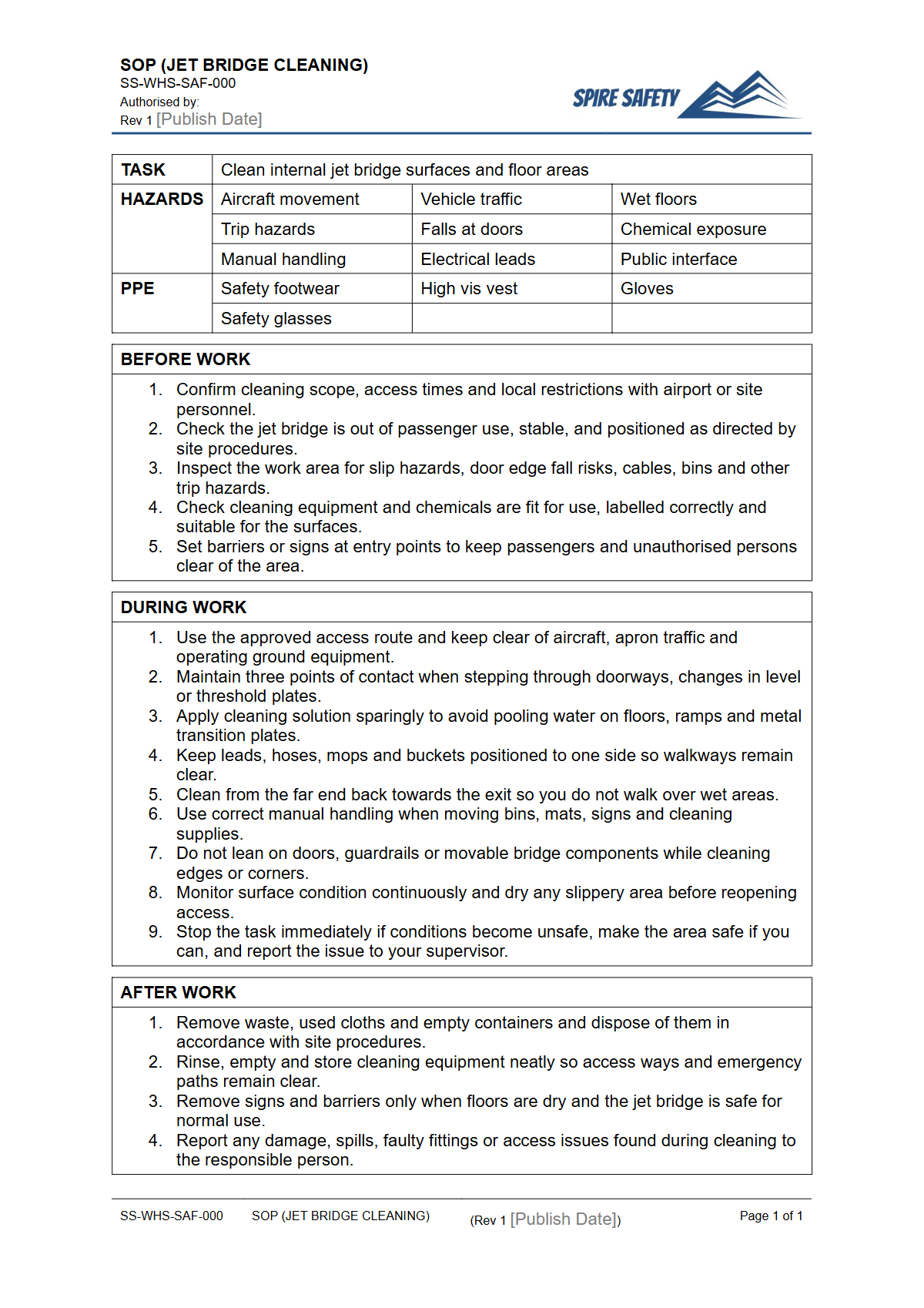
Establish clear, safe work methods for cleaning aviation jet bridges. Download our free Safe Operating Procedure (Jet Bridge Cleaning) template to get started.
Free Safe Operating Procedure (Jet Bridge Cleaning) Template
DOCX • 126 KB + PDF
Updated Oct 2026
No signup required
Purpose of the Free Safe Operating Procedure (Jet Bridge Cleaning) Template
Cleaning aviation jet bridges, also known as aerobridges or passenger boarding bridges, is a specialised task with significant safety risks. This free Safe Operating Procedure (Jet Bridge Cleaning) template provides a structured framework for outlining the required steps to perform the job safely.
It helps organisations document control measures for hazards such as falls from height, slips and trips, exposure to cleaning chemicals, electrical hazards, and interaction with moving equipment and aircraft. A documented SOP is a critical tool for training, operational consistency, and demonstrating a commitment to workplace health and safety.
Using a standardised procedure ensures that every worker follows the same approved, safety-vetted process, reducing the likelihood of incidents and injuries in the high-risk airport environment. This document assists in fulfilling a PCBU's (Person Conducting a Business or Undertaking) primary duty of care by providing a safe system of work.
It formalises pre-start checks, the cleaning process itself, and post-task clean-up, ensuring no critical safety steps are missed.
Video walkthrough
How to Use the Free Safe Operating Procedure (Jet Bridge Cleaning) Template
This Safe Operating Procedure template for jet bridge cleaning is a starting point designed for customisation. After downloading the DOCX or PDF file, you must adapt it to the specific context of your airport, including the types of jet bridges used, the cleaning agents approved, and the unique layout of your aprons and gates.
Effective SOPs are not generic; they are practical, site-specific documents that reflect the real-world operational environment.
To implement this template effectively, begin by conducting a thorough risk assessment for the task in consultation with the workers who will be performing it. Their direct experience is invaluable for identifying practical hazards and effective controls.
Populate the template with these details, including required Personal Protective Equipment (PPE), emergency procedures, and communication protocols with ground control or operations. An SOP should be a core component of your broader WHS management systems.
Important Note on Customisation
This document is a template only. We have provided it as a starting point, but it is your responsibility to ensure it is adapted to your specific machinery, equipment, site, and operational context.
You must consult with your team and other relevant stakeholders to ensure the final Safe Operating Procedure is comprehensive and accurately reflects the risks and control measures for your workplace.
When to Use This Safe Operating Procedure
A Safe Operating Procedure for jet bridge cleaning should be a living document, integrated into daily operations. It is used as a primary training tool for new ground crew or cleaning staff to ensure they understand the approved method before ever starting the task.
It should also be readily available at the worksite as a reference for workers and supervisors to confirm correct procedure, especially for non-routine aspects of the job.
The SOP must be reviewed regularly—at least annually, or whenever there is a change in equipment, chemicals, or work environment. It is also critical to review and, if necessary, update the SOP following any incident, near miss, or safety observation to incorporate learnings and prevent recurrence. Regular reviews are a key part of maintaining safety standards and can be verified through WHS compliance auditing.
Who Should Use It
This SOP template is intended for use by a range of personnel within the aviation and airport services industries. WHS Managers and Safety Officers can use it to establish a baseline for safe work systems.
Operations Managers and Cleaning Supervisors are responsible for implementing the SOP, using it for training, and ensuring their teams adhere to it. The ground crew and cleaning operators who perform the task are the end-users; the document must be written in clear, simple language they can easily understand and follow.
Developing this procedure should be a collaborative effort. Involving multiple stakeholders ensures the final document is both technically sound and practical for on-the-ground application. While a jet bridge is a unique piece of equipment, the principles of documenting safe procedures apply to other airport machinery; for instance, many airports also use specialised mechanical systems for baggage handling, which would require their own specific procedure, similar in structure to our FREE Conveyer System SOP (Safe Operating Procedure) Template.
Integrating with Other Safety Documents
An SOP does not exist in isolation. It should be supported by and cross-referenced with other key safety documents, such as a overarching risk register, chemical safety data sheets (SDS) for cleaning agents, and training records.
For particularly complex or non-routine cleaning challenges, you may need expert advice to ensure all risks are managed, which is where external WHS consulting services can provide significant value. If high-pressure water or air is used in the cleaning process, you should also develop specific procedures for that equipment, using resources like a Free Air Compressor SOP (Safe Operating Procedure) Template as a guide.
By properly documenting and implementing this procedure, your organisation can significantly reduce risk and build a stronger safety culture. For more templates and safety guides, explore our complete free WHS resources library.
Common mistakes
Common mistakes to avoid
- Failing to establish and communicate an exclusion zone around the work area to prevent collisions with other ground vehicles.
- Using incompatible or unapproved cleaning chemicals that can damage the jet bridge's surfaces or create respiratory hazards.
- Inadequate pre-start checks of fall arrest equipment, leading to equipment failure when needed most.
- Not coordinating with air traffic or gate control, leading to unexpected aircraft movement or bridge repositioning during cleaning.
Legal references
Legal considerations
The following legal requirements may be relevant to this type of work.
- Work Health and Safety Act (Harmonised) — Provides the primary duties for protecting workers and other people from work health and safety risks.
- Work Health and Safety Regulations (Harmonised) — Sets out requirements supporting the management of workplace hazards and risks.
The following codes may be relevant to this type of work.
- Managing WHS Risks Code of Practice — Provides practical guidance on identifying hazards, assessing risks and applying effective controls.
- Work Health and Safety Consultation, Cooperation and Coordination Code of Practice — Provides practical guidance on consulting workers and coordinating with other duty holders.
- Managing the Work Environment and Facilities Code of Practice — Provides practical guidance on safe work environments, workplace facilities and related controls.
Did you know
Complex Machinery
A modern passenger jet bridge is a complex piece of electromechanical equipment that can weigh over 20 tonnes and have more than 30 axes of motion to align perfectly with different aircraft doors.
Ramp Incidents
Slips, trips, and falls are among the most common causes of injury for airport ground staff. Contaminants like cleaning fluids, oils, and water significantly increase this risk on the apron and in operational areas.
FAQ
Frequently asked questions
01What are the key hazards to consider when cleaning a jet bridge?
02How often should a jet bridge cleaning SOP be reviewed?
03Is specific training required to clean a jet bridge?
04Can this template be used for cleaning other airport ground support equipment?
Share this resource
Free Safe Operating Procedure (Jet Bridge Cleaning) Template
Browse Categories
How To Use It
- 1Download and open in Word or PDF.
- 2Replace the placeholders with your business details.
- 3Get it reviewed by a WHS specialist before rollout.
Need it customised?
Our WHS consultants can adapt this template to your site, run a gap analysis, or audit what you already have in place.
Book a Free Consultation WHS consulting servicesor call 1300 156 382
Related templates
- Free Safe Operating Procedure (Jet Ski Operation) Template
- Free Safe Operating Procedure (Jib Crane) Template
- Free Safe Operating Procedure (Jigsaw) Template
- Free Safe Operating Procedure (Juice Extractor) Template
- Free Safe Operating Procedure (Jump Starting Vehicles) Template
- Free Safe Operating Procedure (Kayak Operation) Template