
Free Safe Operating Procedure (Jaw Crusher Clearing) Template
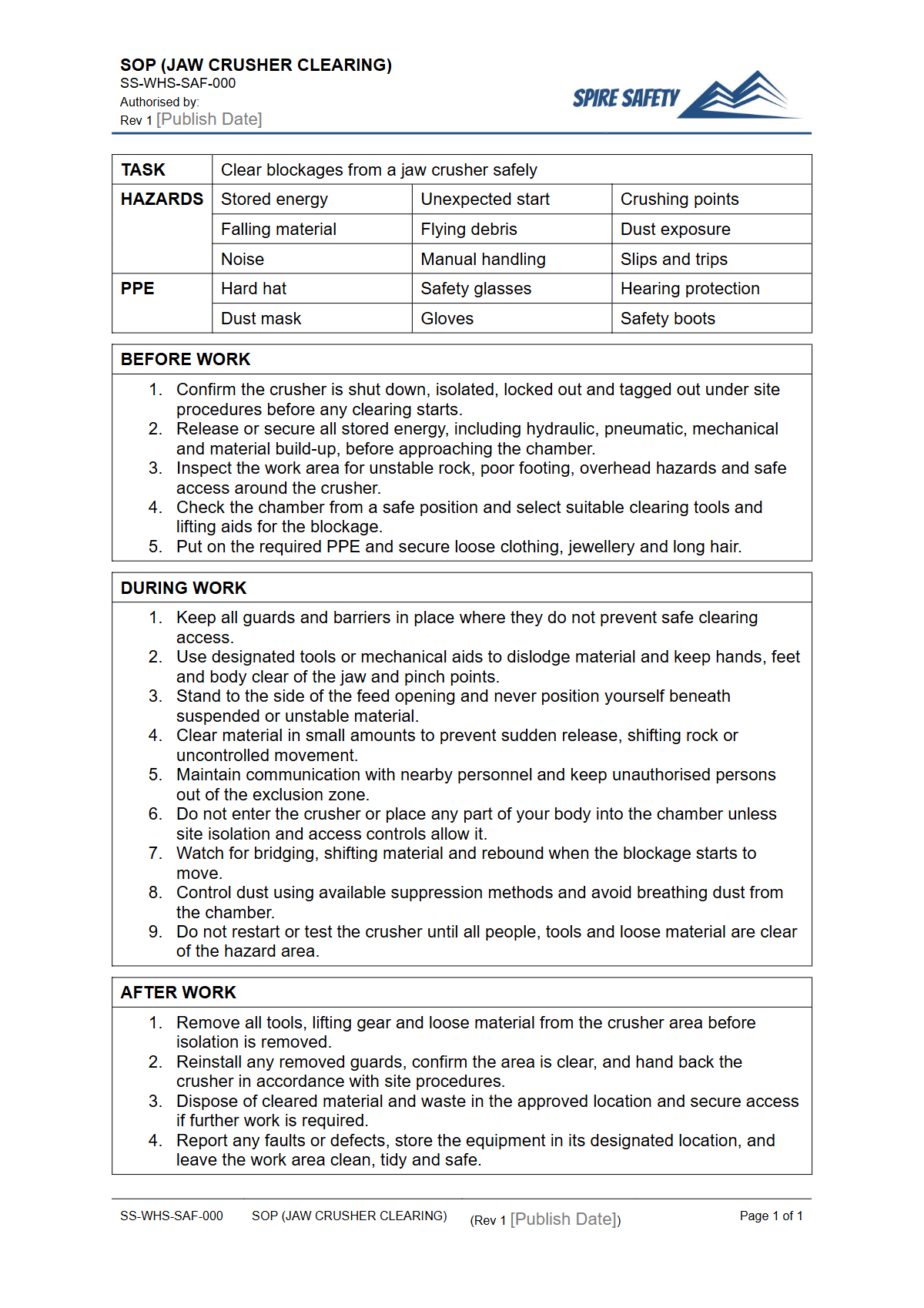
Safely manage the risks of clearing a blocked jaw crusher with our structured Safe Operating Procedure template. Download your free DOCX and PDF to begin.
Free Safe Operating Procedure (Jaw Crusher Clearing) Template
DOCX • 126 KB + PDF
Updated Oct 2026
No signup required
Purpose of the Free Safe Operating Procedure (Jaw Crusher Clearing) Template
Clearing a blocked jaw crusher is a high-risk activity that exposes workers to severe hazards, including stored energy release, entanglement, and crushing injuries. This Free Safe Operating Procedure (Jaw Crusher Clearing) Template provides a structured framework to help your organisation document a safe, standardised process for this specific task.
Using a formal SOP ensures that every step, from energy isolation to final checks, is clearly defined and consistently followed, significantly reducing the risk of incidents. It is an essential tool for any business operating heavy plant in the quarrying, mining, demolition, or recycling industries.
A documented SOP is a critical component of a hazard management strategy. It serves as a practical tool for training workers, a reference for supervisors, and evidence of your commitment to managing risks.
Integrating specific procedures like this one into your broader safety framework is fundamental to building robust comprehensive WHS management systems that protect your people and support your operational goals.
Video walkthrough
How to use the Free Safe Operating Procedure (Jaw Crusher Clearing) Template
This template is provided in both DOCX and PDF formats for your convenience. The DOCX file is fully editable, allowing you to adapt the content to the specific models of jaw crushers used at your site, your unique operational context, and your existing safety protocols.
It is essential to conduct a site-specific risk assessment and incorporate its findings into the final document.
Important: This document is a template, not a finished procedure. You must customise it to reflect the actual equipment, personnel, and risks present in your workplace.
We have provided a solid foundation based on Australian WHS principles, but you are responsible for ensuring the final SOP is accurate and effective for your specific circumstances. Regular reviews and updates are also a key part of the process. An effective way to verify that your customised procedures are being implemented correctly on-site is through periodic WHS compliance auditing.
When to use this Safe Operating Procedure
This Safe Operating Procedure should be used exclusively for the task of clearing a blockage or jam from a jaw crusher that has halted normal operation. It is not intended for routine operation, standard maintenance, or pre-start checks.
The procedure should be initiated by a competent operator or supervisor as soon as a blockage is identified that cannot be cleared through non-invasive operational adjustments. It is particularly critical for situations where any part of a person, or a tool held by a person, may need to approach the crushing chamber.
The SOP should be readily available near the equipment for immediate reference. Jaw crushers are often part of a larger processing line, and procedures for associated equipment like a conveyor system SOP should also be in place.
Who should use it
This SOP is intended for use by multiple roles within an organisation:
- Competent Plant Operators: The primary users who will follow the procedure to safely clear the blockage. They must be trained on this specific SOP and deemed competent in the task.
- Maintenance Personnel: May be required to assist or lead the clearing process, especially if it involves complex isolation or minor disassembly.
- Supervisors and Managers: Responsible for ensuring the SOP is implemented correctly, workers are trained, and all necessary permits (like isolation or confined space entry) are completed.
- WHS Professionals: Use the template to develop and formalise the site-specific procedure as part of the overall safety management system.
All personnel involved must be trained and authorised. Competency for operating associated plant is also vital, and our Scraper SOP template provides a similar framework for other common equipment.
Ensuring operators are trained on a range of machinery, from crushers to loaders, is key to site safety.
The process of clearing a crusher may also require the use of other plant, such as a crane or telehandler, to lift components or tools. Anyone operating this auxiliary equipment must also be competent and follow the relevant Telehandler SOP for that machinery.
Spire Safety offers a wide range of templates for various plant and equipment in our free WHS resources library to support your safety documentation needs.
Common mistakes
Common mistakes to avoid
- Failing to isolate all energy sources, including electrical, hydraulic, pneumatic, and gravitational potential energy.
- Attempting to clear the blockage by reaching into the crushing chamber without using appropriate, purpose-built tools.
- Working alone or without a competent spotter who can monitor the task and raise the alarm if needed.
- Neglecting to re-install all safety guards and devices before restarting the machine after the clearing is complete.
Legal references
Legal considerations
The following legal requirements may be relevant to this type of work.
- Work Health and Safety Act (Harmonised) — Provides the primary duties for protecting workers and other people from work health and safety risks.
- Work Health and Safety Regulations (Harmonised) — Sets out requirements supporting the management of workplace hazards and risks.
The following codes may be relevant to this type of work.
- Managing WHS Risks Code of Practice — Provides practical guidance on identifying hazards, assessing risks and applying effective controls.
- Work Health and Safety Consultation, Cooperation and Coordination Code of Practice — Provides practical guidance on consulting workers and coordinating with other duty holders.
- Managing the Work Environment and Facilities Code of Practice — Provides practical guidance on safe work environments, workplace facilities and related controls.
Did you know
Stored Energy Dangers
A blocked jaw crusher can store immense kinetic energy in its flywheel. An uncontrolled release of this energy during a clearing attempt is a primary cause of catastrophic equipment failure and fatal injuries.
Lockout-Tagout is Critical
According to safety regulators, failure to properly de-energise and lockout machinery before maintenance or clearing tasks is one of the most common factors in workplace fatalities involving plant.
FAQ
Frequently asked questions
01What is a jaw crusher and why is clearing it a high-risk task?
02Does this SOP template cover all types of jaw crushers?
03Who is responsible for developing the final SOP for clearing a jaw crusher?
04How often should a Safe Operating Procedure for jaw crusher clearing be reviewed?
Share this resource
Free Safe Operating Procedure (Jaw Crusher Clearing) Template
Browse Categories
How To Use It
- 1Download and open in Word or PDF.
- 2Replace the placeholders with your business details.
- 3Get it reviewed by a WHS specialist before rollout.
Need it customised?
Our WHS consultants can adapt this template to your site, run a gap analysis, or audit what you already have in place.
Book a Free Consultation WHS consulting servicesor call 1300 156 382
Related templates
- Free Safe Operating Procedure (Jet Blast Area Entry) Template
- Free Safe Operating Procedure (Jet Bridge Cleaning) Template
- Free Safe Operating Procedure (Jet Ski Operation) Template
- Free Safe Operating Procedure (Jib Crane) Template
- Free Safe Operating Procedure (Jigsaw) Template
- Free Safe Operating Procedure (Juice Extractor) Template