
Free Safe Operating Procedure (Jackhammer) Template
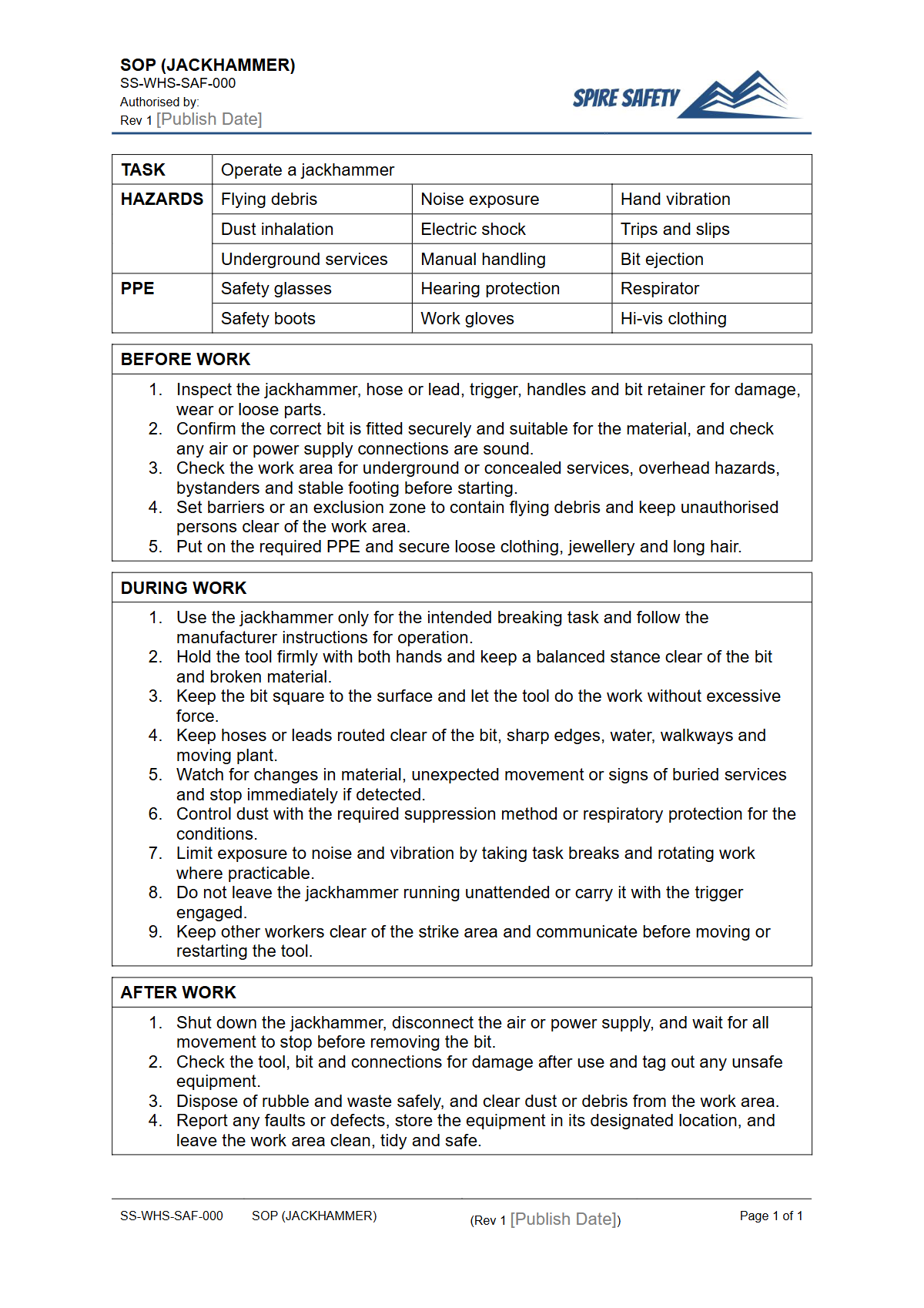
Download our free Safe Operating Procedure (Jackhammer) Template to document safe work methods and control risks.
Free Safe Operating Procedure (Jackhammer) Template
DOCX • 126 KB + PDF
Updated Oct 2026
No signup required
Purpose of the Free Safe Operating Procedure (Jackhammer) Template
Operating a jackhammer, or pneumatic drill, introduces significant workplace hazards including extreme vibration, high noise levels, airborne dust, and manual handling risks. This Free Safe Operating Procedure (Jackhammer) Template provides a structured starting point for your organisation to document a safe system of work for this task.
A well-developed Safe Operating Procedure (SOP) is a key administrative control that outlines step-by-step instructions to help workers perform their duties safely and consistently. It forms a critical part of your overall risk management process, ensuring potential hazards are identified and effective control measures are clearly communicated.
Using this template helps a Person Conducting a Business or Undertaking (PCBU) fulfil their primary duty of care under Australian WHS legislation. It guides the formalisation of pre-start checks, operational steps, required Personal Protective Equipment (PPE), and emergency procedures, reducing the likelihood of incidents and injuries like Hand-Arm Vibration Syndrome (HAVS) or noise-induced hearing loss.
Video walkthrough
How to use the Free Safe Operating Procedure (Jackhammer) Template
This Safe Operating Procedure template is provided in both DOCX and PDF formats for your convenience. The DOCX file is fully editable, allowing you to tailor the content to the specific models of jackhammers used on your site, the materials being worked on (e.g., concrete, asphalt), and your unique environmental conditions.
A generic document is not sufficient; effective safety management requires customisation.
To use the template effectively:
- Download the DOCX file.
- Consult with workers and supervisors who operate the equipment. Their direct experience is invaluable for identifying practical risks and effective controls.
- Modify the sections to reflect your specific equipment, work processes, and risk control measures. Add brand and model numbers where appropriate.
- Detail the specific PPE requirements, such as P2/P3 respiratory protection for silica dust, hearing protection with the correct SLC80 rating, and anti-vibration gloves.
- Incorporate the finished SOP into your induction and training programs.
- Ensure the document is reviewed regularly and updated after any incident or change in process.
Important: We've created this template as a guide based on model WHS principles. You must adapt it to your specific workplace, equipment, and legal obligations.
Integrating this SOP into a comprehensive WHS management system ensures it is used effectively as part of a holistic approach to safety.
When to use a Safe Operating Procedure for a Jackhammer
An SOP for a jackhammer should be developed and implemented before any worker is permitted to use the equipment. It is an essential document for any task involving demolition, excavation, construction, or road maintenance where a pneumatic or electric breaker is required.
It should be readily accessible to operators at all times during the work. You should also consider developing procedures for other high-risk equipment often used in similar settings; for example, you may also need an SOP for a trencher if your work involves excavation.
Key Hazards of Jackhammer Operation
Your customised SOP must address all significant hazards. These typically include:
- Vibration: Prolonged exposure can lead to Hand-Arm Vibration Syndrome (HAVS), a permanent and debilitating condition.
- Noise: Jackhammers can operate well above 100 dB, causing irreversible noise-induced hearing loss and tinnitus if controls are inadequate.
- Airborne Contaminants: Breaking concrete, rock, or masonry can release hazardous dust, including respirable crystalline silica, which can cause silicosis.
- Musculoskeletal Injury: The weight of the tool and the forces involved create risks of sprains, strains, and other ergonomic injuries.
- Struck-by Hazards: Flying debris (rock chips, tool bits) can cause serious impact injuries, particularly to the eyes.
- Associated Plant: Jackhammers are often powered by compressed air, so it's vital to also have a documented SOP for an air compressor to manage risks like hose whip and high-pressure air injection.
Who should use this Safe Operating Procedure
This SOP should be used by several groups within an organisation:
- Workers: As a direct guide for performing the task safely and for reference during pre-start checks.
- Supervisors and Managers: To assist in providing training, instruction, and supervision, and for conducting workplace inspections and verifying correct procedures are followed.
- WHS Professionals and PCBUs: As a tool to ensure duties are being met and to form part of the business's safety management documentation.
All operators must be trained on the contents of the final, site-specific SOP and deemed competent before operating a jackhammer unsupervised. If your team lacks the internal expertise to develop or implement these procedures, seeking guidance from WHS consultants can help bridge the gap. For other high-energy tools, a similar procedural approach is necessary, as outlined in our circular saw SOP.
Reviewing and Improving Your SOP
A Safe Operating Procedure is a living document. It should be reviewed whenever there is a change to the equipment or work environment, after an incident or near-miss occurs, or when new information about a hazard becomes available. Regular reviews, often as part of scheduled WHS compliance audits, ensure the procedure remains relevant and effective. You can find more templates and safety guides in our complete free WHS resources library to support your continuous improvement efforts.
Common mistakes
Common mistakes to avoid
- Using the template 'as-is' without customising it for site-specific hazards and equipment.
- Failing to conduct and document pre-start checks on the tool, power source, and hoses.
- Neglecting controls for secondary hazards, especially respirable crystalline silica dust and noise.
- Assuming operator competency without providing task-specific training based on the SOP.
Legal references
Legal considerations
The following legal requirements may be relevant to this type of work.
- Work Health and Safety Act (Harmonised) — Provides the primary duties for protecting workers and other people from work health and safety risks.
- Work Health and Safety Regulations (Harmonised) — Sets out requirements supporting the management of workplace hazards and risks.
The following codes may be relevant to this type of work.
- Managing WHS Risks Code of Practice — Provides practical guidance on identifying hazards, assessing risks and applying effective controls.
- Work Health and Safety Consultation, Cooperation and Coordination Code of Practice — Provides practical guidance on consulting workers and coordinating with other duty holders.
- Managing the Work Environment and Facilities Code of Practice — Provides practical guidance on safe work environments, workplace facilities and related controls.
Did you know
Vibration Exposure
Hand-Arm Vibration Syndrome (HAVS) from tools like jackhammers is irreversible. Damage can occur after only a few years of regular exposure, leading to permanent numbness, pain, and loss of hand function.
Noise Levels
A typical pneumatic jackhammer operates at around 100-115 decibels (dB). Under Australian WHS regulations, exposure to noise over 85 dB for an 8-hour period requires hearing protection and other control measures.
FAQ
Frequently asked questions
01What should be included in a jackhammer SOP?
02How often should a Safe Operating Procedure for a jackhammer be reviewed?
03Is an SOP a legal requirement for using a jackhammer in Australia?
04What is the difference between an SOP and a SWMS for a jackhammer?
Share this resource
Free Safe Operating Procedure (Jackhammer) Template
Browse Categories
How To Use It
- 1Download and open in Word or PDF.
- 2Replace the placeholders with your business details.
- 3Get it reviewed by a WHS specialist before rollout.
Need it customised?
Our WHS consultants can adapt this template to your site, run a gap analysis, or audit what you already have in place.
Book a Free Consultation WHS consulting servicesor call 1300 156 382
Related templates
- Free Safe Operating Procedure (Jaw Crusher Clearing) Template
- Free Safe Operating Procedure (Jet Blast Area Entry) Template
- Free Safe Operating Procedure (Jet Bridge Cleaning) Template
- Free Safe Operating Procedure (Jet Ski Operation) Template
- Free Safe Operating Procedure (Jib Crane) Template
- Free Safe Operating Procedure (Jigsaw) Template