
Free Safe Operating Procedure (Irrigation Leak Repair) Template
Download our free Safe Operating Procedure (Irrigation Leak Repair) Template to manage risks associated with pressurised water, excavation, and manual tasks.
Free Safe Operating Procedure (Irrigation Leak Repair) Template
DOCX • 126 KB + PDF
Updated Oct 2026
No signup required
Purpose of the Free Safe Operating Procedure (Irrigation Leak Repair) Template
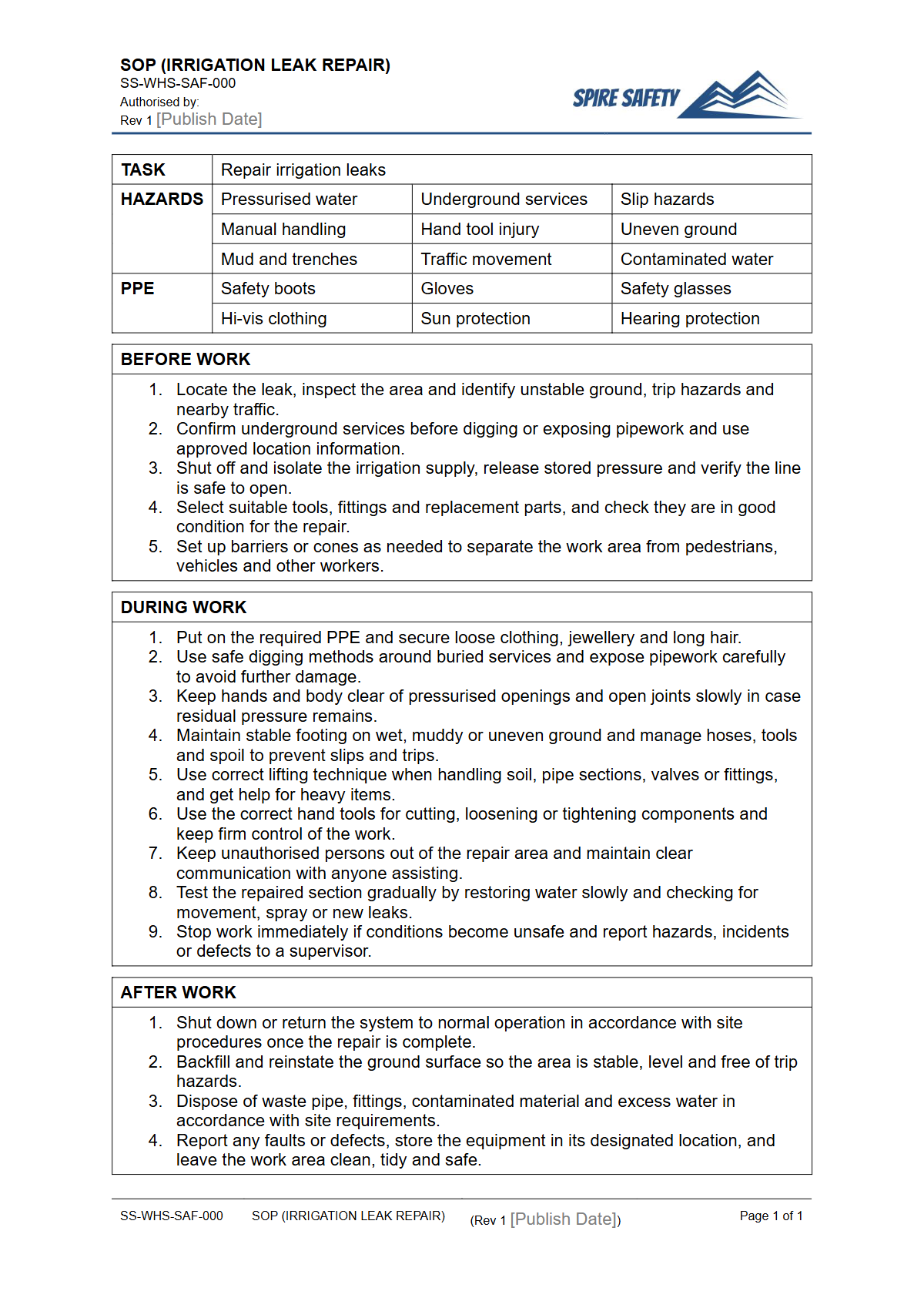
Effectively managing workplace health and safety during maintenance is crucial. Our Free Safe Operating Procedure (Irrigation Leak Repair) Template provides a structured framework for outlining the hazards and control measures associated with finding and fixing leaks in agricultural or commercial irrigation systems.
This document guides workers through a logical sequence of tasks, from initial inspection and isolation to excavation, pipe repair, and system testing. It helps persons conducting a business or undertaking (PCBUs) meet their WHS duties by formalising safe work practices for a common but potentially hazardous task.
This SOP is designed as a foundational document, covering key risks such as uncontrolled release of pressurised water, manual handling injuries, trench collapse, and contact with underground services. While this procedure focuses on leak repair, our general Irrigation System SOP covers routine operation and maintenance.
Video walkthrough
How to use the Free Safe Operating Procedure (Irrigation Leak Repair) Template
This template, available in both DOCX and PDF formats, is a starting point for developing a site-specific procedure. It is not a complete, out-of-the-box solution.
Download the document and consult with your workers and supervisors to adapt it to your unique environment, equipment, and materials. You should add details specific to your irrigation system's make and model, the types of terrain on your site, and the specific repair techniques your team uses.
Important: We have created this template to be comprehensive, but it must be customised to your specific workplace. You are responsible for ensuring the final document is tailored to your site, accurately reflects your processes, and addresses all relevant hazards.
Integrating specific procedures like this into your organisation's WHS management systems ensures consistent application and continuous improvement.
When to use it
An SOP for irrigation leak repair should be used as a key reference document for training and for pre-start planning before any repair work commences. It is most effective when integrated into a proactive maintenance schedule, rather than only being referenced in an emergency.
Workers should be familiar with its contents before they are ever required to perform a repair. It also serves as a valuable tool for incident investigations, helping to identify any deviations from established safe procedures.
If excavation is required to access buried pipes, a FREE Trencher SOP Template should be consulted to manage the distinct hazards associated with digging.
Who should use it
This Safe Operating Procedure is intended for use by anyone involved in the maintenance and repair of irrigation systems. This includes farm workers, horticulturalists, groundskeepers, landscape maintenance staff, and specialist irrigation technicians.
Supervisors and managers should use the SOP to induct new workers, deliver refresher training, and conduct workplace observations to verify that the specified controls are being implemented correctly. For complex sites or for assistance in developing a full suite of custom documents, consider seeking specialist WHS consulting to ensure your safety framework is robust.
It also provides a clear standard for contractors who may be engaged to perform repairs, ensuring they adhere to the site's safety requirements. For tasks that involve using compressed air to clear lines, an Air Compressor SOP outlines the critical safety steps to prevent injuries from high-pressure air.
This template is just one of many professionally developed documents available to download. Explore our complete free WHS resources library for more templates and guides to support your safety management system.
Common mistakes
Common mistakes to avoid
- Failing to fully de-pressurise and isolate the system before starting work.
- Not checking for underground services like power, gas, or communications cables before digging.
- Using incorrect PPE, particularly inadequate eye protection or gloves when handling sealants.
- Neglecting to properly backfill and compact soil after the repair, creating trip or vehicle rollover hazards.
Legal references
Legal considerations
The following legal requirements may be relevant to this type of work.
- Work Health and Safety Act (Harmonised) — Provides the primary duties for protecting workers and other people from work health and safety risks.
- Work Health and Safety Regulations (Harmonised) — Sets out requirements supporting the management of workplace hazards and risks.
The following codes may be relevant to this type of work.
- Managing WHS Risks Code of Practice — Provides practical guidance on identifying hazards, assessing risks and applying effective controls.
- Work Health and Safety Consultation, Cooperation and Coordination Code of Practice — Provides practical guidance on consulting workers and coordinating with other duty holders.
- Managing the Work Environment and Facilities Code of Practice — Provides practical guidance on safe work environments, workplace facilities and related controls.
Did you know
Water Loss
According to the Australian Bureau of Statistics, agriculture is the largest user of water in Australia. Even small, persistent leaks in irrigation systems can lead to the loss of millions of litres of water over a season, impacting both costs and environmental sustainability.
Excavation Risks
A seemingly small trench for a pipe repair can be a significant hazard. An unsupported trench can collapse with immense force, and striking an underground electrical cable or gas line can have fatal consequences.
FAQ
Frequently asked questions
01What is the difference between an SOP and a SWMS?
02Does this template cover electrical safety for irrigation pumps?
03How often should we review our Irrigation Leak Repair SOP?
04Can I use this SOP for both surface and subsurface irrigation systems?
Share this resource
Free Safe Operating Procedure (Irrigation Leak Repair) Template
Browse Categories
How To Use It
- 1Download and open in Word or PDF.
- 2Replace the placeholders with your business details.
- 3Get it reviewed by a WHS specialist before rollout.
Need it customised?
Our WHS consultants can adapt this template to your site, run a gap analysis, or audit what you already have in place.
Book a Free Consultation WHS consulting servicesor call 1300 156 382
Related templates
- Free Safe Operating Procedure (Irrigation Line Flush) Template
- Free Safe Operating Procedure (Irrigation Valve Check) Template
- Free Safe Operating Procedure (Irrigation Zone Test) Template
- Free Safe Operating Procedure (Isolation Signage Setup) Template
- Free Safe Operating Procedure (Jackhammer) Template
- Free Safe Operating Procedure (Jaw Crusher Clearing) Template