
Free Safe Operating Procedure (Irrigation Line Flush) Template
Download our free Safe Operating Procedure (Irrigation Line Flush) template. This customisable DOCX and PDF helps define safe work practices for your team.
Free Safe Operating Procedure (Irrigation Line Flush) Template
DOCX • 126 KB + PDF
Updated Oct 2026
No signup required
Purpose of the Free Safe Operating Procedure (Irrigation Line Flush) Template
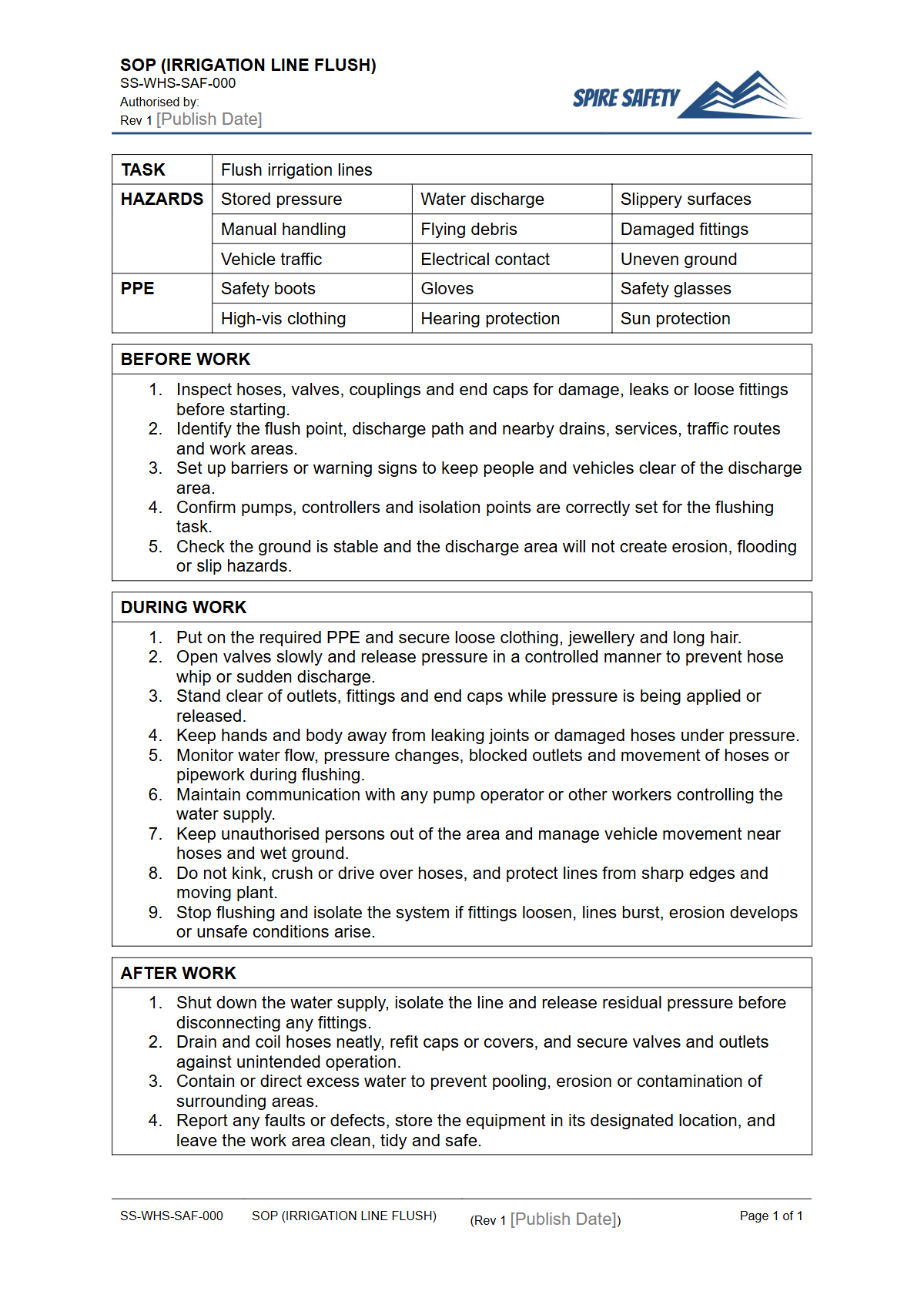
Flushing irrigation lines is a critical maintenance task in agriculture, horticulture, and commercial landscaping to ensure system efficiency and longevity. This Free Safe Operating Procedure (Irrigation Line Flush) Template provides a structured framework for outlining the required safety measures for this process.
The procedure involves forcing water, sometimes with cleaning agents or compressed air, through the lines to remove sediment, algae, mineral deposits, and other blockages. Key hazards include exposure to high-pressure fluids, hazardous chemicals, excessive noise, and slip or trip hazards from wet surfaces.
Using a documented SOP helps standardise the task, ensuring it is performed safely and consistently every time. It prompts a systematic approach to identifying hazards and implementing effective control measures, such as correct system isolation and depressurisation.
This document serves as a specific guide for the flushing task and can be a key part of a more comprehensive Irrigation System SOP that covers general operation and maintenance.
Video walkthrough
How to use the Free Safe Operating Procedure (Irrigation Line Flush) Template
This template is provided in both DOCX and PDF formats for your convenience. The DOCX file is fully editable, allowing you to adapt it to the specific equipment, chemicals, and environmental conditions at your worksite.
It is structured to guide you through documenting essential safety information, including required PPE, pre-operational checks, the step-by-step flushing process, and emergency procedures.
Note: This document is a template and must be customised to your specific workplace. We recommend a person with appropriate knowledge consults with operators and supervisors to identify the unique hazards, equipment, chemicals, and control measures relevant to your site.
This ensures the final SOP is practical and effective. Once tailored, this SOP becomes a cornerstone of your WHS management systems, providing a clear reference for training, task supervision, and risk management.
When to use it
A Safe Operating Procedure for flushing irrigation lines should be used whenever the task is performed. It is especially important during non-routine maintenance activities where risks can be higher. Specific scenarios include:
- At the start or end of the growing season (commissioning or winterising).
- Following repairs or modifications to the irrigation network.
- As a corrective action to clear known blockages or improve water flow.
- As part of a scheduled preventative maintenance program to prevent biofilm and scale buildup.
- When introducing cleaning or sanitising agents into the system.
Consistently applying the SOP ensures that even infrequent tasks are performed with the same level of diligence and safety awareness, especially when using compressed air. In such cases, an air compressor SOP should be consulted in conjunction.
Who should use it
This SOP is designed for use by all personnel involved in the maintenance of irrigation systems. This includes, but is not limited to:
- Farm workers and agricultural technicians
- Groundskeepers and maintenance staff
- Horticulturalists and landscaping professionals
- Irrigation system installers and technicians
Supervisors and managers should also use this document to verify that workers are trained and competent to perform the task safely. The SOP serves as an essential tool for providing instruction, conducting competency assessments, and investigating any incidents that may occur.
For organisations needing help with implementation or training, our WHS consulting services can provide expert guidance.
Key Elements of an Effective Procedure
To be effective, your customised SOP should clearly address several critical areas. The template provides sections for each of these, which you should populate with site-specific details.
Hazard Identification: Detail all potential hazards, such as high-pressure water/air jets, unsecured whipping hoses, chemical splashes, noise from pumps or compressors, and electrical hazards associated with system components.
Personal Protective Equipment (PPE): Specify the mandatory PPE based on your risk assessment. This typically includes safety glasses or a face shield, chemical-resistant gloves, waterproof boots, and hearing protection if noise levels exceed exposure standards.
Pre-Operational Checks: Outline the checks required before starting, including inspecting hoses for damage, confirming pressure ratings of components, checking that pressure relief valves are functional, and ensuring isolation points are clearly marked and accessible.
Step-by-Step Flushing Guide: Provide a clear, sequential guide for the entire process. This should cover securing the work area, system isolation and depressurisation, controlled introduction of water/air, securing flush points to prevent whipping, and procedures for safely re-pressurising the system.
This complements procedures for other related equipment, such as a trencher SOP used during system installation or repair.
This structured approach to safety documentation forms a vital part of your overall WHS obligations. To find other useful documents, you can browse our complete free WHS resources library for more templates and guides.
Common mistakes
Common mistakes to avoid
- Failing to fully depressurise the system before disconnecting hoses or fittings.
- Not securing the open end of a hose, which can cause it to whip violently under pressure.
- Using incompatible cleaning chemicals that can damage system components or create hazardous reactions.
- Neglecting to inspect pressure gauges and relief valves before starting the job.
Legal references
Legal considerations
The following legal requirements may be relevant to this type of work.
- Work Health and Safety Act (Harmonised) — Provides the primary duties for protecting workers and other people from work health and safety risks.
- Work Health and Safety Regulations (Harmonised) — Sets out requirements supporting the management of workplace hazards and risks.
The following codes may be relevant to this type of work.
- Managing WHS Risks Code of Practice — Provides practical guidance on identifying hazards, assessing risks and applying effective controls.
- Work Health and Safety Consultation, Cooperation and Coordination Code of Practice — Provides practical guidance on consulting workers and coordinating with other duty holders.
- Managing the Work Environment and Facilities Code of Practice — Provides practical guidance on safe work environments, workplace facilities and related controls.
Did you know
Biofilm Buildup
Biofilm, a slimy layer of microorganisms, can form inside irrigation lines in just a few weeks. It not only clogs emitters but can also harbour plant pathogens, making regular flushing essential for crop health.
The Danger of Water Hammer
Closing valves too quickly in a high-flow irrigation system can create a hydraulic shockwave known as 'water hammer'. This pressure surge can be powerful enough to burst pipes and damage fittings, posing a significant safety risk.
FAQ
Frequently asked questions
01What are the main hazards when flushing irrigation lines?
02How often should irrigation lines be flushed?
03Is this irrigation line flush SOP template compliant with Australian WHS laws?
04What PPE is required for flushing irrigation lines?
Share this resource
Free Safe Operating Procedure (Irrigation Line Flush) Template
Browse Categories
How To Use It
- 1Download and open in Word or PDF.
- 2Replace the placeholders with your business details.
- 3Get it reviewed by a WHS specialist before rollout.
Need it customised?
Our WHS consultants can adapt this template to your site, run a gap analysis, or audit what you already have in place.
Book a Free Consultation WHS consulting servicesor call 1300 156 382
Related templates
- Free Safe Operating Procedure (Irrigation Valve Check) Template
- Free Safe Operating Procedure (Irrigation Zone Test) Template
- Free Safe Operating Procedure (Isolation Signage Setup) Template
- Free Safe Operating Procedure (Jackhammer) Template
- Free Safe Operating Procedure (Jaw Crusher Clearing) Template
- Free Safe Operating Procedure (Jet Blast Area Entry) Template