
Free Safe Operating Procedure (Irrigation Valve Check) Template
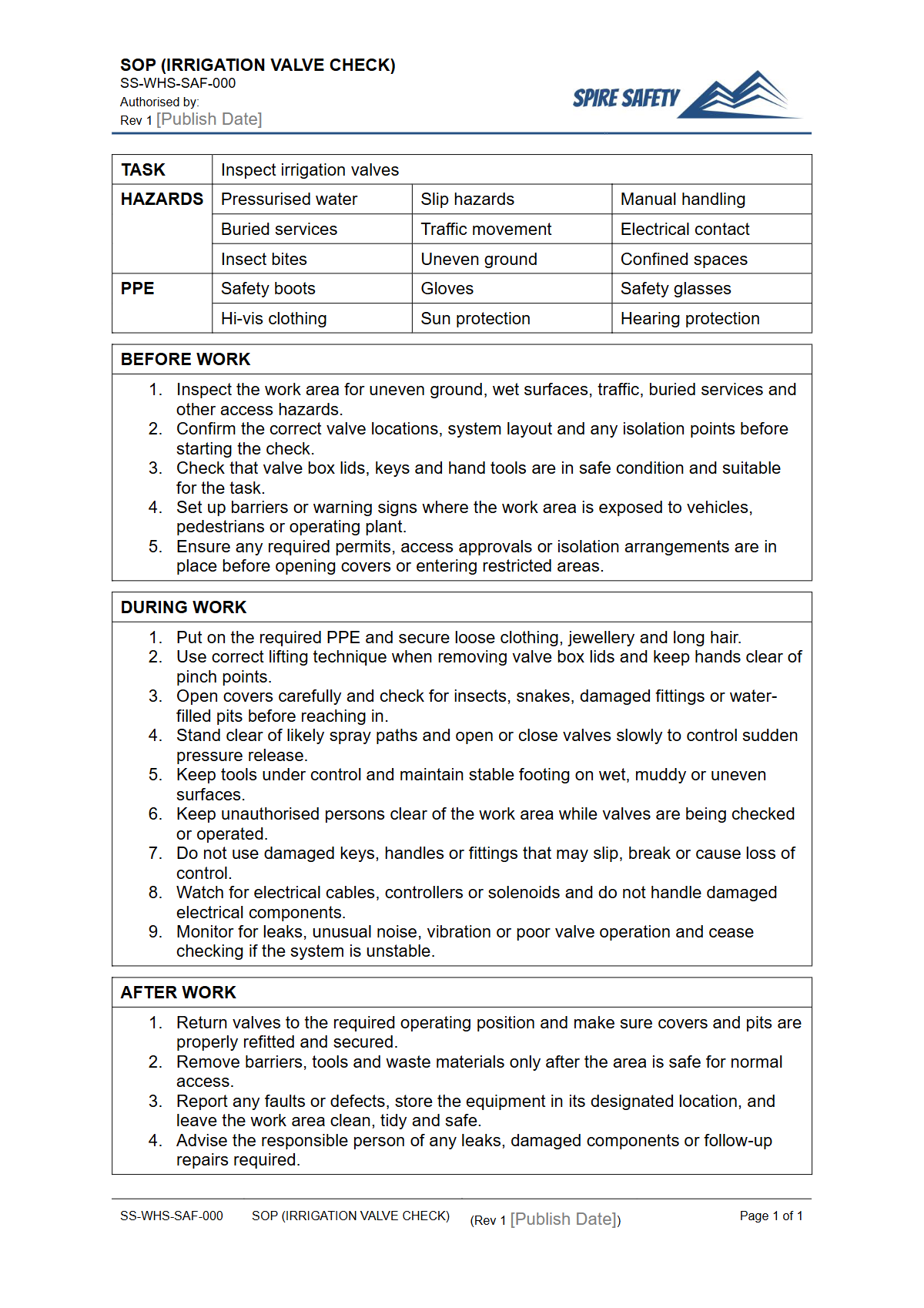
Download our Free Safe Operating Procedure (Irrigation Valve Check) Template to formalise safety steps for routine checks. Get your DOCX and PDF today.
Free Safe Operating Procedure (Irrigation Valve Check) Template
DOCX • 126 KB + PDF
Updated Oct 2026
No signup required
Purpose of the Free Safe Operating Procedure (Irrigation Valve Check) Template
This Free Safe Operating Procedure (Irrigation Valve Check) Template provides a structured starting point for organisations in agriculture, horticulture, landscaping, and facilities management to document the process for safely inspecting and servicing irrigation valves. Performing these checks without a formalised procedure can expose workers to numerous hazards, including the uncontrolled release of stored energy (water pressure), ergonomic strains from manual handling, and slips or falls on wet surfaces.
Using a SOP helps standardise the task, ensuring safety controls are consistently applied every time.
A valve check is a specific task within a larger network of tasks. This procedure is designed to complement a broader irrigation system SOP, which would cover the overall operation of the entire system.
By clearly defining the steps for this one critical maintenance activity, you help minimise risk and provide a clear reference for training and supervision. The goal is to ensure that every valve check is performed efficiently, correctly, and, most importantly, safely.
Video walkthrough
How to use the Free Safe Operating Procedure (Irrigation Valve Check) Template
This downloadable document is a template, not a finished safety document. To be effective, it must be carefully customised to reflect the specific circumstances of your workplace.
This involves identifying the unique valve types you use (e.g., gate, ball, diaphragm, solenoid), the site-specific environmental conditions, and the tools and equipment available to your workers. We strongly recommend that you consult with the workers who actually perform the task during the customisation process to ensure the procedure is practical and reflects on-the-ground realities.
Once customised, this SOP becomes a key document within your overall safety framework. Integrating individual procedures like this one into overarching WHS management systems ensures a cohesive and comprehensive approach to managing workplace risk.
Your final document should be reviewed, approved by management, and used to train all relevant personnel before work commences. It should be stored in a location easily accessible to workers who need it.
Key Elements of an Effective Safe Operating Procedure
A robust SOP for checking irrigation valves should be clear, concise, and cover all stages of the task. Our template prompts you to detail the essential safety components to create a comprehensive guide for your team.
Pre-Operational Checks
Before any work begins, the operator must conduct several preliminary checks. This includes inspecting tools for damage, ensuring the correct Personal Protective Equipment (PPE) is available and in good condition, and assessing the work area for immediate hazards like poor lighting, uneven ground, or other personnel.
The procedure should require workers to identify and confirm all water and power isolation points before proceeding.
Step-by-Step Task Sequence
The core of the SOP is a logical, step-by-step description of the task. For an irrigation valve check, this typically includes: isolating the system from water pressure and electrical power (if applicable), bleeding or depressurising the specific line, manually or automatically cycling the valve, inspecting for smooth operation and signs of wear or leaks, and cleaning components as necessary.
If accessing the valve requires digging, a separate procedure like a Trencher SOP may be required for any associated excavation work.
Emergency Procedures
Things can go wrong, and your SOP must account for that. This section should clearly outline the steps to take in an emergency, such as a burst pipe, a jammed valve leading to pressure build-up, or a worker injury.
It should include the location of emergency shut-offs, first aid kits, and emergency contact information.
Review and Improvement
Safe Operating Procedures are living documents that require periodic review to remain effective. This SOP should be reviewed at least annually, or more frequently if there is an incident, a near miss, or a change in equipment, processes, or legislation.
Regular reviews ensure the procedure stays relevant and continues to provide the best protection for your workers. Involving your team in the review process can identify opportunities for improvement.
For organisations looking to ensure their safety documentation and practices remain aligned with their legal obligations, engaging external experts for periodic WHS compliance auditing can provide valuable assurance and identify gaps. This external perspective helps maintain the integrity of your safety management system.
You can also explore our extensive free WHS resources library for other templates and guides to support your safety efforts.
Common mistakes
Common mistakes to avoid
- Forgetting to depressurise the line after isolating the main water supply.
- Using incorrect tools, such as pliers instead of a valve key, which can damage the valve stem or handle.
- Failing to check for leaks after the check is complete and the system is re-pressurised.
- Neglecting to wear appropriate PPE, especially safety glasses to protect from unexpected spray.
Legal references
Legal considerations
The following legal requirements may be relevant to this type of work.
- Work Health and Safety Act (Harmonised) — Provides the primary duties for protecting workers and other people from work health and safety risks.
- Work Health and Safety Regulations (Harmonised) — Sets out requirements supporting the management of workplace hazards and risks.
The following codes may be relevant to this type of work.
- Managing WHS Risks Code of Practice — Provides practical guidance on identifying hazards, assessing risks and applying effective controls.
- Work Health and Safety Consultation, Cooperation and Coordination Code of Practice — Provides practical guidance on consulting workers and coordinating with other duty holders.
- Managing the Work Environment and Facilities Code of Practice — Provides practical guidance on safe work environments, workplace facilities and related controls.
Did you know
Water Pressure Hazards
A sudden release from a high-pressure irrigation line can have enough force to cause serious impact injuries, throw a worker off balance, or create rapid soil erosion around foundations and equipment.
Valve Types
The most common irrigation valves include gate valves for simple on/off control, ball valves for quick shut-off, and automated diaphragm or solenoid valves that are controlled electronically.
FAQ
Frequently asked questions
01What are the main hazards involved in an irrigation valve check?
02How often should an irrigation valve check SOP be reviewed?
03Is this template suitable for all types of irrigation systems?
04What is the purpose of isolating the system before a valve check?
Share this resource
Free Safe Operating Procedure (Irrigation Valve Check) Template
Browse Categories
How To Use It
- 1Download and open in Word or PDF.
- 2Replace the placeholders with your business details.
- 3Get it reviewed by a WHS specialist before rollout.
Need it customised?
Our WHS consultants can adapt this template to your site, run a gap analysis, or audit what you already have in place.
Book a Free Consultation WHS consulting servicesor call 1300 156 382
Related templates
- Free Safe Operating Procedure (Irrigation Zone Test) Template
- Free Safe Operating Procedure (Isolation Signage Setup) Template
- Free Safe Operating Procedure (Jackhammer) Template
- Free Safe Operating Procedure (Jaw Crusher Clearing) Template
- Free Safe Operating Procedure (Jet Blast Area Entry) Template
- Free Safe Operating Procedure (Jet Bridge Cleaning) Template