
Free Safe Operating Procedure (Irrigation Filter Clean) Template
Effectively manage hazards associated with cleaning irrigation filters with our customisable template.
Free Safe Operating Procedure (Irrigation Filter Clean) Template
DOCX • 126 KB + PDF
Updated Oct 2026
No signup required
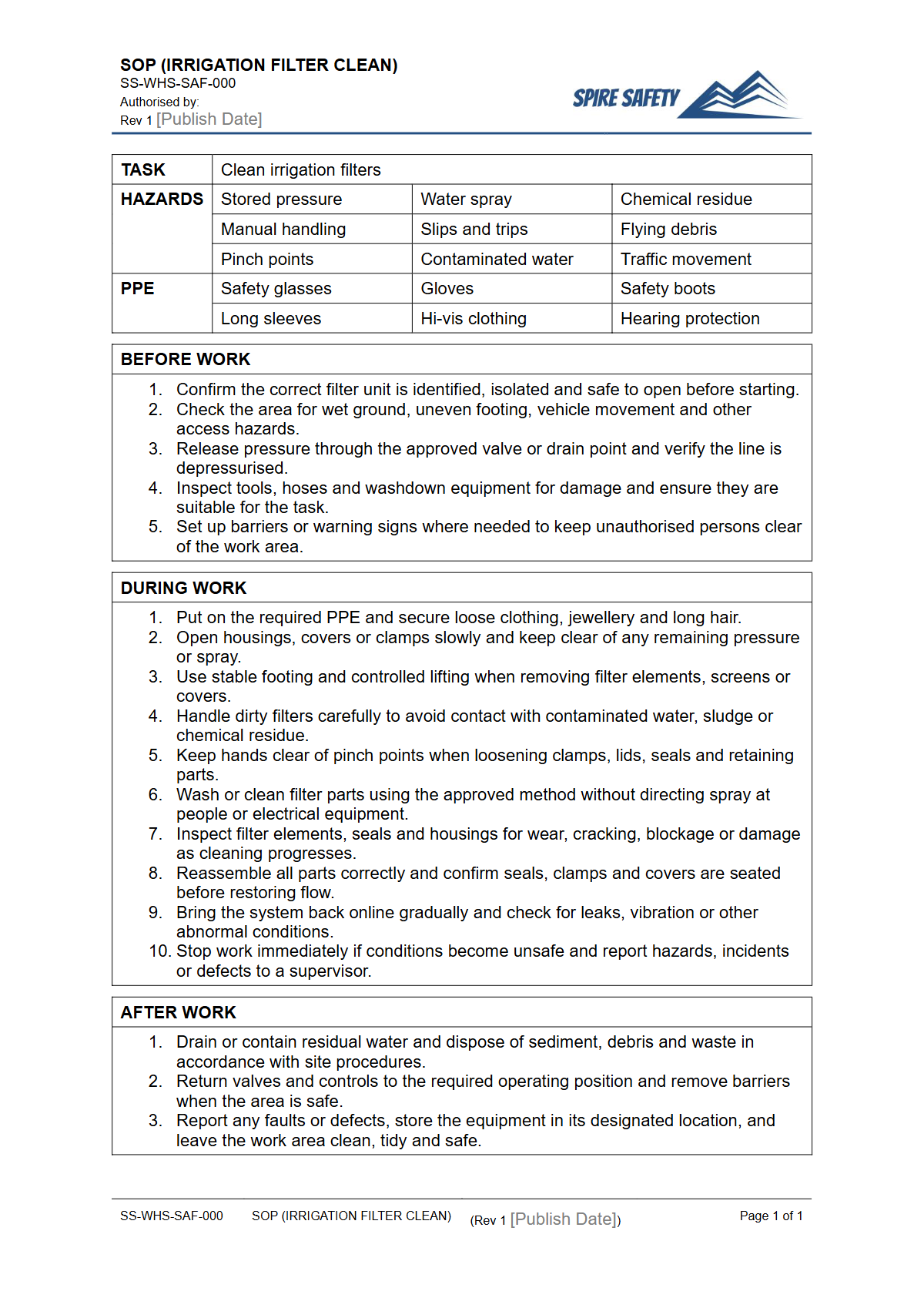
Purpose of the Free Safe Operating Procedure (Irrigation Filter Clean) Template
Cleaning irrigation filters is a common but potentially hazardous task in agriculture, landscaping, and horticulture. This free Safe Operating Procedure (Irrigation Filter Clean) Template provides a structured framework for documenting the safest way to perform this activity.
It helps organisations meet their duty of care under Australian WHS laws by formalising a step-by-step process that controls risks such as exposure to stored pressure, hazardous chemicals, biological contaminants, and manual handling injuries. By implementing a clear SOP, you can ensure consistency in procedures, simplify worker training, and create a verifiable record of your risk management efforts.
This document is designed to work alongside broader safety documentation, such as our free Irrigation System SOP, to build a comprehensive approach to water management safety on your site. A well-defined procedure minimises the chance of equipment damage, prevents injuries, and demonstrates a proactive safety culture.
It serves as a critical reference tool for workers before they start the task and for supervisors conducting safety observations.
Video walkthrough
How to use the Free Safe Operating Procedure (Irrigation Filter Clean) Template
This template is provided in both DOCX and PDF formats for your convenience. The DOCX version is fully editable, allowing you to tailor the content to the specific irrigation systems and workplace conditions at your site.
To use it effectively, download the file and consult with workers who regularly perform the task, as well as supervisors and WHS personnel. Modify the steps to reflect the exact make and model of your filters, the specific personal protective equipment (PPE) required, and your site's emergency procedures.
Important: This document is a template, not a finished product. We have provided a solid foundation based on Australian WHS principles, but you must customise it to your unique operational context.
Generic procedures are insufficient for managing specific risks. Integrating customised SOPs into your broader WHS management systems is key to ensuring they are used, reviewed, and effectively maintained as part of your overall safety framework.
When to use a Safe Operating Procedure for an Irrigation Filter Clean
An SOP for cleaning irrigation filters should be used every time the task is performed. It is most critical during scheduled preventative maintenance, as it ensures all safety checks are completed systematically.
It should also be referenced before undertaking unscheduled cleaning, such as clearing a sudden blockage, to ensure workers do not take shortcuts under pressure. Furthermore, this SOP is an essential training document for new or inexperienced employees, providing them with a clear, authoritative guide to follow under supervision.
Regular review of the SOP is also vital. It should be assessed annually, or whenever there is a change in equipment, chemicals, or work processes.
For tasks involving other pressurised equipment on site, you may also need separate procedures, such as an Air Compressor SOP, to cover all related plant and machinery. Post-incident investigations should always include a review of the relevant SOP to identify any gaps or areas for improvement.
Who should use it
This Safe Operating Procedure is intended for a range of personnel within an organisation. Primarily, it is for the workers who directly perform the filter cleaning task, including farmhands, groundskeepers, and maintenance staff.
It gives them a clear, step-by-step guide to follow to ensure their own safety and the safety of others. Supervisors and managers must use the SOP to train their teams, monitor work practices, and enforce safety standards.
They are responsible for ensuring the procedure is understood and followed correctly.
Work Health and Safety (WHS) officers or coordinators will also use this document as part of their auditing and risk management activities. It provides a benchmark against which actual work practices can be measured.
For businesses needing expert guidance on tailoring this or other documents, our WHS consulting services can provide tailored support to ensure your procedures are practical and robust for your specific operational needs.
Developing task-specific SOPs is a fundamental part of managing workplace hazards. Whether digging trenches for new lines or performing routine maintenance, documented procedures are essential.
For related agricultural or earthmoving tasks, you might find our free Trencher SOP useful. Building a complete set of procedures for all high-risk tasks helps create a safer working environment for everyone.
You can browse our complete free WHS resources library for other templates, checklists, and guides to support your safety management system. We are continually adding new documents to help Australian businesses manage their WHS obligations effectively.
Common mistakes
Common mistakes to avoid
- Failing to fully de-pressurise and isolate the system before starting work.
- Neglecting to wear appropriate PPE, particularly eye protection and gloves.
- Underestimating the risks of biological or chemical contaminants in the filter sludge.
- Using incorrect tools or excessive force, leading to equipment damage or injury.
Legal references
Legal considerations
The following legal requirements may be relevant to this type of work.
- Work Health and Safety Act (Harmonised) — Provides the primary duties for protecting workers and other people from work health and safety risks.
- Work Health and Safety Regulations (Harmonised) — Sets out requirements supporting the management of workplace hazards and risks.
The following codes may be relevant to this type of work.
- Managing WHS Risks Code of Practice — Provides practical guidance on identifying hazards, assessing risks and applying effective controls.
- Work Health and Safety Consultation, Cooperation and Coordination Code of Practice — Provides practical guidance on consulting workers and coordinating with other duty holders.
- Managing the Work Environment and Facilities Code of Practice — Provides practical guidance on safe work environments, workplace facilities and related controls.
Did you know
High-Pressure Dangers
High-pressure water injection injuries, possible from faulty irrigation systems, can be extremely serious. The initial injury may appear minor, but the injected fluid can cause severe tissue damage, infection, and compartment syndrome, sometimes requiring amputation.
FAQ
Frequently asked questions
01What hazards are involved in cleaning an irrigation filter?
02How often should an irrigation filter SOP be reviewed?
03Can this template be used for all types of irrigation filters?
04Is a Safe Operating Procedure a legal requirement in Australia?
Share this resource
Free Safe Operating Procedure (Irrigation Filter Clean) Template
Browse Categories
How To Use It
- 1Download and open in Word or PDF.
- 2Replace the placeholders with your business details.
- 3Get it reviewed by a WHS specialist before rollout.
Need it customised?
Our WHS consultants can adapt this template to your site, run a gap analysis, or audit what you already have in place.
Book a Free Consultation WHS consulting servicesor call 1300 156 382
Related templates
- Free Safe Operating Procedure (Irrigation Head Check) Template
- Free Safe Operating Procedure (Irrigation Leak Repair) Template
- Free Safe Operating Procedure (Irrigation Line Flush) Template
- Free Safe Operating Procedure (Irrigation Valve Check) Template
- Free Safe Operating Procedure (Irrigation Zone Test) Template
- Free Safe Operating Procedure (Isolation Signage Setup) Template