
Free Safe Operating Procedure (Instrument Washer) Template
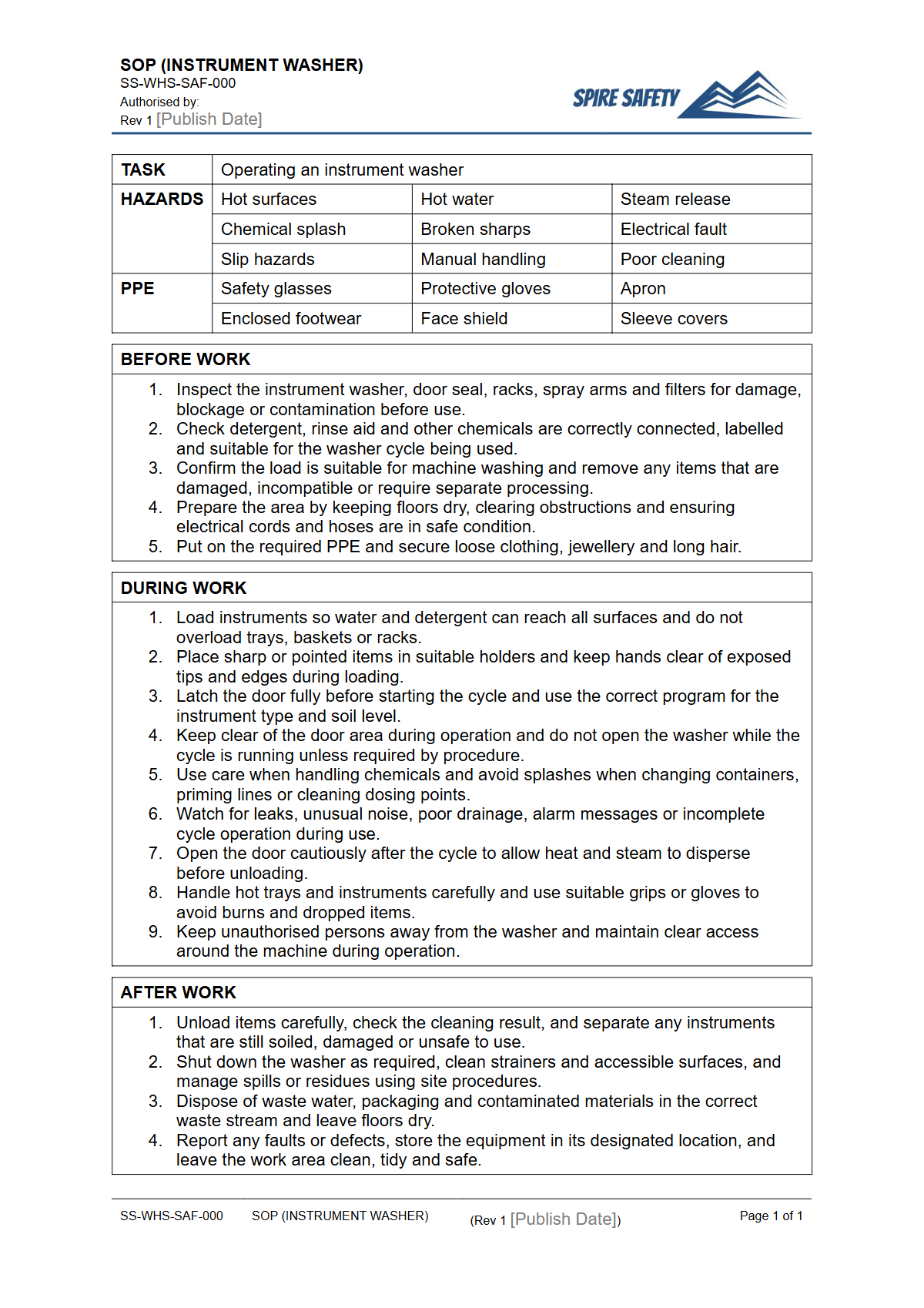
Download our free Safe Operating Procedure for instrument washers to standardise safe work practices. This customisable template helps you manage risks.
Free Safe Operating Procedure (Instrument Washer) Template
DOCX • 126 KB + PDF
Updated Oct 2026
No signup required
Purpose of the Free Safe Operating Procedure (Instrument Washer) Template
Operating an instrument washer, whether in a medical, laboratory, or hospitality setting, involves specific risks that must be managed to ensure worker safety. This Free Safe Operating Procedure (Instrument Washer) Template provides a structured framework for documenting the required steps to operate this equipment safely.
It helps organisations meet their duty of care by identifying hazards such as high temperatures, steam, exposure to cleaning chemicals, electrical faults, and ergonomic strains from loading and unloading.
By implementing a clear SOP, you standardise the process, reduce the likelihood of operator error, and create a vital training tool for new employees. A documented procedure ensures that all operators follow the same safe, efficient steps every time, which is critical for both safety and operational consistency.
This is just as important for specialised equipment like instrument washers as it is for more common kitchen appliances, where a detailed Safe Operating Procedure for a deep fryer is essential for managing thermal hazards.
Video walkthrough
How to use the Free Safe Operating Procedure (Instrument Washer) Template
This template is provided as a fully editable DOCX file, with a PDF version also available for easy printing and distribution. It is designed as a foundational document that must be adapted to your specific circumstances.
To use it effectively, download the file and systematically work through each section, filling in details relevant to your workplace.
Important: You must customise this Safe Operating Procedure to align with the manufacturer's instructions for your specific model of instrument washer, the safety data sheets (SDS) for the detergents and chemicals you use, and the unique conditions of your work environment. We strongly recommend conducting a site-specific risk assessment to inform your customisations. Integrating this SOP into your broader safety framework helps formalise your processes, which is a key component of comprehensive WHS management systems.
When to use an Instrument Washer SOP
A Safe Operating Procedure for an instrument washer should be a core part of your daily operations. It should be readily accessible to all operators at or near the equipment. Key times to use and refer to the SOP include:
- Training and Induction: Use the SOP as the primary document for training new staff on how to use the instrument washer safely and correctly.
- Daily Operation: Operators can use it as a quick reference to confirm steps, especially for non-routine tasks like maintenance or troubleshooting.
- Refresher Training: It serves as an excellent tool for periodic refresher courses to prevent complacency and reinforce safe work habits.
- Incident Investigation: Following any incident or near miss involving the equipment, the SOP should be reviewed to determine if the procedure was followed and if it needs revision.
Regular reviews of your SOPs are a critical part of maintaining a safe workplace. This can be done as part of your internal review cycle or with the help of external WHS compliance auditing services to ensure your procedures remain current and effective.
Who should use this Safe Operating Procedure
This SOP is intended for a range of personnel within an organisation. The primary users are the operators of the instrument washer, including sterile processing technicians, laboratory assistants, medical staff, and kitchen hands.
They rely on the SOP to perform their tasks safely.
Supervisors and Managers should use the SOP to oversee work, conduct training, and ensure consistent application of safety standards across their teams. Having documented procedures like this one and a Conveyer System SOP ensures that all interconnected processes are managed with the same level of safety diligence.
WHS Professionals and Committees will find this template valuable for developing and implementing safety protocols. It provides a solid starting point that is aligned with the model WHS framework, helping to build a library of task-specific procedures.
This is particularly useful in environments with diverse machinery, where you might also need a Safe Operating Procedure for air compressors or other plant.
This template is one of many documents available in our library of free WHS resources, all designed to assist Australian businesses in building safer workplaces.
Common mistakes
Common mistakes to avoid
- Not wearing appropriate PPE, especially heat-resistant gloves and safety glasses.
- Overloading washer trays, which prevents proper cleaning and can damage the machine.
- Using the incorrect type or amount of detergent, leading to ineffective disinfection or chemical residue.
- Failing to perform routine cleaning of filters and spray arms, reducing performance.
Legal references
Legal considerations
The following legal requirements may be relevant to this type of work.
- Work Health and Safety Act (Harmonised) — Provides the primary duties for protecting workers and other people from work health and safety risks.
- Work Health and Safety Regulations (Harmonised) — Sets out requirements supporting the management of workplace hazards and risks.
The following codes may be relevant to this type of work.
- Managing WHS Risks Code of Practice — Provides practical guidance on identifying hazards, assessing risks and applying effective controls.
- Work Health and Safety Consultation, Cooperation and Coordination Code of Practice — Provides practical guidance on consulting workers and coordinating with other duty holders.
- Managing the Work Environment and Facilities Code of Practice — Provides practical guidance on safe work environments, workplace facilities and related controls.
Did you know
Thermal Disinfection
Many medical-grade instrument washers use a final rinse at temperatures between 80°C and 93°C for thermal disinfection. This poses a significant burn hazard if operators open the door too soon or handle trays without proper PPE.
Chemical Potency
Detergents for automated instrument washers are often highly concentrated and can be strongly alkaline or acidic. Unprotected contact can cause severe chemical burns, and vapours may irritate the respiratory system.
FAQ
Frequently asked questions
01What are the main hazards of using an instrument washer?
02Is a Safe Operating Procedure a legal requirement for an instrument washer in Australia?
03How often should an instrument washer SOP be reviewed?
04Can this template be used for any brand of instrument washer?
Share this resource
Free Safe Operating Procedure (Instrument Washer) Template
Browse Categories
How To Use It
- 1Download and open in Word or PDF.
- 2Replace the placeholders with your business details.
- 3Get it reviewed by a WHS specialist before rollout.
Need it customised?
Our WHS consultants can adapt this template to your site, run a gap analysis, or audit what you already have in place.
Book a Free Consultation WHS consulting servicesor call 1300 156 382
Related templates
- Free Safe Operating Procedure (Insulation Tester) Template
- Free Safe Operating Procedure (Intercom Panel Cleaning) Template
- Free Safe Operating Procedure (Irrigation Filter Clean) Template
- Free Safe Operating Procedure (Irrigation Head Check) Template
- Free Safe Operating Procedure (Irrigation Leak Repair) Template
- Free Safe Operating Procedure (Irrigation Line Flush) Template