
Free Safe Operating Procedure (Injector Cleaning) Template
Establish clear safety protocols for injector cleaning tasks with our structured template. Download your free Safe Operating Procedure in DOCX or PDF today.
Free Safe Operating Procedure (Injector Cleaning) Template
DOCX • 126 KB + PDF
Updated Oct 2026
No signup required
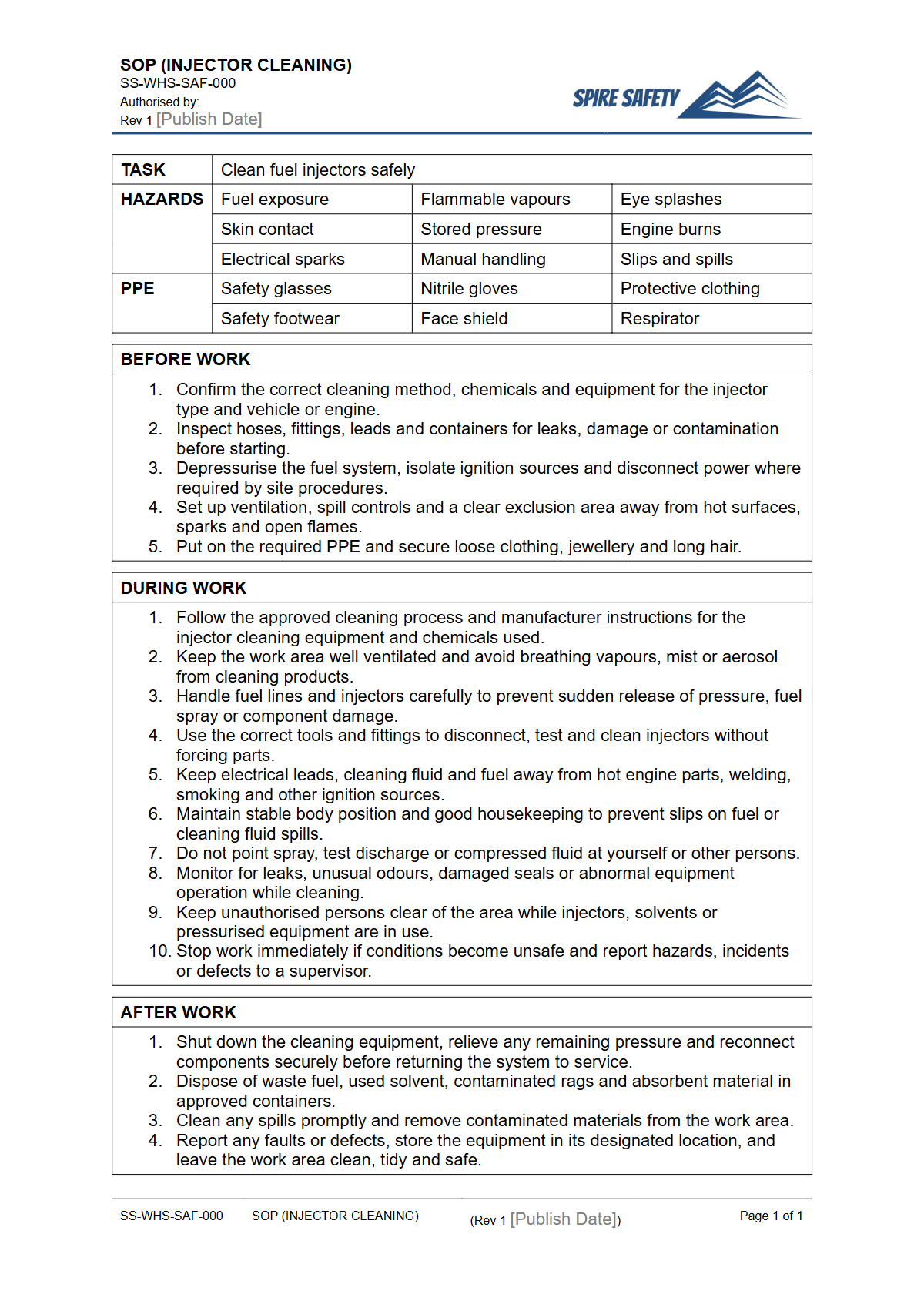
Purpose of the Free Safe Operating Procedure (Injector Cleaning) Template
Injector cleaning, whether on-vehicle or on a bench, involves significant hazards including exposure to flammable and toxic chemicals, high-pressure fluid injection, and electrical risks. This Free Safe Operating Procedure (Injector Cleaning) Template provides a structured starting point for organisations to document a clear, step-by-step process for performing this task safely.
By formally outlining the required precautions, PPE, and emergency responses, you can minimise the risk of injury, fire, and property damage in your workshop. A documented SOP is a critical tool for demonstrating due diligence and ensuring all workers follow a consistent, safe method of work.
Properly managing hazardous chemicals and high-pressure equipment is a fundamental aspect of workshop safety. This SOP helps codify controls for these risks, forming a key component of your overall safety framework. For tasks involving similar pressure-related hazards, you might also benefit from our Free Air Compressor SOP (Safe Operating Procedure) Template.
Video walkthrough
How to use the Free Safe Operating Procedure (Injector Cleaning) Template
This document, available in both DOCX and PDF, is a foundation for you to build upon. It is not a complete, ready-to-use procedure.
You must adapt it to the specific context of your workplace, including the types of injectors serviced (petrol, diesel), the cleaning equipment used (ultrasonic baths, pressurised canister systems), and the specific chemical products you have on site. It is vital to reference the Safety Data Sheet (SDS) for each cleaning agent and incorporate its specific handling, storage, and first aid requirements into your final SOP.
Important: This is a template that must be customised to your specific workplace. We've provided a framework, but you need to add details about your exact equipment, chemicals, and internal procedures.
Effective SOPs are practical documents that reflect your actual operational environment. Integrating these procedures into your broader WHS management systems is key to maintaining a safe workplace.
When to use this Safe Operating Procedure
This Safe Operating Procedure should be used as a primary reference document for all injector cleaning activities. It is essential for inducting new technicians or apprentices, providing a clear guide to the approved method of work.
It also serves as a crucial tool for refresher training to ensure established safety standards are maintained over time. Furthermore, the SOP should be reviewed and referenced before undertaking non-routine injector cleaning tasks or when introducing new equipment or chemical solvents to the process.
Regular reviews ensure the procedure remains relevant and effective.
The process of customising and implementing this SOP may also highlight areas for improvement in your overall safety practices. Engaging in periodic WHS compliance auditing can help ensure your documented procedures align with your on-the-ground activities and meet legislative requirements.
Who should use this Safe Operating Procedure
This SOP is intended for use by all personnel involved in servicing and cleaning fuel injectors. This includes:
- Qualified Automotive Technicians and Diesel Mechanics who perform the task.
- Apprentices, who must use the SOP under the direct supervision of a qualified person.
- Workshop Supervisors and Managers, who are responsible for ensuring the procedure is implemented, understood, and followed by all relevant staff. They also use it to conduct training and verify competency.
Supervisors must ensure that workers are not only provided with the SOP but also trained on its contents and the specific hazards of the job. For guidance on customising this or other safety documents, consider seeking professional advice from a WHS consulting firm to ensure your documentation is robust and fit-for-purpose. Similar procedural discipline is required for other workshop equipment, as detailed in resources like our FREE Circular Saw SOP Template.
Common mistakes
Common mistakes to avoid
- Using incorrect or incompatible cleaning solvents not specified for the injector type.
- Failing to completely depressurise the fuel system before disconnecting any lines.
- Neglecting to wear appropriate PPE, especially safety glasses and chemical-resistant gloves.
- Performing the cleaning process in a poorly ventilated area, risking inhalation of hazardous fumes.
Legal references
Legal considerations
The following legal requirements may be relevant to this type of work.
- Work Health and Safety Act (Harmonised) — Provides the primary duties for protecting workers and other people from work health and safety risks.
- Work Health and Safety Regulations (Harmonised) — Sets out requirements supporting the management of workplace hazards and risks.
The following codes may be relevant to this type of work.
- Managing WHS Risks Code of Practice — Provides practical guidance on identifying hazards, assessing risks and applying effective controls.
- Work Health and Safety Consultation, Cooperation and Coordination Code of Practice — Provides practical guidance on consulting workers and coordinating with other duty holders.
- Managing the Work Environment and Facilities Code of Practice — Provides practical guidance on safe work environments, workplace facilities and related controls.
Did you know
High-Pressure Hazard
Fluid injection injuries from diesel fuel systems can occur at pressures as low as 700 kPa (100 psi). These injuries require immediate specialist medical attention as they can cause severe tissue damage or amputation.
Ultrasonic Cleaning
Ultrasonic cleaners use a process called cavitation—the rapid formation and collapse of microscopic bubbles in a liquid—to dislodge contaminants from intricate injector components without causing abrasive damage.
FAQ
Frequently asked questions
01What should be included in an SOP for injector cleaning?
02Are injector cleaning chemicals hazardous?
03How often should we review our injector cleaning SOP?
04Is this template suitable for both petrol and diesel injectors?
Share this resource
Free Safe Operating Procedure (Injector Cleaning) Template
Browse Categories
How To Use It
- 1Download and open in Word or PDF.
- 2Replace the placeholders with your business details.
- 3Get it reviewed by a WHS specialist before rollout.
Need it customised?
Our WHS consultants can adapt this template to your site, run a gap analysis, or audit what you already have in place.
Book a Free Consultation WHS consulting servicesor call 1300 156 382
Related templates
- Free Safe Operating Procedure (Inkjet Coder) Template
- Free Safe Operating Procedure (Inspection Camera) Template
- Free Safe Operating Procedure (Instrument Washer) Template
- Free Safe Operating Procedure (Insulation Tester) Template
- Free Safe Operating Procedure (Intercom Panel Cleaning) Template
- Free Safe Operating Procedure (Irrigation Filter Clean) Template