
Free Safe Operating Procedure (Inspection Camera) Template
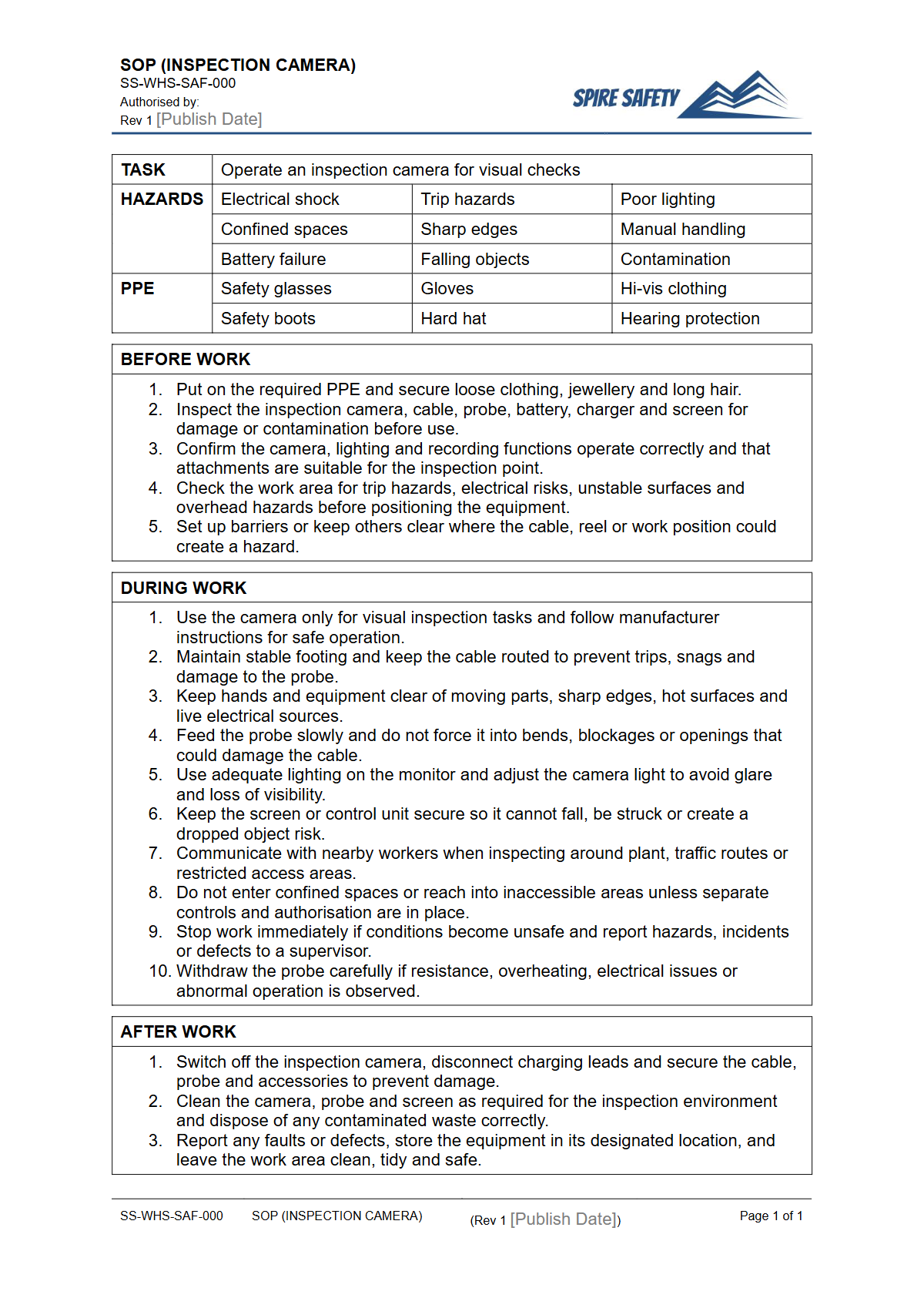
Download our free Safe Operating Procedure (Inspection Camera) Template to outline the safe use of inspection cameras in your workplace.
Free Safe Operating Procedure (Inspection Camera) Template
DOCX • 126 KB + PDF
Updated Oct 2026
No signup required
Purpose of the Free Safe Operating Procedure (Inspection Camera) Template
Using an inspection camera, also known as a borescope or drain snake camera, introduces specific workplace risks that must be managed. This Free Safe Operating Procedure (Inspection Camera) Template provides a structured starting point for your business to document a safe system of work.
An effective SOP is a key administrative control that outlines step-by-step instructions for performing a task safely. It helps operators understand the potential hazards and the control measures required to mitigate them, such as electrical shock, ergonomic strains from handling equipment, and exposure to biological or chemical contaminants in pipes and cavities.
By formalising your procedures, you create a consistent, repeatable process that reduces the likelihood of incidents and supports worker training. This document serves as a practical tool to help meet your duties under Australian WHS legislation, which requires a Person Conducting a Business or Undertaking (PCBU) to provide and maintain a safe work environment.
While this template provides a solid foundation, developing robust safety protocols is a core part of creating comprehensive WHS management systems that protect your team and your business.
Video walkthrough
How to Use the Free Safe Operating Procedure (Inspection Camera) Template
This template is designed for immediate use and customisation. Available in both DOCX and PDF formats, you can download it and begin editing to suit your specific operational needs.
The document is structured logically, covering sections for required PPE, pre-operational checks, step-by-step operating procedures, and post-operational tasks. To use it effectively, you must adapt the content to reflect the exact models of inspection cameras your team uses, the specific environments they work in (e.g., commercial plumbing, HVAC, automotive), and any unique site hazards they may encounter.
Important: It is crucial to remember that this template is a starting point. We have developed it to be customised for your specific workplace, equipment models, and operational context.
A generic SOP that doesn't reflect your actual work practices will not be effective in managing risk. For tasks involving complex machinery, you might also require procedures for other equipment, such as our Free Air Compressor SOP (Safe Operating Procedure) Template, which is often used on the same work sites.
When to Use It
A Safe Operating Procedure for an inspection camera should be integrated into your daily workflow and safety management processes. It is not a document to be filed away and forgotten.
Use it during worker induction and onboarding to provide clear initial instruction. It should also be a central resource for task-specific training and regular refresher courses to ensure ongoing competence.
Furthermore, the SOP should be readily accessible in the work area for quick reference by operators before they begin a task. Following any incident, near miss, or change in equipment or process, the SOP must be reviewed and updated to incorporate any new learnings or control measures. Regular reviews are essential to ensure the procedure remains relevant and effective, a process often formalised through scheduled WHS compliance auditing.
Who Should Use It
This SOP template is intended for a range of personnel within an organisation. WHS Managers and Safety Officers can use it to establish and standardise safe work methods as part of the broader safety framework.
Supervisors and Team Leaders are responsible for implementing the SOP, using it to train their workers and monitor compliance on the ground. They must ensure that all operators have read, understood, and signed off on the procedure before being authorised to use the equipment.
Finally, the operators of the inspection cameras are the primary end-users. The SOP gives them clear, unambiguous instructions to follow, empowering them to work safely and identify when conditions deviate from the established procedure.
This approach fosters a positive safety culture where everyone takes responsibility for their own safety and the safety of others. For other specialised tasks, you can find more procedural documents in our free WHS resources library to support your team.
Similarly, documenting procedures for equipment like trenching machinery using a resource such as our FREE Trencher SOP Template follows the same safety-first principle.
Common mistakes
Common mistakes to avoid
- Failing to inspect the camera, cable, and power source for damage before use.
- Not managing cables effectively, creating significant trip hazards for the operator and others.
- Using the equipment without the correct Personal Protective Equipment (PPE) for the environment, such as gloves and eye protection.
- Neglecting to decontaminate the camera head and cable after use in contaminated areas like drains or sewers.
Legal references
Legal considerations
The following legal requirements may be relevant to this type of work.
- Work Health and Safety Act (Harmonised) — Provides the primary duties for protecting workers and other people from work health and safety risks.
- Work Health and Safety Regulations (Harmonised) — Sets out requirements supporting the management of workplace hazards and risks.
The following codes may be relevant to this type of work.
- Managing WHS Risks Code of Practice — Provides practical guidance on identifying hazards, assessing risks and applying effective controls.
- Work Health and Safety Consultation, Cooperation and Coordination Code of Practice — Provides practical guidance on consulting workers and coordinating with other duty holders.
- Managing the Work Environment and Facilities Code of Practice — Provides practical guidance on safe work environments, workplace facilities and related controls.
Did you know
From Medicine to Maintenance
Inspection cameras, or borescopes, were first developed for medical gastroscopy in the 1950s before being adapted for industrial use to inspect engines and machinery without disassembly.
Confined Space Tool
Many inspection camera tasks occur in or near confined spaces, which have their own strict WHS regulations regarding risk assessment, entry permits, monitoring, and rescue plans.
FAQ
Frequently asked questions
01What hazards are associated with using an inspection camera?
02Does this inspection camera SOP cover maintenance activities?
03Is an SOP a legal requirement for inspection cameras in Australia?
04How often should we review our Safe Operating Procedure for inspection cameras?
Share this resource
Free Safe Operating Procedure (Inspection Camera) Template
Browse Categories
How To Use It
- 1Download and open in Word or PDF.
- 2Replace the placeholders with your business details.
- 3Get it reviewed by a WHS specialist before rollout.
Need it customised?
Our WHS consultants can adapt this template to your site, run a gap analysis, or audit what you already have in place.
Book a Free Consultation WHS consulting servicesor call 1300 156 382
Related templates
- Free Safe Operating Procedure (Instrument Washer) Template
- Free Safe Operating Procedure (Insulation Tester) Template
- Free Safe Operating Procedure (Intercom Panel Cleaning) Template
- Free Safe Operating Procedure (Irrigation Filter Clean) Template
- Free Safe Operating Procedure (Irrigation Head Check) Template
- Free Safe Operating Procedure (Irrigation Leak Repair) Template