
Free Safe Operating Procedure (Infrared Thermometer) Template
Download our free Safe Operating Procedure for infrared thermometers to document safe work methods. This template helps standardise use and control risks.
Free Safe Operating Procedure (Infrared Thermometer) Template
DOCX • 126 KB + PDF
Updated Oct 2026
No signup required
Purpose of the Free Safe Operating Procedure (Infrared Thermometer) Template
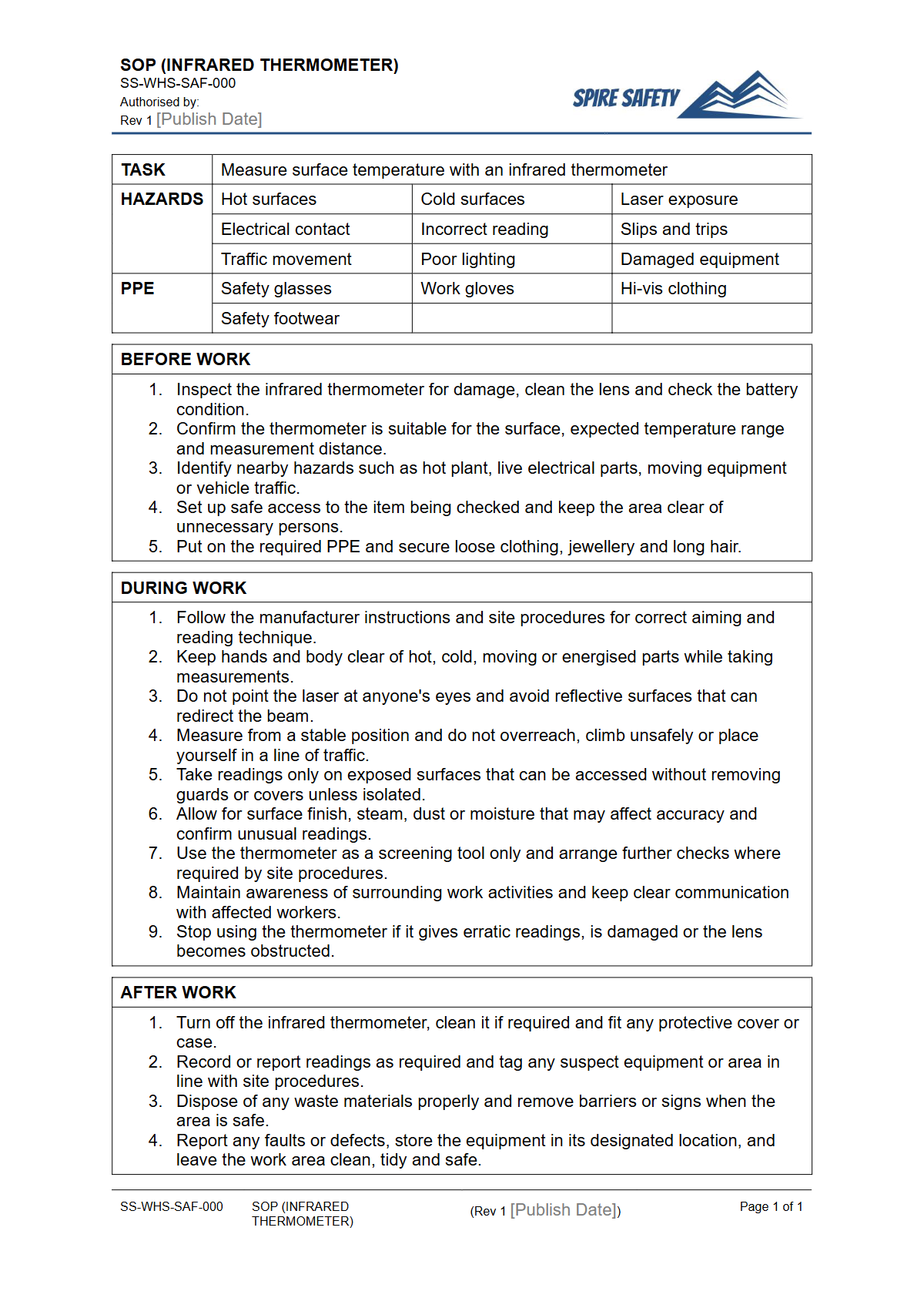
An infrared thermometer is a valuable tool for non-contact temperature measurement across various industries, from hospitality to industrial maintenance. This Free Safe Operating Procedure (Infrared Thermometer) Template provides a structured framework for documenting the safe and correct use of this equipment.
Its purpose is to minimise risks, such as inaccurate readings or laser-related hazards, and to ensure that all workers follow a consistent, safe method. By implementing a formal SOP, your organisation can standardise procedures for tasks like checking food temperatures, monitoring electrical panels for overheating components, or diagnosing HVAC system faults.
A well-defined SOP is a fundamental component of a safe system of work. For example, when used in a commercial kitchen, this procedure complements other safety documents like a deep fryer SOP template by ensuring all temperature-critical control points are managed safely and effectively.
It serves as a key training resource for new employees and a reference point for experienced personnel, helping to embed a proactive safety culture within your team.
Video walkthrough
How to use the Free Safe Operating Procedure (Infrared Thermometer) Template
This Safe Operating Procedure template is provided in both DOCX and PDF formats to suit your organisation's needs. To use it effectively, download the file and integrate it into your safety management system.
The document is designed as a comprehensive starting point, but it requires customisation to reflect the specific context of your workplace. You must add your company name, identify the persons responsible for implementing and reviewing the procedure, and detail the specific models of infrared thermometers in use.
Review each step in the template and adapt it to align with your operational tasks and the manufacturer’s instructions for your equipment. This includes defining the exact applications (e.g., checking switchboard terminals, monitoring bearing temperatures), setting clear temperature limits, and specifying personal protective equipment (PPE) if required.
A robust SOP is a vital part of your overall WHS management systems, demonstrating your commitment to managing workplace hazards.
Please note: We have drafted this template to be a solid starting point. You must customise it with your specific workplace details, equipment models, and identified hazards to ensure it is fit for purpose at your site.
When to use it
An SOP for an infrared thermometer should be developed and used in any workplace where non-contact temperature measurement is part of a work task, especially where safety is a factor. Key scenarios include:
- Food Safety: In kitchens, cafes, and food production facilities to check the surface temperature of food during cooking, cooling, and holding, ensuring it remains outside the temperature danger zone (5°C to 60°C).
- Electrical Maintenance: By electricians and technicians to scan electrical panels, circuit breakers, and connections for hot spots that indicate a potential failure or fire risk, without making physical contact.
- Mechanical Maintenance: To monitor the temperature of motors, bearings, and other moving parts to detect overheating, which can be an early sign of wear or failure. This is often done alongside maintenance on other equipment covered by documents like a free Air Compressor SOP template.
- HVAC Systems: For technicians to diagnose issues with heating, ventilation, and air conditioning systems by checking temperatures at vents, coils, and compressors.
Who should use it
This Safe Operating Procedure should be used by any worker or contractor tasked with using an infrared thermometer as part of their job. This includes a diverse range of roles, such as:
- Chefs and kitchen staff
- Maintenance electricians and technicians
- Mechanical fitters and engineers
- HVAC specialists
- Building and facility managers
- Quality assurance personnel
Furthermore, supervisors and managers have a responsibility to ensure that the SOP is understood, followed, and enforced. They must provide adequate training and verify competency.
The effectiveness of these procedures is often verified during safety reviews and WHS compliance auditing, where auditors check for evidence of documented processes and consistent implementation.
Key elements of an effective SOP
A comprehensive SOP for an infrared thermometer should cover several critical areas to be effective. The template guides you through identifying hazards like the laser pointer and specifying controls, such as never pointing it at a person.
It includes sections for pre-operational checks, like verifying battery life and cleanliness of the lens. The core of the document is the step-by-step operating procedure, which should be customised to detail how to take a reading correctly, considering factors like distance-to-spot ratio and emissivity settings for different surfaces.
If you need assistance developing and implementing these kinds of detailed procedures, engaging professional WHS consulting services can provide expert guidance.
After completing your customisation, ensure the document is formally approved, and a version history is maintained. Use it as a central part of your training program for all relevant workers. You can find more templates and checklists to support your safety management system in our free WHS resources library.
Common mistakes
Common mistakes to avoid
- Pointing the laser pointer at a person's eyes.
- Taking a measurement from too far away, causing the spot size to be larger than the target.
- Ignoring or incorrectly setting the emissivity for different material surfaces.
- Using a thermometer with low batteries, which can compromise reading accuracy.
Legal references
Legal considerations
The following legal requirements may be relevant to this type of work.
- Work Health and Safety Act (Harmonised) — Provides the primary duties for protecting workers and other people from work health and safety risks.
- Work Health and Safety Regulations (Harmonised) — Sets out requirements supporting the management of workplace hazards and risks.
The following codes may be relevant to this type of work.
- Managing WHS Risks Code of Practice — Provides practical guidance on identifying hazards, assessing risks and applying effective controls.
- Work Health and Safety Consultation, Cooperation and Coordination Code of Practice — Provides practical guidance on consulting workers and coordinating with other duty holders.
- Managing the Work Environment and Facilities Code of Practice — Provides practical guidance on safe work environments, workplace facilities and related controls.
Did you know
Distance-to-Spot Ratio
Every infrared thermometer has a 'distance-to-spot' (D:S) ratio, like 12:1. This means at 12 metres away, it measures the temperature of a 1-metre-wide spot. The further away you are, the larger the area it measures, which can lead to inaccurate readings if you're targeting a small component.
Not for Shiny Surfaces
Infrared thermometers struggle to read shiny, reflective surfaces like polished stainless steel or aluminium accurately. The low emissivity of these materials causes the thermometer to reflect ambient temperatures, giving a false reading. A piece of non-reflective tape can be applied to the surface to get a more reliable measurement.
FAQ
Frequently asked questions
01What are the main hazards when using an infrared thermometer?
02How often should an infrared thermometer be calibrated?
03What is emissivity and why is it important?
04Can this type of thermometer be used for human fever screening?
Share this resource
Free Safe Operating Procedure (Infrared Thermometer) Template
Browse Categories
How To Use It
- 1Download and open in Word or PDF.
- 2Replace the placeholders with your business details.
- 3Get it reviewed by a WHS specialist before rollout.
Need it customised?
Our WHS consultants can adapt this template to your site, run a gap analysis, or audit what you already have in place.
Book a Free Consultation WHS consulting servicesor call 1300 156 382
Related templates
- Free Safe Operating Procedure (Ingredient Decanting) Template
- Free Safe Operating Procedure (Injector Cleaning) Template
- Free Safe Operating Procedure (Inkjet Coder) Template
- Free Safe Operating Procedure (Inspection Camera) Template
- Free Safe Operating Procedure (Instrument Washer) Template
- Free Safe Operating Procedure (Insulation Tester) Template