
Free Safe Operating Procedure (Industrial Vacuum) Template
Download our free Safe Operating Procedure for industrial vacuums to formalise safe work methods and manage hazards. Get your customisable DOCX template today.
Free Safe Operating Procedure (Industrial Vacuum) Template
DOCX • 126 KB + PDF
Updated Oct 2026
No signup required
Purpose of the Free Safe Operating Procedure (Industrial Vacuum) Template
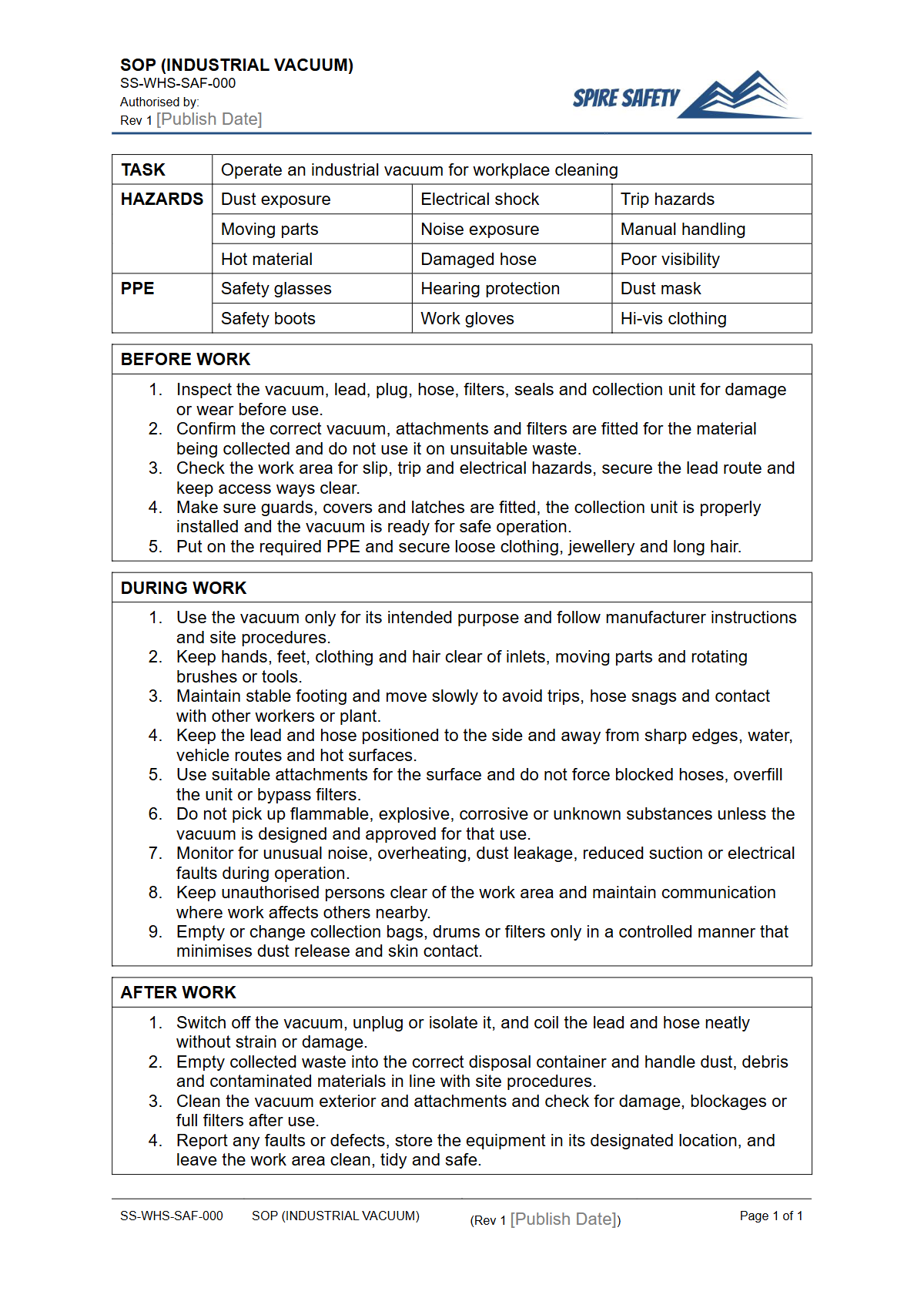
This free Safe Operating Procedure (Industrial Vacuum) template provides a structured framework for documenting the safe use of industrial vacuum cleaners in your workplace. Its primary purpose is to standardise operating steps, clearly identify potential hazards, and specify the control measures required to mitigate risks.
By formalising these procedures, you create a reliable reference for workers, helping to prevent incidents related to electrical hazards, hazardous dust exposure, noise, and manual handling.
A well-developed SOP is a cornerstone of effective safety training and competency verification for operators. It forms a critical component of implementing a robust WHS management system, ensuring consistency in how tasks are performed and promoting a proactive safety culture.
Using this template helps your organisation meet its duty of care by systematically managing the risks associated with this common piece of industrial equipment.
Video walkthrough
How to use the Free Safe Operating Procedure (Industrial Vacuum) Template
Our free Safe Operating Procedure (Industrial Vacuum) template is available for immediate download in both DOCX and PDF formats. The DOCX file is fully editable, allowing you to adapt it to your specific operational needs. To effectively implement this SOP, follow these steps:
- Download the template and open the DOCX file.
- Consult with experienced operators, supervisors, and WHS personnel.
- Customise the document with site-specific information, including the make and model of your industrial vacuums, work locations, and specific tasks.
- Detail the required Personal Protective Equipment (PPE) based on your risk assessment, such as hearing protection, respiratory masks, and safety glasses.
- Outline pre-start checks, step-by-step operating instructions, and cleaning and maintenance procedures.
- Define the emergency procedures, including shutdown steps and who to contact.
- Once finalised and approved, use the SOP as a central part of your training program for all relevant workers.
This template provides a structured starting point aligned with Australian WHS practice. We must stress: it needs to be carefully customised to reflect the specific industrial vacuum models, tasks, and unique hazards present in your workplace.
When to use it
A Safe Operating Procedure for an industrial vacuum should be used as a primary reference document in several key situations. It is essential for inducting new employees or training workers who are new to operating the equipment.
The SOP should be readily available in the work area for operators to consult at any time, especially when performing non-routine tasks or encountering an unexpected issue.
Furthermore, this procedure should be a key document during refresher training sessions to reinforce safe work habits. It also serves as a crucial reference point when conducting incident investigations or reviewing processes after a near miss.
It also serves as a key reference document during regular WHS compliance auditing to verify that established procedures are being followed correctly.
Who should use it
This Safe Operating Procedure is intended for use by several groups within an organisation to ensure a consistent and safe approach to equipment operation.
Key users include:
- Operators: Workers who use the industrial vacuum should follow the SOP as a direct, step-by-step guide to perform their tasks safely.
- Supervisors and Managers: Team leaders and managers use the SOP to train their staff, supervise work, and supports your compliance efforts with established safety protocols. They are responsible for making sure the procedure is understood and followed.
- WHS Professionals: Health and safety advisors and officers use this document as part of the overall safety management system. They assist in its development, review, and integration with broader risk assessments and training programs. This SOP is essential for anyone directly involved with the equipment, just as a Conveyer System SOP template is vital for operators of that machinery.
For operations involving larger, vehicle-mounted equipment, our free Vacuum Truck SOP provides a more specialised template. Ensuring correct documentation is in place for all plant and equipment is a fundamental WHS requirement.
For other common industrial plant, you might also require our free Air Compressor SOP to ensure consistent safety standards across your site.
Common mistakes
Common mistakes to avoid
- Using a generic template without customising it for specific machine models and workplace conditions.
- Failing to consult with operators when drafting or reviewing the procedure, leading to impractical steps.
- Not providing adequate training on the SOP, assuming workers will read and understand it on their own.
- Neglecting to review and update the SOP after an incident or when a new hazard is identified.
Legal references
Legal considerations
The following legal requirements may be relevant to this type of work.
- Work Health and Safety Act (Harmonised) — Provides the primary duties for protecting workers and other people from work health and safety risks.
- Work Health and Safety Regulations (Harmonised) — Sets out requirements supporting the management of workplace hazards and risks.
The following codes may be relevant to this type of work.
- Managing WHS Risks Code of Practice — Provides practical guidance on identifying hazards, assessing risks and applying effective controls.
- Work Health and Safety Consultation, Cooperation and Coordination Code of Practice — Provides practical guidance on consulting workers and coordinating with other duty holders.
- Managing the Work Environment and Facilities Code of Practice — Provides practical guidance on safe work environments, workplace facilities and related controls.
Did you know
Dust Dangers
Some industrial dusts, like those from wood or flour, can be combustible. If suspended in the air in the right concentration, they can be ignited by a spark from machinery, causing a serious explosion.
Noise Exposure
The noise from an industrial vacuum can easily exceed 85 decibels (dB), the level at which hearing protection becomes mandatory under Australian WHS regulations to prevent long-term hearing damage.
FAQ
Frequently asked questions
01What must be included in an SOP for an industrial vacuum?
02How often should a Safe Operating Procedure be reviewed?
03Is an SOP the same as a risk assessment?
04Who is responsible for writing an SOP?
Share this resource
Free Safe Operating Procedure (Industrial Vacuum) Template
Browse Categories
How To Use It
- 1Download and open in Word or PDF.
- 2Replace the placeholders with your business details.
- 3Get it reviewed by a WHS specialist before rollout.
Need it customised?
Our WHS consultants can adapt this template to your site, run a gap analysis, or audit what you already have in place.
Book a Free Consultation WHS consulting servicesor call 1300 156 382
Related templates
- Free Safe Operating Procedure (Infrared Thermometer) Template
- Free Safe Operating Procedure (Ingredient Decanting) Template
- Free Safe Operating Procedure (Injector Cleaning) Template
- Free Safe Operating Procedure (Inkjet Coder) Template
- Free Safe Operating Procedure (Inspection Camera) Template
- Free Safe Operating Procedure (Instrument Washer) Template