
Free Safe Operating Procedure (Induction Heater) Template
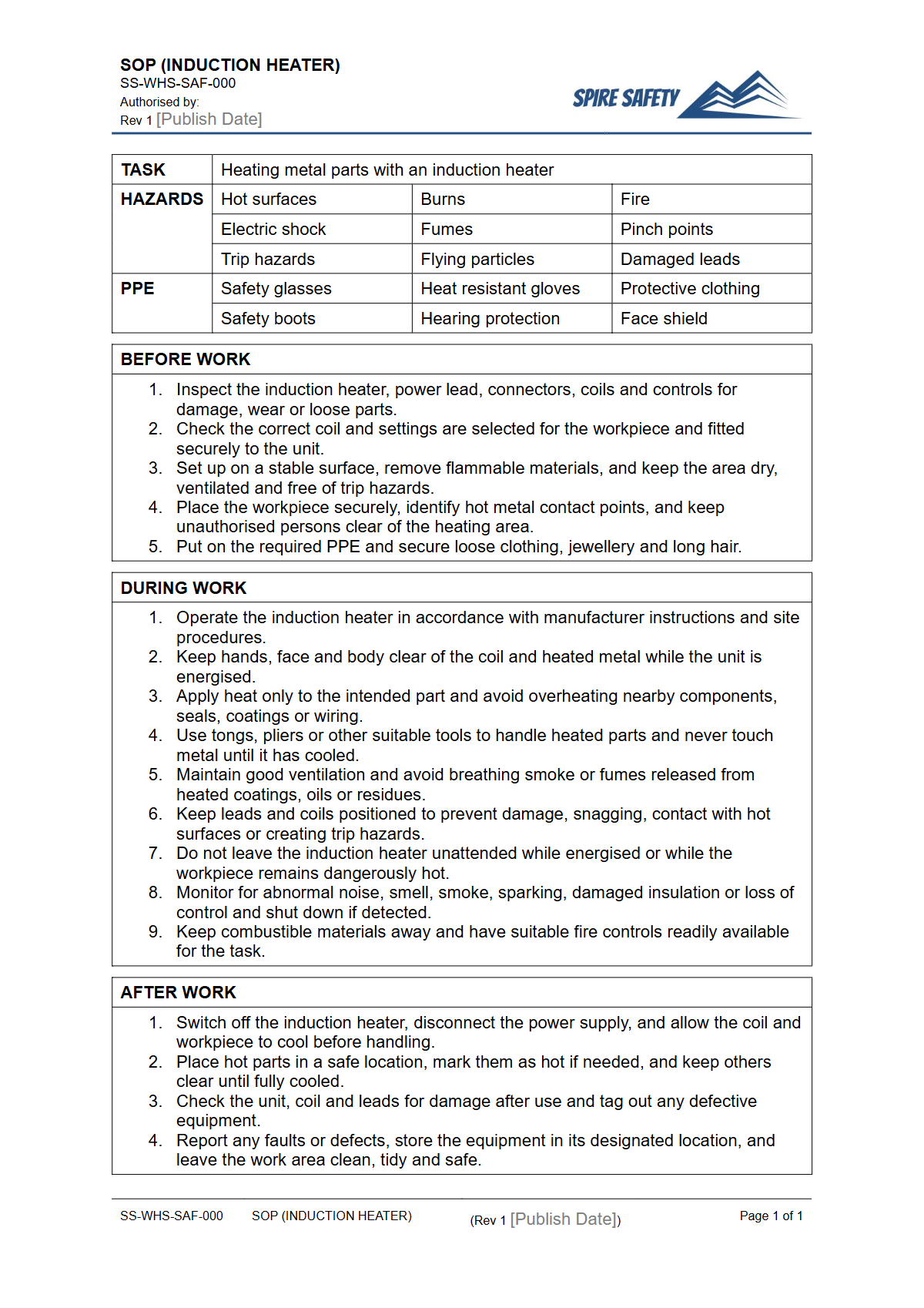
Develop a clear process for the safe use of induction heaters in your workplace. Download our free Safe Operating Procedure (Induction Heater) Template.
Free Safe Operating Procedure (Induction Heater) Template
DOCX • 126 KB + PDF
Updated Oct 2026
No signup required
Purpose of the Free Safe Operating Procedure (Induction Heater) Template
Induction heaters are powerful tools used in workshops, manufacturing, and automotive repair for heating metallic parts without an open flame. However, they introduce significant hazards, including severe burns from hot components, electrical risks, and exposure to strong electromagnetic fields (EMFs).
This Free Safe Operating Procedure (Induction Heater) Template provides a structured starting point for documenting the essential safety measures required to control these risks. It is designed to help your organisation establish a formal, repeatable process for the safe use of this equipment.
A well-developed Safe Operating Procedure (SOP) is a fundamental component of a safe system of work. It outlines potential hazards, specifies necessary personal protective equipment (PPE), and provides clear, step-by-step instructions for pre-operational checks, operation, and shutdown.
Formalising this process helps ensure all workers operate the equipment consistently and safely, reducing the likelihood of incidents and injuries. Implementing documented procedures like this is a key part of building robust and comprehensive WHS management systems.
Video walkthrough
How to use the Free Safe Operating Procedure (Induction Heater) Template
This template is provided in both DOCX and PDF formats for your convenience. The DOCX file is fully editable, allowing you to tailor it to the specific requirements of your workplace and the induction heater model you use.
It is crucial to adapt the content to reflect your site-specific risk assessment findings.
To effectively use this template, follow these steps:
- Download: Choose your preferred format (DOCX for editing or PDF for reference).
- Customise: This is the most critical step. You must review and edit the document to align with your specific equipment, tasks, and operational environment. We have included common hazards and controls, but you must add, remove, or modify sections based on the manufacturer’s instructions for your particular machine and your own risk assessment.
- Consult: Involve workers who operate the induction heater in the drafting and review process. Their hands-on experience is invaluable for creating a practical and effective procedure.
- Approve: Once finalised, the SOP should be formally approved by a manager or supervisor.
- Train: All relevant personnel must be trained on the contents of the final, approved SOP before they are authorised to use the equipment.
Many workplaces use a variety of powered equipment, each requiring its own documented procedure. For other common workshop machinery, you might find our Air Compressor SOP template a useful companion resource.
When to use a Safe Operating Procedure
An SOP for an induction heater should be used in several key situations. It forms the basis of initial training and competency assessment for new operators.
It should also be readily available at the point of use as a quick reference guide for workers before they start a task. Furthermore, the SOP is an essential document during incident investigations and should be reviewed as part of any post-incident analysis.
Supervisors can use the SOP as a checklist during safety observations to verify that correct procedures are being followed. Regular review of SOPs is also a critical activity that demonstrates proactive safety management, a process often verified through regular WHS compliance auditing to ensure ongoing effectiveness and alignment with best practice.
Who should use this resource
This Safe Operating Procedure template is designed for use by Persons Conducting a Business or Undertaking (PCBUs), WHS managers, supervisors, and team leaders. These roles are responsible for ensuring that safe work systems are developed, implemented, and maintained.
While they lead the development, the final document is for the workers who operate the equipment daily.
Every operator must be trained on the specific procedures outlined in the finalised SOP. This ensures they understand the risks and the required control measures needed to protect themselves and others.
Just as with other heating equipment, such as that covered in a deep fryer operation SOP, clear instructions are non-negotiable for high-risk tasks. Documenting these processes helps fulfil the primary duty of care under Australian WHS legislation.
If you require assistance with conducting the necessary risk assessments or customising procedures for complex or high-risk machinery, consider engaging our specialist WHS consulting services for expert guidance. You can also explore hundreds of other documents in our complete free WHS resources library to support your safety management system.
Common mistakes
Common mistakes to avoid
- Using incorrect, worn, or damaged heating coils for the specific application.
- Failing to wear appropriate personal protective equipment (PPE), especially thermal-resistant gloves and safety glasses.
- Neglecting to check the manufacturer’s guidelines on safe distances for electromagnetic field (EMF) exposure.
- Operating the unit in a wet or poorly ventilated environment, increasing electrical and fume-related risks.
Legal references
Legal considerations
The following legal requirements may be relevant to this type of work.
- Work Health and Safety Act (Harmonised) — Provides the primary duties for protecting workers and other people from work health and safety risks.
- Work Health and Safety Regulations (Harmonised) — Sets out requirements supporting the management of workplace hazards and risks.
The following codes may be relevant to this type of work.
- Managing WHS Risks Code of Practice — Provides practical guidance on identifying hazards, assessing risks and applying effective controls.
- Work Health and Safety Consultation, Cooperation and Coordination Code of Practice — Provides practical guidance on consulting workers and coordinating with other duty holders.
- Managing the Work Environment and Facilities Code of Practice — Provides practical guidance on safe work environments, workplace facilities and related controls.
Did you know
EMF Exposure Risks
Induction heaters generate strong electromagnetic fields. Workers with pacemakers, insulin pumps, or other active medical implants must maintain a safe distance as specified by the manufacturer's guidelines and their medical professional.
No Open Flame
Unlike traditional gas torches, induction heating creates no flame. This significantly reduces the risk of fire and ignition of flammable vapours, making it a safer option for use in automotive workshops and confined spaces.
FAQ
Frequently asked questions
01What are the main hazards of using an induction heater?
02Is an SOP legally required for an induction heater in Australia?
03How often should an induction heater SOP be reviewed?
04Can this template be used for any brand of induction heater?
Share this resource
Free Safe Operating Procedure (Induction Heater) Template
Browse Categories
How To Use It
- 1Download and open in Word or PDF.
- 2Replace the placeholders with your business details.
- 3Get it reviewed by a WHS specialist before rollout.
Need it customised?
Our WHS consultants can adapt this template to your site, run a gap analysis, or audit what you already have in place.
Book a Free Consultation WHS consulting servicesor call 1300 156 382
Related templates
- Free Safe Operating Procedure (Industrial Fan) Template
- Free Safe Operating Procedure (Industrial Robot) Template
- Free Safe Operating Procedure (Industrial Sewing Machine) Template
- Free Safe Operating Procedure (Industrial Vacuum) Template
- Free Safe Operating Procedure (Infrared Thermometer) Template
- Free Safe Operating Procedure (Ingredient Decanting) Template