
Free Safe Operating Procedure (Industrial Fan) Template
Our free Safe Operating Procedure (Industrial Fan) template provides a structured starting point for your workplace safety. Download the DOCX and PDF now.
Free Safe Operating Procedure (Industrial Fan) Template
DOCX • 126 KB + PDF
Updated Oct 2026
No signup required
Purpose of the Free Safe Operating Procedure (Industrial Fan) Template
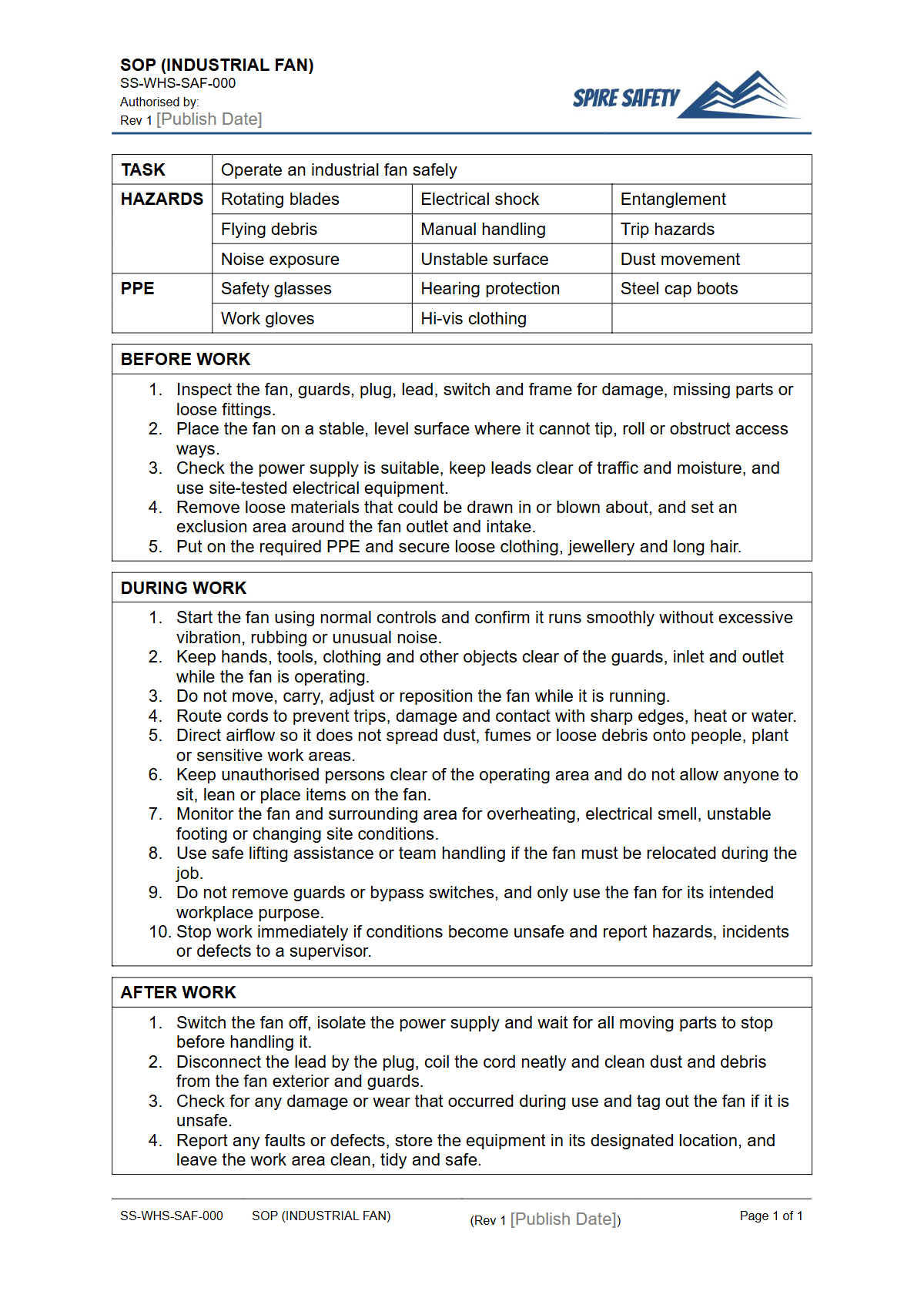
This free Safe Operating Procedure (Industrial Fan) template provides a structured framework for documenting the safe use of large-scale industrial and ventilation fans in your workplace. Its primary purpose is to help your organisation manage risks and outline clear, step-by-step instructions for operators.
Using this SOP helps standardise pre-start checks, operation, shutdown, cleaning, and basic maintenance tasks, minimising the risk of incidents involving moving parts, electrical hazards, or unexpected start-ups.
A documented SOP is a critical component of any safety management system. It serves as a key training resource for new workers and a reference for experienced personnel, ensuring everyone follows the same safe work methods.
Formalising your procedures also demonstrates a commitment to meeting your duties under Australian WHS legislation. Similar to how our free Air Compressor SOP template helps manage risks for that specific plant, this document is tailored to the unique hazards of industrial fans.
What's included in the template?
The template is delivered in a fully editable DOCX format, allowing extensive customisation. It includes sections for:
- Required Personal Protective Equipment (PPE)
- Pre-operational safety checks
- Step-by-step operating instructions
- Post-operation and shutdown procedures
- Maintenance and cleaning guidelines (including lockout/tagout)
- Emergency procedures and contacts
Video walkthrough
How to use the Free Safe Operating Procedure (Industrial Fan) Template
Using this template is straightforward. First, download the file in your preferred format (DOCX for editing or PDF for reference).
Next, review the document and adapt its contents to match the specific make and model of industrial fan used at your site, the environment it operates in, and any state-specific WHS regulations that apply. This involves conducting a thorough risk assessment for the task.
Important: This document is a template and must be customised to your workplace. We have provided a structured starting point aligned with Australian WHS principles, but it is your responsibility to ensure the final SOP is specific to your equipment, operational context, and internal procedures.
Always consult the manufacturer’s operating manual and integrate its recommendations.
Once customised, the SOP should be integrated into your broader WHS management systems. This involves making it accessible to all relevant workers, incorporating it into training programs, and scheduling regular reviews to ensure it remains current and effective.
When to use an Industrial Fan SOP
A Safe Operating Procedure for an industrial fan should be used consistently as a primary reference document for all interactions with the equipment. It is not a document to be filed away and forgotten.
Workers should refer to it during pre-start inspections to ensure all guards are in place and the unit is safe to energise. It also guides the correct sequence for starting, operating, and stopping the fan safely.
The SOP is especially critical before any maintenance, cleaning, or repair work begins. It should clearly detail the lockout/tagout (LOTO) procedure required to isolate the fan from its energy source, preventing accidental activation.
This process is fundamental for protecting workers, much like the safety protocols detailed in our free Conveyer System SOP for similar high-risk maintenance tasks.
Who should use it
This template is designed for use by Persons Conducting a Business or Undertaking (PCBUs), WHS managers, supervisors, and team leaders responsible for drafting and implementing safety documentation. They will perform the initial customisation to ensure the SOP accurately reflects site-specific risks and control measures.
Operators and maintenance personnel are the primary end-users of the completed SOP. It provides them with clear, authoritative instructions to follow, reinforcing safe work habits and providing a reliable guide for non-routine situations.
Regular WHS compliance auditing activities will often involve checking that workers are familiar with and are following the established SOPs for high-risk plant.
The principles of documenting safe procedures for plant with high-speed moving parts are transferable. Just as you would detail specific safety steps for power tools using a resource like our free Circular Saw SOP, this template helps apply that same rigour to industrial fans.
You can find many other useful documents in our free WHS resources library to support your safety goals.
Common mistakes
Common mistakes to avoid
- Failing to perform pre-start checks on guards and emergency stops.
- Using fans not rated for potentially explosive or corrosive atmospheres.
- Neglecting to follow formal lockout/tagout (LOTO) procedures before maintenance or cleaning.
- Incorrectly positioning the fan, which can create unintended wind tunnels or block emergency exits.
Legal references
Legal considerations
The following legal requirements may be relevant to this type of work.
- Work Health and Safety Act (Harmonised) — Provides the primary duties for protecting workers and other people from work health and safety risks.
- Work Health and Safety Regulations (Harmonised) — Sets out requirements supporting the management of workplace hazards and risks.
The following codes may be relevant to this type of work.
- Managing WHS Risks Code of Practice — Provides practical guidance on identifying hazards, assessing risks and applying effective controls.
- Work Health and Safety Consultation, Cooperation and Coordination Code of Practice — Provides practical guidance on consulting workers and coordinating with other duty holders.
- Managing the Work Environment and Facilities Code of Practice — Provides practical guidance on safe work environments, workplace facilities and related controls.
Did you know
Airflow Power
A single large industrial fan, like those used in warehouses or mines, can move over 1 million cubic feet of air per minute (CFM). This immense power is why robust guarding and safe procedures are essential.
The 'Finger Test' Myth
The outdated 'finger test' to check if a fan guard is safe is a dangerous myth. Australian Standard AS/NZS 4024.1 specifies precise measurements for guarding openings based on their distance from the hazard zone to prevent access by body parts.
FAQ
Frequently asked questions
01What hazards are associated with industrial fans?
02How often should a Safe Operating Procedure for an industrial fan be reviewed?
03Is training required to operate an industrial fan?
04What should be included in an emergency procedure for an industrial fan incident?
Share this resource
Free Safe Operating Procedure (Industrial Fan) Template
Browse Categories
How To Use It
- 1Download and open in Word or PDF.
- 2Replace the placeholders with your business details.
- 3Get it reviewed by a WHS specialist before rollout.
Need it customised?
Our WHS consultants can adapt this template to your site, run a gap analysis, or audit what you already have in place.
Book a Free Consultation WHS consulting servicesor call 1300 156 382
Related templates
- Free Safe Operating Procedure (Industrial Robot) Template
- Free Safe Operating Procedure (Industrial Sewing Machine) Template
- Free Safe Operating Procedure (Industrial Vacuum) Template
- Free Safe Operating Procedure (Infrared Thermometer) Template
- Free Safe Operating Procedure (Ingredient Decanting) Template
- Free Safe Operating Procedure (Injector Cleaning) Template