
Free Safe Operating Procedure (Inboard Motor) Template
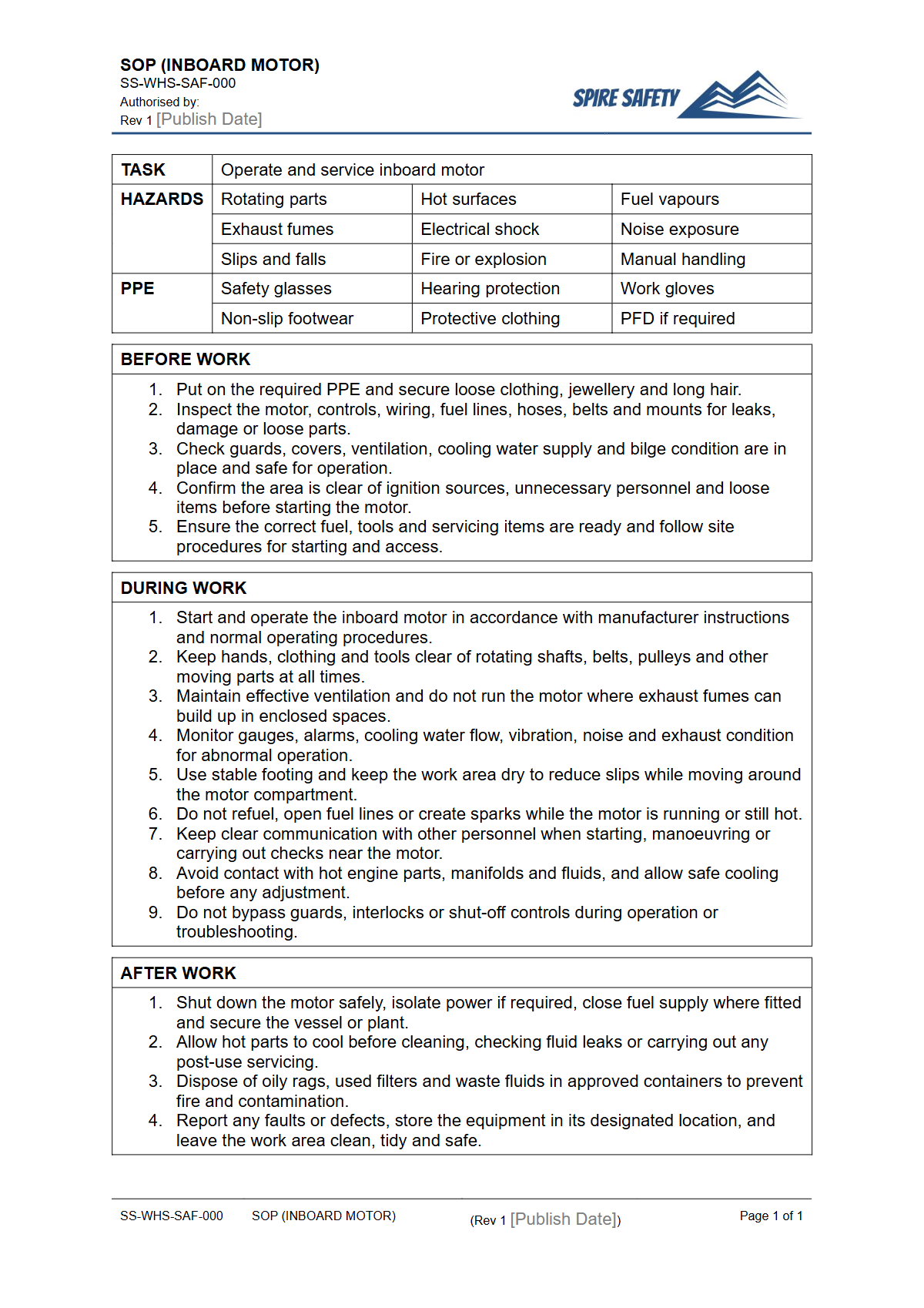
Download our free Safe Operating Procedure (Inboard Motor) Template. This customisable DOCX and PDF provides a structured starting point for your safety docs.
Free Safe Operating Procedure (Inboard Motor) Template
DOCX • 126 KB + PDF
Updated Oct 2026
No signup required
Purpose of the Free Safe Operating Procedure (Inboard Motor) Template
A well-documented Safe Operating Procedure (SOP) is essential for managing the significant risks associated with operating and maintaining inboard motors. Our free Safe Operating Procedure (Inboard Motor) Template provides a structured starting point for your organisation to formalise its safety processes.
It helps you systematically identify hazards such as moving parts, high temperatures, electrical systems, fuel handling, and potential carbon monoxide exposure. Documenting these procedures ensures that all personnel follow a consistent, safe method of work every time.
Using a standardised format helps communicate risk controls clearly, forming a critical part of your overall safety management framework. Formal procedures are not just for complex equipment; even seemingly straightforward machinery requires clear guidance to prevent incidents. For instance, documenting procedures for other common plant like an air compressor is equally important, which is why we also provide resources like our free Air Compressor SOP.
Video walkthrough
How to use the Free Safe Operating Procedure (Inboard Motor) Template
This template is designed to be a foundation, not a final document. To make it effective, you must adapt it to your specific workplace, equipment, and tasks.
Start by downloading the DOCX or PDF and engaging in consultation with the workers who actually operate and service the inboard motors. Their direct experience is invaluable for identifying practical hazards and effective control measures.
You should add specific details such as the make and model of the motor, the environment it operates in (e.g., enclosed space, marine vessel), and any unique modifications. Integrate the finalised SOP into your broader WHS management systems, ensuring it's used for training, inductions, and risk assessments.
Remember, an SOP is a living document that should evolve with your operational needs.
A Note on Customisation
We have created this template as a guide based on common Australian WHS practices. You are responsible for ensuring the final document is comprehensive and accurately reflects the specific risks and control measures relevant to your site.
We are not liable for any incidents that may occur; the responsibility for creating a safe workplace rests with the PCBU (Person Conducting a Business or Undertaking).
When to use a Safe Operating Procedure
An SOP for an inboard motor should be developed and implemented before any worker is permitted to operate or perform maintenance on the equipment. It serves as a primary training tool for new and young workers, ensuring they understand the approved methods from day one.
It should also be used for regular refresher training to prevent complacency and reinforce safe work habits. Furthermore, the SOP must be reviewed and updated following any incident or near miss, when new equipment is introduced, or when a work process changes.
This proactive approach applies to all types of machinery, not just engines. Having clear instructions for tasks involving high-risk tools is fundamental to workplace safety, as shown in the guidance provided by our free Circular Saw SOP.
Who should use this document
This Safe Operating Procedure should be used by several key groups within an organisation. Persons Conducting a Business or Undertaking (PCBUs) and their management teams are responsible for ensuring such procedures are developed, implemented, and maintained.
Supervisors must use the SOP to train and oversee workers, ensuring compliance with the documented steps. Most importantly, operators and maintenance personnel must use the SOP as their guide for performing tasks safely.
Competency is key; no worker should operate an inboard motor without being trained on the specific contents of the finalised SOP. If you require assistance in developing or implementing these critical safety documents, consider engaging professional WHS consulting services to ensure your processes are robust and effective.
The template includes sections for pre-operational checks, step-by-step operating instructions, shutdown procedures, and required Personal Protective Equipment (PPE). This comprehensive structure helps ensure no critical safety step is overlooked.
For other examples of structured procedures, you can review our free Conveyer System SOP template to see how similar principles apply to different machinery.
By thoroughly customising this template, you create a valuable tool that not only aids compliance but actively contributes to a safer working environment. The process of developing the SOP itself—involving consultation and risk analysis—is a powerful safety exercise. For more templates and safety documents, you can explore our complete free WHS resources library.
Common mistakes
Common mistakes to avoid
- Using a generic template without adding site-specific details about the motor and tasks.
- Failing to adequately train workers on the contents of the finalised SOP.
- Not involving experienced operators and maintenance staff during the drafting process.
- Forgetting to review and update the SOP after a near miss, incident, or change in equipment.
Legal references
Legal considerations
The following legal requirements may be relevant to this type of work.
- Work Health and Safety Act (Harmonised) — Provides the primary duties for protecting workers and other people from work health and safety risks.
- Work Health and Safety Regulations (Harmonised) — Sets out requirements supporting the management of workplace hazards and risks.
The following codes may be relevant to this type of work.
- Managing WHS Risks Code of Practice — Provides practical guidance on identifying hazards, assessing risks and applying effective controls.
- Work Health and Safety Consultation, Cooperation and Coordination Code of Practice — Provides practical guidance on consulting workers and coordinating with other duty holders.
- Managing the Work Environment and Facilities Code of Practice — Provides practical guidance on safe work environments, workplace facilities and related controls.
Did you know
Silent Danger
An inboard engine running in a poorly ventilated space can produce lethal concentrations of carbon monoxide (CO) in just a few minutes. CO is colourless and odourless, making CO detectors and proper ventilation critical safety controls.
Water Injection
Many marine inboard engines use a wet exhaust system, where water is injected into the exhaust pipe to cool it down. A failure in this system can cause the engine to overheat or, in some cases, allow water to flow back into the engine cylinders, causing catastrophic damage.
FAQ
Frequently asked questions
01What is a Safe Operating Procedure (SOP) for an inboard motor?
02Is this free inboard motor SOP template ready to use immediately?
03Who is responsible for creating and implementing the SOP?
04How often should a Safe Operating Procedure be reviewed?
Share this resource
Free Safe Operating Procedure (Inboard Motor) Template
Browse Categories
How To Use It
- 1Download and open in Word or PDF.
- 2Replace the placeholders with your business details.
- 3Get it reviewed by a WHS specialist before rollout.
Need it customised?
Our WHS consultants can adapt this template to your site, run a gap analysis, or audit what you already have in place.
Book a Free Consultation WHS consulting servicesor call 1300 156 382
Related templates
- Free Safe Operating Procedure (Inbound Freight Check) Template
- Free Safe Operating Procedure (Inbound Load Staging) Template
- Free Safe Operating Procedure (Incontinence Linen Bag) Template
- Free Safe Operating Procedure (Incubator) Template
- Free Safe Operating Procedure (Induction Cooktop) Template
- Free Safe Operating Procedure (Induction Heater) Template