
Free Safe Operating Procedure (Inbound Load Staging) Template
Streamline your receiving process with our free Safe Operating Procedure for inbound load staging. Download this customisable template to get started.
Free Safe Operating Procedure (Inbound Load Staging) Template
DOCX • 126 KB + PDF
Updated Oct 2026
No signup required
Purpose of the Free Safe Operating Procedure (Inbound Load Staging) Template
Managing the flow of inbound goods is a critical control point for any business. The process of receiving and staging loads introduces significant risks, including vehicle-pedestrian interactions, manual handling injuries, and property damage from mobile plant.
This Free Safe Operating Procedure (Inbound Load Staging) Template provides a structured framework for documenting and standardising your workplace’s approach to these tasks.
Using a documented SOP helps ensure that all workers, from warehouse staff to delivery drivers, understand the expected sequence of work and the key safety controls. It forms an essential part of your overall safety management system, helping you meet your duties to provide a safe working environment.
Integrating clear procedures like this one is a fundamental aspect of building robust WHS management systems that protect your people and your business.
Video walkthrough
How to use the Free Safe Operating Procedure (Inbound Load Staging) Template
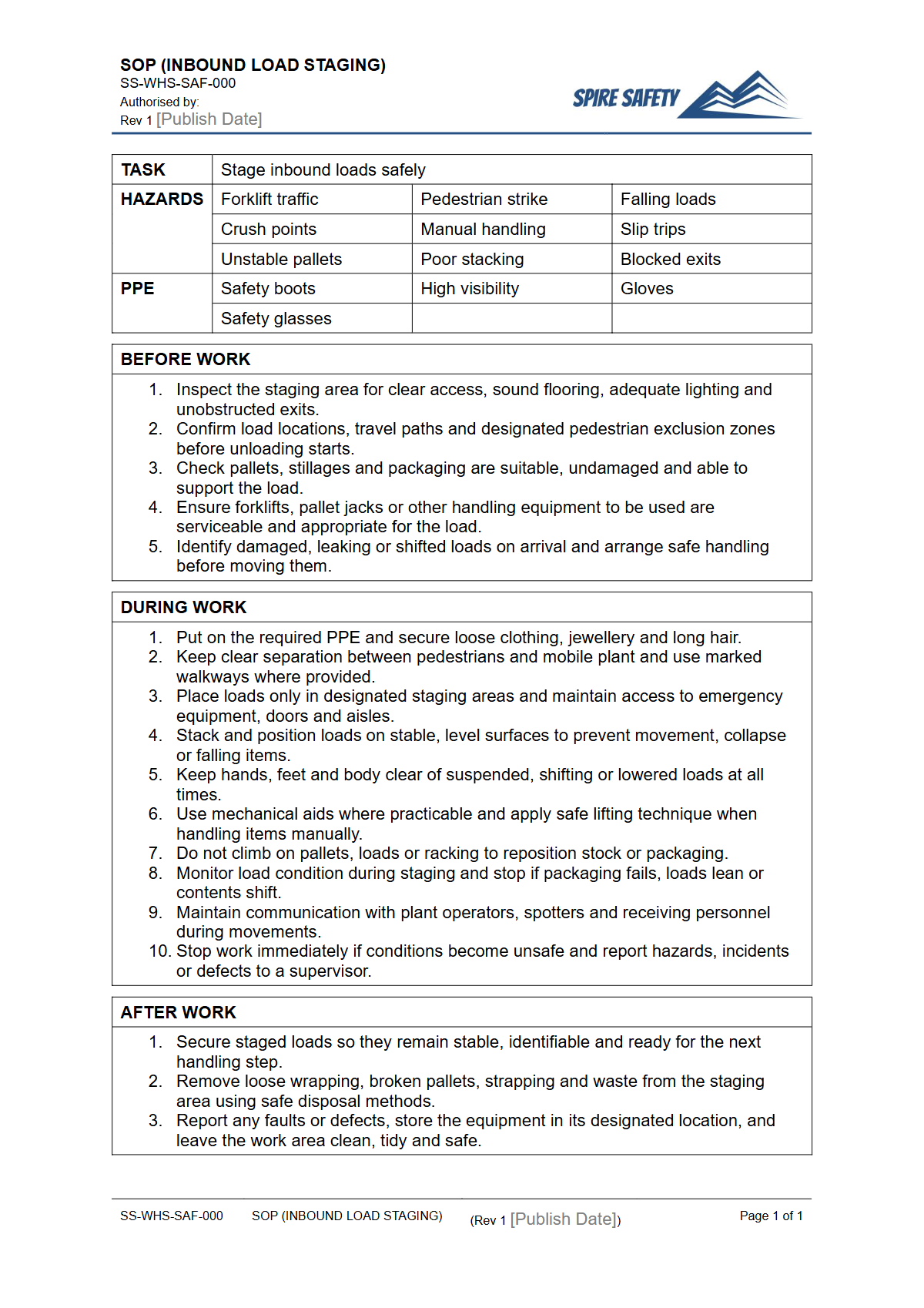
This template is provided in both DOCX and PDF formats for your convenience. The DOCX file is fully editable, allowing you to tailor the content to the specific environment of your loading dock, warehouse, or yard.
It includes sections covering responsibilities, hazard identification, required personal protective equipment (PPE), and step-by-step procedural instructions.
Important: This document is a template, not a finished procedure. To be effective, you must adapt it to your specific site, equipment, types of loads received, and internal traffic management plan.
We have included comments and placeholders to guide your customisation process. For tasks involving specific machinery, you may need to cross-reference other SOPs, such as our free Telehandler SOP template if that equipment is used in your staging process.
Key Inclusions in the SOP
Our template prompts you to consider several critical phases of the inbound staging process, ensuring a comprehensive approach to risk management.
Traffic Management and Area Setup
A core component of the procedure is establishing a safe area for unloading and staging. This includes defining exclusion zones for pedestrians, ensuring clear signage, checking that the ground surface is stable and level, and verifying that the area is free from obstructions.
Poorly defined staging areas are a common finding during a WHS compliance audit, and this template helps address that gap.
Communication and Coordination
The SOP emphasises clear communication between the delivery driver and site personnel. It outlines the steps for driver induction, exchanging paperwork, and confirming that the vehicle is immobilised with the parking brake engaged before anyone approaches to unload.
It's also vital to integrate procedures for related equipment, which might require a specific conveyer system SOP for automated areas.
Unloading and Load Assessment
This section guides you in documenting the steps for visually inspecting the load for any signs of shifting or instability before opening vehicle doors. It also covers the safe methods for unloading, whether by forklift, crane, or manual handling, and the process for checking goods against the delivery docket.
Emergency Procedures
No procedure is complete without a plan for when things go wrong. The template includes a section for you to detail the specific emergency responses for your site, such as what to do in case of a load spill, fire, or medical emergency.
If you require assistance in developing site-specific emergency plans, our WHS consulting services can assist your organisation.
Who Should Use this SOP Template?
This resource is designed for anyone responsible for overseeing or managing workplace safety in logistics, warehousing, manufacturing, or retail environments. This includes:
- Warehouse Managers and Supervisors
- Logistics and Supply Chain Coordinators
- Work Health and Safety (WHS/OHS) Advisors and Managers
- Business Owners responsible for operational safety
It provides a valuable, practical tool for developing and implementing safe work practices aligned with the Australian model WHS framework. For more ready-to-use safety documents, you can browse our complete free WHS resources library.
Common mistakes
Common mistakes to avoid
- Failing to customise the template to address site-specific hazards and traffic flow.
- Assuming delivery drivers automatically understand internal traffic rules without a proper induction.
- Creating staging areas that obstruct emergency exits, aisles, or firefighting equipment.
- Neglecting to review and update the procedure after a near miss, incident, or change in process.
Legal references
Legal considerations
The following legal requirements may be relevant to this type of work.
- Work Health and Safety Act (Harmonised) — Provides the primary duties for protecting workers and other people from work health and safety risks.
- Work Health and Safety Regulations (Harmonised) — Sets out requirements supporting the management of workplace hazards and risks.
The following codes may be relevant to this type of work.
- Managing WHS Risks Code of Practice — Provides practical guidance on identifying hazards, assessing risks and applying effective controls.
- Work Health and Safety Consultation, Cooperation and Coordination Code of Practice — Provides practical guidance on consulting workers and coordinating with other duty holders.
- Managing the Work Environment and Facilities Code of Practice — Provides practical guidance on safe work environments, workplace facilities and related controls.
Did you know
Staging vs. Put-Away
A 'staging area' is for the temporary holding, checking, and processing of inbound goods. 'Put-away' is the separate, subsequent task of moving those goods to their final storage location. Separating these processes improves both logistical accuracy and workplace safety.
Vehicle Interaction Risks
A significant portion of serious workplace incidents in storage and logistics environments involve collisions between mobile plant (like forklifts) and pedestrians. A well-designed staging area with clear traffic flow and exclusion zones is a primary and essential control measure.
FAQ
Frequently asked questions
01What is the difference between a Safe Operating Procedure (SOP) and a Safe Work Method Statement (SWMS)?
02How often should our inbound load staging SOP be reviewed?
03Is this template suitable for staging hazardous materials?
04Who needs to be trained on the Inbound Load Staging SOP?
Share this resource
Free Safe Operating Procedure (Inbound Load Staging) Template
Browse Categories
How To Use It
- 1Download and open in Word or PDF.
- 2Replace the placeholders with your business details.
- 3Get it reviewed by a WHS specialist before rollout.
Need it customised?
Our WHS consultants can adapt this template to your site, run a gap analysis, or audit what you already have in place.
Book a Free Consultation WHS consulting servicesor call 1300 156 382
Related templates
- Free Safe Operating Procedure (Incontinence Linen Bag) Template
- Free Safe Operating Procedure (Incubator) Template
- Free Safe Operating Procedure (Induction Cooktop) Template
- Free Safe Operating Procedure (Induction Heater) Template
- Free Safe Operating Procedure (Industrial Fan) Template
- Free Safe Operating Procedure (Industrial Robot) Template