
Free Safe Operating Procedure (Incontinence Linen Bag) Template
Properly managing soiled linen is critical for infection control and worker safety in care settings. Download our free template to create a clear procedure.
Free Safe Operating Procedure (Incontinence Linen Bag) Template
DOCX • 126 KB + PDF
Updated Oct 2026
No signup required
Purpose of the Free Safe Operating Procedure (Incontinence Linen Bag) Template
Handling linen contaminated with bodily fluids presents significant health and safety risks in aged care, healthcare, and disability support settings. Without a standardised process, workers are exposed to biological hazards, including bacteria and viruses, and are at risk of musculoskeletal injuries from manual handling.
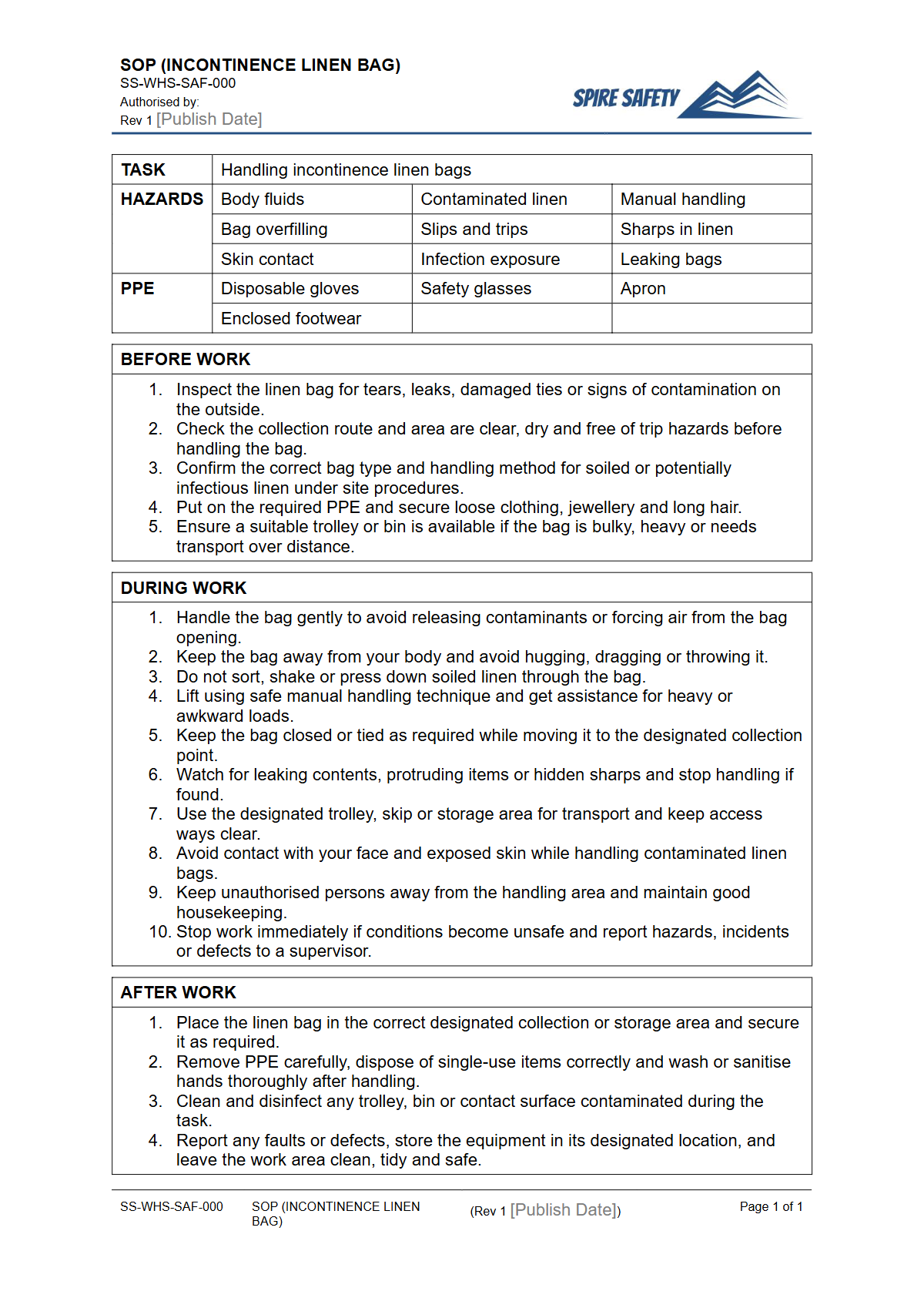
This Free Safe Operating Procedure (Incontinence Linen Bag) Template provides a structured starting point for your organisation to document a safe, repeatable process. It helps to minimise guesswork, control infection pathways, and demonstrate a commitment to worker safety.
A well-defined SOP is a fundamental component of effective WHS management systems, providing clarity for staff and supervisors.
Video walkthrough
How to use the Free Safe Operating Procedure (Incontinence Linen Bag) Template
This resource is available as a fully editable DOCX file and a print-ready PDF. The DOCX version allows you to tailor the content to match the specific procedures, equipment, and environment of your facility.
A comprehensive SOP should outline the required PPE, step-by-step instructions for bagging soiled linen, transport protocols, and procedures for cleaning spills.
Important: This document is a template and must be customised to the specific hazards and controls in your workplace. We are not responsible for the implementation or outcomes of your final procedure.
It is essential to conduct a site-specific risk assessment to ensure all relevant hazards are identified and controlled.
When to use this SOP
This Safe Operating Procedure should be implemented as the standard process for all tasks involving the handling and bagging of incontinence linen. It is particularly crucial during:
- Routine changing of resident or patient bedding and clothing.
- Cleaning up after episodes of incontinence.
- Segregation of contaminated linen for laundry processing.
- Induction and training for new care, cleaning, or laundry staff.
- Refresher training sessions for all relevant personnel.
The SOP serves as both a guide for performing the task safely and a tool for training and competency assessment.
Who should use it
This procedure is designed for all personnel who may come into contact with soiled or contaminated linen. This includes, but is not limited to:
- Personal Care Assistants (PCAs) and Assistants in Nursing (AINs).
- Registered and Enrolled Nurses (RNs and ENs).
- Domestic, cleaning, and laundry staff.
- Facility managers and supervisors responsible for overseeing safety protocols.
Supervisors must ensure that staff are not only trained in the procedure but also follow it consistently. If your organisation needs assistance developing or implementing role-specific safety documentation, our WHS consulting services can provide expert guidance.
Key Safety Considerations
Biological Hazards
The primary risk is exposure to infectious agents. The SOP must specify the use of appropriate Personal Protective Equipment (PPE) such as disposable gloves and aprons.
It should also detail correct hand hygiene practices before and after the task and the correct technique for sealing bags to prevent aerosolisation of contaminants.
Manual Handling Risks
Linen bags can become heavy and awkward to carry, leading to strains and sprains. Your procedure should include controls such as not overfilling bags (e.g., filling to no more than two-thirds full), using trolleys for transport, and ensuring clear, unobstructed pathways to the laundry or holding area.
Review and Improvement
Safe Operating Procedures are not static documents. They should be reviewed regularly—at least annually—or whenever there is a change in work practices, equipment, or following an incident or near miss.
This continuous improvement cycle ensures the procedure remains effective and relevant. Formal WHS compliance auditing can help identify gaps in your safety systems and ensure your documentation aligns with current best practices.
Integrating SOPs Across Your Facility
A culture of safety is built by applying consistent standards to all high-risk tasks, not just those in direct care. For example, kitchens within care facilities also contain significant hazards that require formalised procedures.
Ensuring you have documented processes for all areas, such as a free Safe Operating Procedure for deep fryer operation, helps build a comprehensive safety framework across your entire organisation. You can explore hundreds of other templates in our free WHS resources library to support your safety management system.
Common mistakes
Common mistakes to avoid
- Overfilling linen bags, creating significant manual handling risks and potential for bag failure.
- Leaving bags on the floor, which creates trip hazards and contaminates the exterior of the bag.
- Using incorrect bag types (e.g., standard waste bags) that are not fluid-resistant or strong enough.
- Incorrectly removing PPE after handling soiled linen, leading to self-contamination.
Legal references
Legal considerations
The following legal requirements may be relevant to this type of work.
- Work Health and Safety Act (Harmonised) — Provides the primary duties for protecting workers and other people from work health and safety risks.
- Work Health and Safety Regulations (Harmonised) — Sets out requirements supporting the management of workplace hazards and risks.
The following codes may be relevant to this type of work.
- Managing WHS Risks Code of Practice — Provides practical guidance on identifying hazards, assessing risks and applying effective controls.
- Work Health and Safety Consultation, Cooperation and Coordination Code of Practice — Provides practical guidance on consulting workers and coordinating with other duty holders.
- Managing the Work Environment and Facilities Code of Practice — Provides practical guidance on safe work environments, workplace facilities and related controls.
Did you know
Infection Control
Healthcare-associated infections (HAIs) affect thousands of Australians each year. Standardised procedures for handling contaminated materials like soiled linen are a critical first line of defence in preventing cross-contamination.
Manual Handling in Care
The healthcare and social assistance industry has one of the highest rates of serious workers' compensation claims in Australia, with body stressing and manual handling being a leading cause of injury.
FAQ
Frequently asked questions
01What PPE is typically required for handling soiled linen bags?
02How should you seal an incontinence linen bag to prevent leaks?
03Can you mix different types of soiled linen in the same bag?
04What is the difference between an SOP and a SWMS?
Share this resource
Free Safe Operating Procedure (Incontinence Linen Bag) Template
Browse Categories
How To Use It
- 1Download and open in Word or PDF.
- 2Replace the placeholders with your business details.
- 3Get it reviewed by a WHS specialist before rollout.
Need it customised?
Our WHS consultants can adapt this template to your site, run a gap analysis, or audit what you already have in place.
Book a Free Consultation WHS consulting servicesor call 1300 156 382
Related templates
- Free Safe Operating Procedure (Incubator) Template
- Free Safe Operating Procedure (Induction Cooktop) Template
- Free Safe Operating Procedure (Induction Heater) Template
- Free Safe Operating Procedure (Industrial Fan) Template
- Free Safe Operating Procedure (Industrial Robot) Template
- Free Safe Operating Procedure (Industrial Sewing Machine) Template