
Free Safe Operating Procedure (Impact Wrench) Template
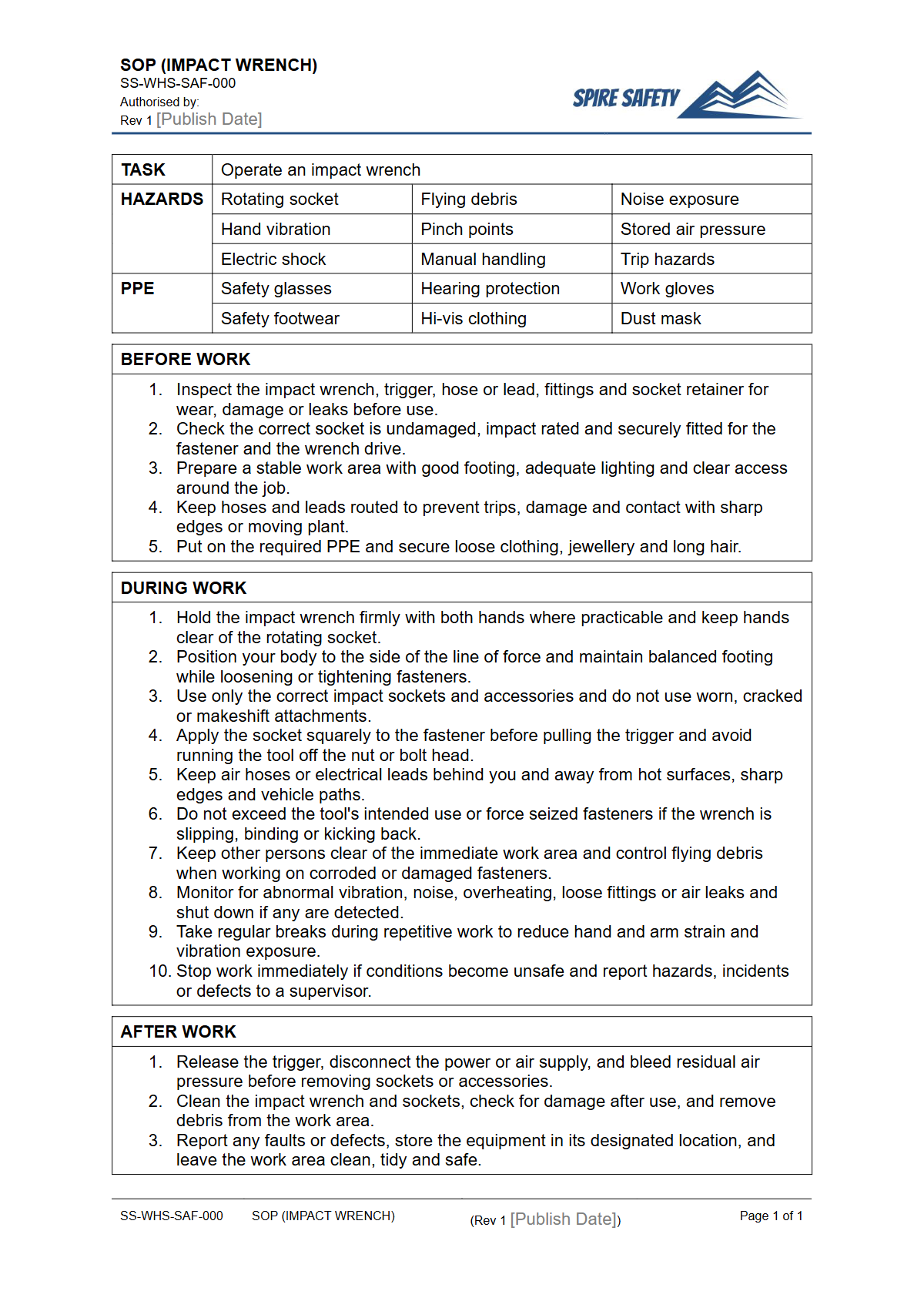
Download our free Safe Operating Procedure (Impact Wrench) Template to formalise safe work practices. This customisable guide helps ensure operator safety.
Free Safe Operating Procedure (Impact Wrench) Template
DOCX • 126 KB + PDF
Updated Oct 2026
No signup required
Purpose of the Free Safe Operating Procedure (Impact Wrench) Template
Using an impact wrench, whether pneumatic or battery-powered, introduces significant workplace hazards if not managed correctly. This free Safe Operating Procedure (Impact Wrench) Template provides a structured starting point for your business to document the required steps for safe operation.
It helps you formalise risk controls for hazards like high-pressure air, noise, vibration, projectiles from shattering sockets, and musculoskeletal injuries from incorrect handling. By implementing a clear SOP, you establish a consistent, safe method of work that can be used for training, inductions, and ongoing competency management.
A well-drafted SOP is a key control measure for managing risks associated with plant and equipment. It outlines pre-start checks, step-by-step operating instructions, and shutdown procedures to guide workers.
Since many impact wrenches are pneumatic, it's also crucial to manage the power source safely. Our Free Air Compressor SOP (Safe Operating Procedure) Template provides specific guidance on the safe use and maintenance of air compressors, complementing this procedure.
Video walkthrough
How to use the Free Safe Operating Procedure (Impact Wrench) Template
This template is provided in DOCX format for easy editing and a PDF for quick reference. It is designed as a foundational document, aligned with Australian WHS principles, that you must adapt to your specific workplace.
Generic procedures are not effective; a Safe Operating Procedure must reflect the exact equipment, environment, and tasks your workers perform.
To use this template effectively:
- Consult with the workers who actually operate the impact wrenches. Their input is essential for creating a practical and effective document.
- Conduct a WHS consulting session or an internal risk assessment on the specific models of impact wrenches used at your site.
- Modify the template to include details specific to your tools, such as brand, model, power source (pneumatic/cordless), and required socket types.
- Clearly define the required Personal Protective Equipment (PPE), such as safety glasses, hearing protection, and gloves.
- Integrate the final, approved SOP into your training and induction programs.
Important: This is a template only. We have populated it with common headings and prompts, but you must customise it with your own site-specific information, risk assessments, and legal obligations to ensure it is suitable for your operations.
Like our FREE Circular Saw SOP Template, it must be tailored to the specific tool in use.
When to use a Safe Operating Procedure
A Safe Operating Procedure for an impact wrench should be developed and implemented before the equipment is first used in the workplace. It serves as a critical administrative control to direct safe behaviour.
The SOP should be a living document, reviewed and updated regularly. Key triggers for a review include when a new model of impact wrench is introduced, if there is a change in the work environment or task, after an incident or near miss involving the tool, or as part of a scheduled review cycle (typically every 1-2 years).
Regular reviews can be integrated into your broader safety management system verification, similar to a WHS compliance auditing schedule.
Who should use this Safe Operating Procedure
This document is intended for multiple audiences within an organisation. Persons Conducting a Business or Undertaking (PCBUs) have the primary duty of care and are responsible for providing safe systems of work, including the development of SOPs.
Supervisors and managers must use the SOP to train workers, enforce safe work practices, and monitor compliance. Most importantly, operators of impact wrenches must be trained on and follow the SOP to ensure their own safety and the safety of others around them.
Documenting procedures like this is a fundamental part of building robust WHS management systems that protect your people and your business.
Documenting procedures for all types of plant is essential, not just for handheld tools. The principles in this SOP can be applied to larger equipment, such as when developing a FREE Telehandler SOP Template. For more guides, checklists, and templates, you can browse our complete free WHS resources library.
Common mistakes
Common mistakes to avoid
- Using standard, non-impact rated sockets which can shatter under load.
- Failing to check air pressure and inspect hoses for damage before use.
- Neglecting to wear appropriate PPE, especially safety glasses and hearing protection.
- Applying uncontrolled torque, leading to over-tightening or component damage.
Legal references
Legal considerations
The following legal requirements may be relevant to this type of work.
- Work Health and Safety Act (Harmonised) — Provides the primary duties for protecting workers and other people from work health and safety risks.
- Work Health and Safety Regulations (Harmonised) — Sets out requirements supporting the management of workplace hazards and risks.
The following codes may be relevant to this type of work.
- Managing WHS Risks Code of Practice — Provides practical guidance on identifying hazards, assessing risks and applying effective controls.
- Work Health and Safety Consultation, Cooperation and Coordination Code of Practice — Provides practical guidance on consulting workers and coordinating with other duty holders.
- Managing the Work Environment and Facilities Code of Practice — Provides practical guidance on safe work environments, workplace facilities and related controls.
Did you know
Vibration Risk
Prolonged or regular use of high-vibration tools like impact wrenches can lead to Hand-Arm Vibration Syndrome (HAVS), a painful and disabling condition affecting nerves, blood vessels, and joints.
Socket Safety
Only use sockets specifically rated for impact use. Standard chrome sockets are brittle and can shatter explosively when used with an impact wrench, creating high-velocity projectiles.
FAQ
Frequently asked questions
01What are the main hazards of using an impact wrench?
02Does this impact wrench SOP cover pneumatic and cordless models?
03Who is responsible for training workers on the Safe Operating Procedure?
04How often should a Safe Operating Procedure for an impact wrench be reviewed?
Share this resource
Free Safe Operating Procedure (Impact Wrench) Template
Browse Categories
How To Use It
- 1Download and open in Word or PDF.
- 2Replace the placeholders with your business details.
- 3Get it reviewed by a WHS specialist before rollout.
Need it customised?
Our WHS consultants can adapt this template to your site, run a gap analysis, or audit what you already have in place.
Book a Free Consultation WHS consulting servicesor call 1300 156 382
Related templates
- Free Safe Operating Procedure (Inboard Motor) Template
- Free Safe Operating Procedure (Inbound Freight Check) Template
- Free Safe Operating Procedure (Inbound Load Staging) Template
- Free Safe Operating Procedure (Incontinence Linen Bag) Template
- Free Safe Operating Procedure (Incubator) Template
- Free Safe Operating Procedure (Induction Cooktop) Template