
Free Safe Operating Procedure (Ice Crusher) Template
Document the safe use of commercial ice crushers with our customisable template. Download your free Safe Operating Procedure to improve workplace safety.
Free Safe Operating Procedure (Ice Crusher) Template
DOCX • 126 KB + PDF
Updated Oct 2026
No signup required
Purpose of the Free Safe Operating Procedure (Ice Crusher) Template
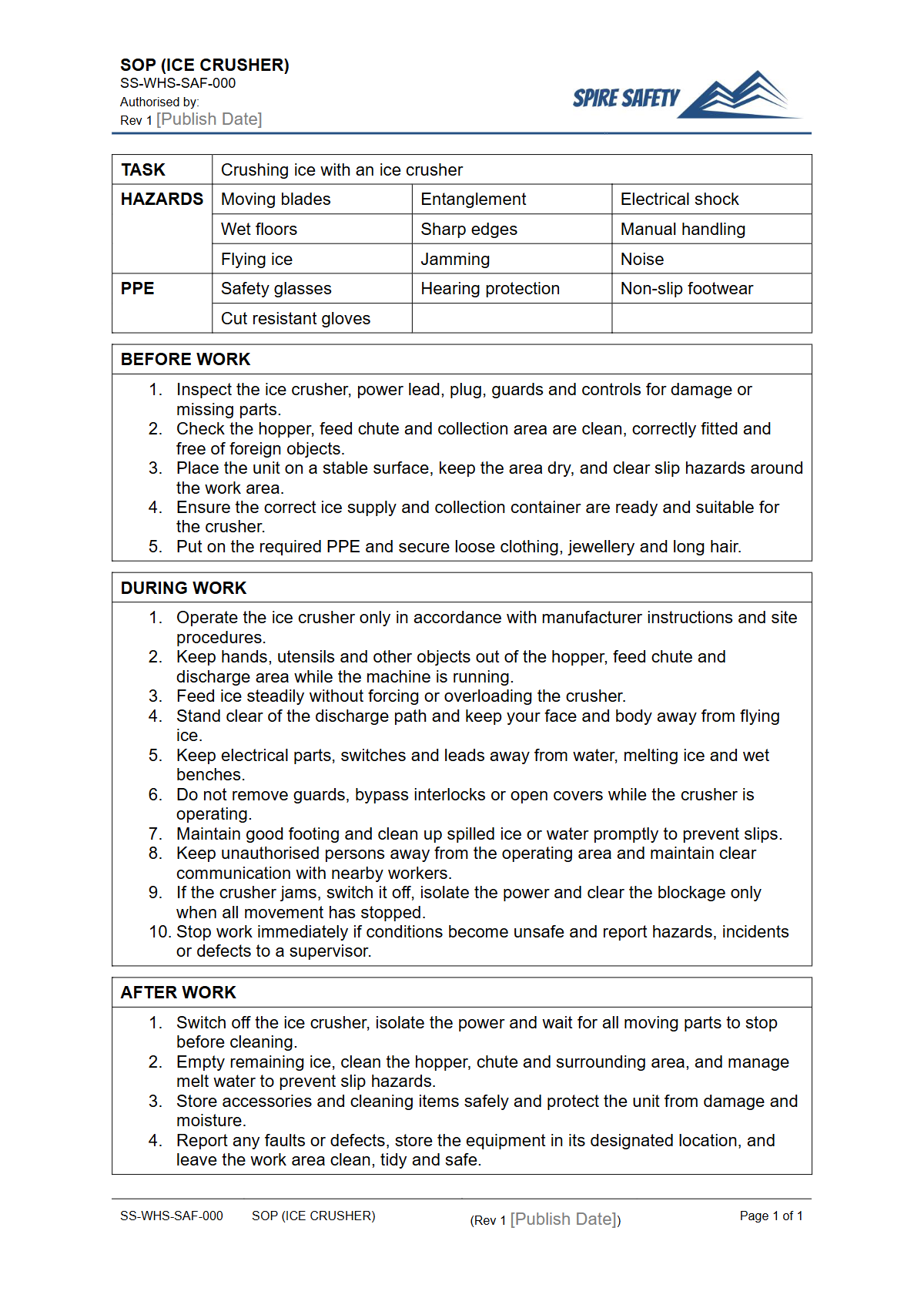
This Free Safe Operating Procedure (Ice Crusher) Template provides a structured framework for documenting the safe use of commercial ice crushing machines. These appliances, common in bars, restaurants, and healthcare facilities, introduce specific workplace hazards that must be managed.
The primary purpose of an SOP is to provide clear, step-by-step instructions that minimise the risk of injury to operators and other personnel.
Key risks associated with ice crushers include contact with moving parts (blades, augers, or crushing mechanisms), electrical shock, noise exposure, and ergonomic strains from manual handling. Additionally, spills of water and ice create significant slip hazards.
A well-drafted SOP, based on a thorough risk assessment, is a critical control measure. It standardises operations, ensuring every worker follows the same safe process for setup, operation, cleaning, and shutdown.
For comparison, you can see how similar principles apply in our free deep fryer SOP, which addresses hazards in a different piece of kitchen equipment.
Video walkthrough
How to use the Free Safe Operating Procedure (Ice Crusher) Template
To effectively use this Safe Operating Procedure for an Ice Crusher, you must customise it to reflect the specific make and model of the machine in your workplace, as well as your unique operational context. A generic document is not sufficient; it must be made site-specific to be effective.
We have provided a comprehensive starting point in both DOCX and PDF formats for your convenience.
Follow these steps to implement the SOP:
- Download and Customise: Download the DOCX version and fill in the details specific to your ice crusher, including its location, model, and emergency shutdown procedures.
- Consult with Workers: Involve the workers who actually operate the machine. Their hands-on experience is invaluable for identifying practical steps and potential issues that may not be in the manufacturer's manual.
- Conduct a Risk Assessment: Use the template as a guide to formalise the findings of your risk assessment, detailing the identified hazards and the control measures you have put in place.
- Train and Verify: Train all operators on the finalised SOP. Competency should be verified before a worker is permitted to operate the machine unsupervised.
- Review and Update: Schedule regular reviews of the SOP (e.g., annually) or whenever there is a change in equipment, procedures, or after an incident.
By integrating this document into your daily operations, you are taking a crucial step towards building robust WHS management systems. An SOP is a foundational element of a safe system of work, demonstrating a commitment to proactive risk management.
When to use this Safe Operating Procedure
A Safe Operating Procedure for an ice crusher is not a document to be filed away and forgotten. It is an active tool that should be used consistently throughout the equipment's lifecycle.
It should be readily accessible to all relevant staff, ideally located near the machine itself for quick reference.
Specific instances for its use include:
- New Worker Induction: As a core part of training for new employees who will be required to use the ice crusher.
- Refresher Training: During periodic refresher sessions to ensure ongoing competency and awareness of risks.
- Before Operation: As a pre-start checklist to ensure the machine and surrounding area are safe for use.
- During Cleaning and Maintenance: To follow the correct lockout-tagout (LOTO) or isolation procedures, preventing accidental startup.
- Incident Investigation: As a reference point to determine if procedures were followed correctly in the event of an accident or near-miss.
The principles of documenting processes for machinery with hazardous moving parts are universal, whether it is for an ice crusher in a kitchen or an SOP for a circular saw in a workshop.
Who should use this Safe Operating Procedure
The responsibility for using and maintaining a Safe Operating Procedure extends to several roles within a business, as defined by Australian WHS legislation. A Person Conducting a Business or Undertaking (PCBU) holds the primary duty of care to ensure, so far as is reasonably practicable, the health and safety of workers.
Key personnel include:
- Managers and Supervisors: They are responsible for ensuring the SOP is developed, implemented, and reviewed. They must also ensure that workers are trained on the procedure and are following it correctly. The effectiveness of this implementation is often verified during WHS compliance auditing.
- Workers/Operators: They have a duty to take reasonable care for their own health and safety and that of others. This includes following the instructions laid out in the SOP, wearing required Personal Protective Equipment (PPE), and reporting any faults or hazards immediately.
- Health and Safety Representatives (HSRs): HSRs should be consulted during the development and review of the SOP, representing the safety interests and concerns of their work group.
This document is one of many tools available to help businesses meet their safety obligations. You can explore our complete free WHS resources library for more templates, checklists, and guides to support your safety management efforts.
Common mistakes
Common mistakes to avoid
- Using hands, utensils, or improper tools to clear ice jams instead of de-energising and using a designated tool.
- Failing to disconnect the power source before starting any cleaning or maintenance.
- Neglecting to clean up spilt water or ice around the machine, creating a serious slip hazard for everyone in the area.
- Not wearing appropriate Personal Protective Equipment (PPE), such as cut-resistant gloves, when handling or cleaning blades.
Legal references
Legal considerations
The following legal requirements may be relevant to this type of work.
- Work Health and Safety Act (Harmonised) — Provides the primary duties for protecting workers and other people from work health and safety risks.
- Work Health and Safety Regulations (Harmonised) — Sets out requirements supporting the management of workplace hazards and risks.
The following codes may be relevant to this type of work.
- Managing WHS Risks Code of Practice — Provides practical guidance on identifying hazards, assessing risks and applying effective controls.
- Work Health and Safety Consultation, Cooperation and Coordination Code of Practice — Provides practical guidance on consulting workers and coordinating with other duty holders.
- Managing the Work Environment and Facilities Code of Practice — Provides practical guidance on safe work environments, workplace facilities and related controls.
Did you know
Slips, Trips, and Falls
Slips, trips, and falls are a leading cause of injury in the hospitality industry. An ice crusher SOP is not complete without procedures for cleaning up spilt water and ice immediately to control this common hazard.
Laceration Risks
The majority of severe lacerations from ice crushers and blenders occur during cleaning or when attempting to clear a jam. A robust SOP will always mandate that the machine is disconnected from its power source before any such task is performed.
FAQ
Frequently asked questions
01What hazards are associated with using a commercial ice crusher?
02How often should an SOP for an ice crusher be reviewed?
03Is training required even if we have a detailed SOP?
04Can this template be used for a domestic ice crusher at home?
Share this resource
Free Safe Operating Procedure (Ice Crusher) Template
Browse Categories
How To Use It
- 1Download and open in Word or PDF.
- 2Replace the placeholders with your business details.
- 3Get it reviewed by a WHS specialist before rollout.
Need it customised?
Our WHS consultants can adapt this template to your site, run a gap analysis, or audit what you already have in place.
Book a Free Consultation WHS consulting servicesor call 1300 156 382
Related templates
- Free Safe Operating Procedure (Ice Machine) Template
- Free Safe Operating Procedure (Ice Maker Cleaning) Template
- Free Safe Operating Procedure (Ice Scoop Handling) Template
- Free Safe Operating Procedure (Illegal Dump Cleanup) Template
- Free Safe Operating Procedure (Impact Crusher Clearing) Template
- Free Safe Operating Procedure (Impact Driver) Template