
Free Safe Operating Procedure (Illegal Dump Cleanup) Template
Tackle illegal dumping safely with our free Safe Operating Procedure template. Download the customisable DOCX to formalise your cleanup protocols today.
Free Safe Operating Procedure (Illegal Dump Cleanup) Template
DOCX • 126 KB + PDF
Updated Oct 2026
No signup required
Purpose of the Free Safe Operating Procedure (Illegal Dump Cleanup) Template
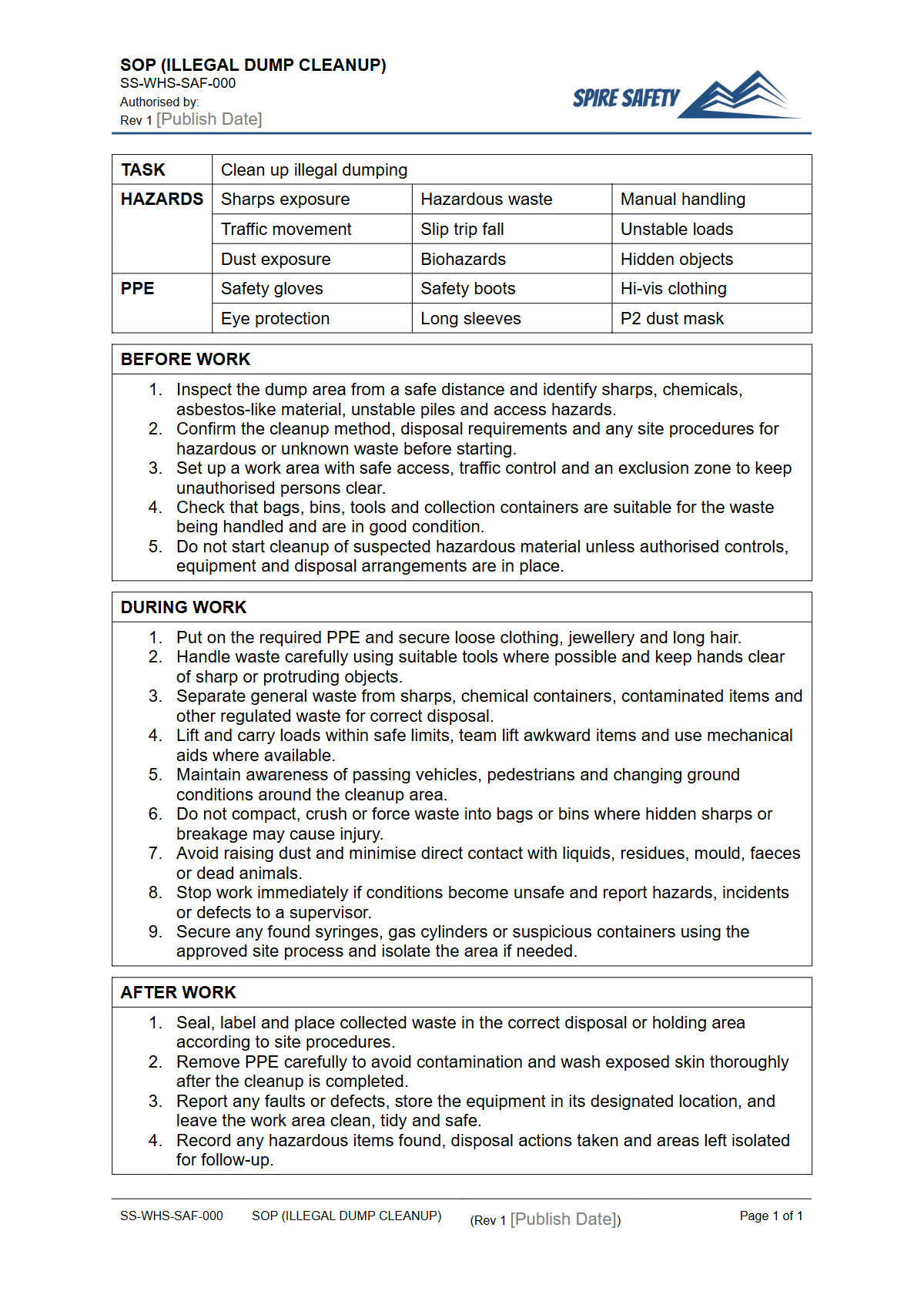
Dealing with illegally dumped waste presents a range of unpredictable health and safety risks. This Free Safe Operating Procedure (Illegal Dump Cleanup) Template provides a structured starting point for organisations to develop a formal, documented process for managing these cleanups.
The primary purpose of this SOP is to protect workers from potential hazards by outlining a consistent, step-by-step method for assessing the site, handling waste, and using equipment. It helps standardise your approach to hazard identification, Personal Protective Equipment (PPE) selection, waste segregation, and emergency response.
Implementing a formal SOP helps a Person Conducting a Business or Undertaking (PCBU) meet their primary duty of care under Australian WHS laws. It serves as a practical tool for risk management, ensuring that tasks are performed safely and systematically every time.
This document is designed to be adapted to cover the specific hazards your teams might encounter, from sharps and biological waste to unidentified chemical containers and physically unstable materials. Using a clear procedure also aids in training and ensures all personnel, including new employees and contractors, understand the expected safety standards and work methods.
Video walkthrough
How to use the Free Safe Operating Procedure (Illegal Dump Cleanup) Template
This document is a foundational template that must be customised to reflect the specific circumstances of your workplace and the nature of the cleanup tasks. After downloading the DOCX file, consult with your workers and health and safety representatives to tailor the content.
This involves adding site-specific details, identifying the machinery used, listing the exact types of PPE required, and detailing your organisation's unique emergency and waste disposal protocols.
Important: This is a template, not a completed document. To be effective, you must adapt it to your specific operational needs and risk profile.
We strongly recommend a thorough risk assessment is conducted for each site before work begins. The completed SOP should be integrated into your broader WHS management systems, reviewed regularly, and updated whenever processes or equipment change.
Ensure all relevant personnel are trained on the final procedure and that a signed copy is kept on record.
When to use a Safe Operating Procedure for an Illegal Dump Cleanup
An SOP for illegal dump cleanup should be implemented whenever workers are tasked with clearing waste from a non-designated disposal site. This applies to a wide range of scenarios, including roadside dumping, waste left in parks and bushland, materials abandoned on industrial or commercial properties, and rubbish cleared from waterways.
The procedure should be considered a mandatory part of the planning phase for any such cleanup operation, before any personnel enter the site to begin physical work.
It is particularly critical when the contents of the dumped material are unknown, as this presents the highest level of risk. The SOP guides workers through a cautious initial assessment to identify obvious and hidden dangers.
Formalising your procedures is also a key component of due diligence, and regular reviews of these documents can be part of your overall WHS compliance auditing program to ensure ongoing effectiveness and alignment with safety legislation.
Who should use it
This template is designed for use by any organisation or individual responsible for managing or conducting illegal dump cleanups. This includes Health and Safety Managers, Supervisors, and Team Leaders within local councils, state government agencies (such as environmental protection authorities), and land management organisations.
It is also highly relevant for private contractors, civil construction companies, and property maintenance firms who are engaged to clear abandoned waste.
The SOP should be used by the frontline workers performing the cleanup, as it provides them with clear, actionable safety instructions. Competency is key; for instance, if heavy materials are present, only trained and licensed operators should be using equipment as outlined in a specific FREE Telehandler SOP Template. The procedure reinforces the importance of using the right tools and methods for the job, ensuring a safer work environment for everyone involved.
Common Hazards in Illegal Dump Sites
Illegal dump sites can harbour a dangerous mix of waste materials. A robust SOP must prompt workers to actively look for and manage these risks. Key hazards include:
- Physical Hazards: Sharps (needles, broken glass), rusty metal, unstable piles of rubbish that could collapse, and tripping hazards.
- Chemical Hazards: Unlabelled drums containing unknown liquids, pesticides, solvents, asbestos-containing materials, and batteries.
- Biological Hazards: Decomposing animal carcasses, medical waste, spoiled food, and human waste, which can expose workers to bacteria and pathogens.
- Mechanical Hazards: If the cleanup involves machinery like loaders or compactors, a FREE Scraper SOP Template can help detail the safe operation of that specific plant.
Your customised SOP should include specific controls for these hazards, such as establishing exclusion zones, using designated sharps containers, and having spill kits readily available. If powered tools are needed for cutting or dismantling waste, a Free Air Compressor SOP (Safe Operating Procedure) Template might be a useful supplementary document to ensure tools are operated correctly. For more templates covering a wide range of tasks and equipment, browse our complete free WHS resources library.
Common mistakes
Common mistakes to avoid
- Underestimating the hazards present in the waste, especially those that are hidden.
- Using incorrect or insufficient Personal Protective Equipment (PPE) for the identified risks.
- Failing to properly secure the site from public access during cleanup operations.
- Lacking a clear plan for managing unexpected discoveries like asbestos, chemicals, or unexploded ordnance.
Legal references
Legal considerations
The following legal requirements may be relevant to this type of work.
- Work Health and Safety Act (Harmonised) — Provides the primary duties for protecting workers and other people from work health and safety risks.
- Work Health and Safety Regulations (Harmonised) — Sets out requirements supporting the management of workplace hazards and risks.
The following codes may be relevant to this type of work.
- Managing WHS Risks Code of Practice — Provides practical guidance on identifying hazards, assessing risks and applying effective controls.
- Work Health and Safety Consultation, Cooperation and Coordination Code of Practice — Provides practical guidance on consulting workers and coordinating with other duty holders.
- Managing the Work Environment and Facilities Code of Practice — Provides practical guidance on safe work environments, workplace facilities and related controls.
Did you know
The Cost of Dumping
Australian local governments spend tens of millions of dollars each year cleaning up illegally dumped waste. These costs are ultimately passed on to ratepayers and the community.
Hierarchy of Control
Safe Operating Procedures (SOPs) are an 'administrative control' in the hierarchy of risk control. They are used to manage risks that cannot be eliminated or engineered out of a process.
FAQ
Frequently asked questions
01What are the main hazards to consider in an illegal dump cleanup?
02What PPE is required for cleaning up illegal dumping?
03Can this SOP template be used for asbestos removal?
04How often should an SOP for illegal dump cleanup be reviewed?
Share this resource
Free Safe Operating Procedure (Illegal Dump Cleanup) Template
Browse Categories
How To Use It
- 1Download and open in Word or PDF.
- 2Replace the placeholders with your business details.
- 3Get it reviewed by a WHS specialist before rollout.
Need it customised?
Our WHS consultants can adapt this template to your site, run a gap analysis, or audit what you already have in place.
Book a Free Consultation WHS consulting servicesor call 1300 156 382
Related templates
- Free Safe Operating Procedure (Impact Crusher Clearing) Template
- Free Safe Operating Procedure (Impact Driver) Template
- Free Safe Operating Procedure (Impact Wrench) Template
- Free Safe Operating Procedure (Inboard Motor) Template
- Free Safe Operating Procedure (Inbound Freight Check) Template
- Free Safe Operating Procedure (Inbound Load Staging) Template