
Free Safe Operating Procedure (Ice Maker Cleaning) Template
Download our free Safe Operating Procedure (Ice Maker Cleaning) template to manage risks in your hospitality or food service workplace.
Free Safe Operating Procedure (Ice Maker Cleaning) Template
DOCX • 126 KB + PDF
Updated Oct 2026
No signup required
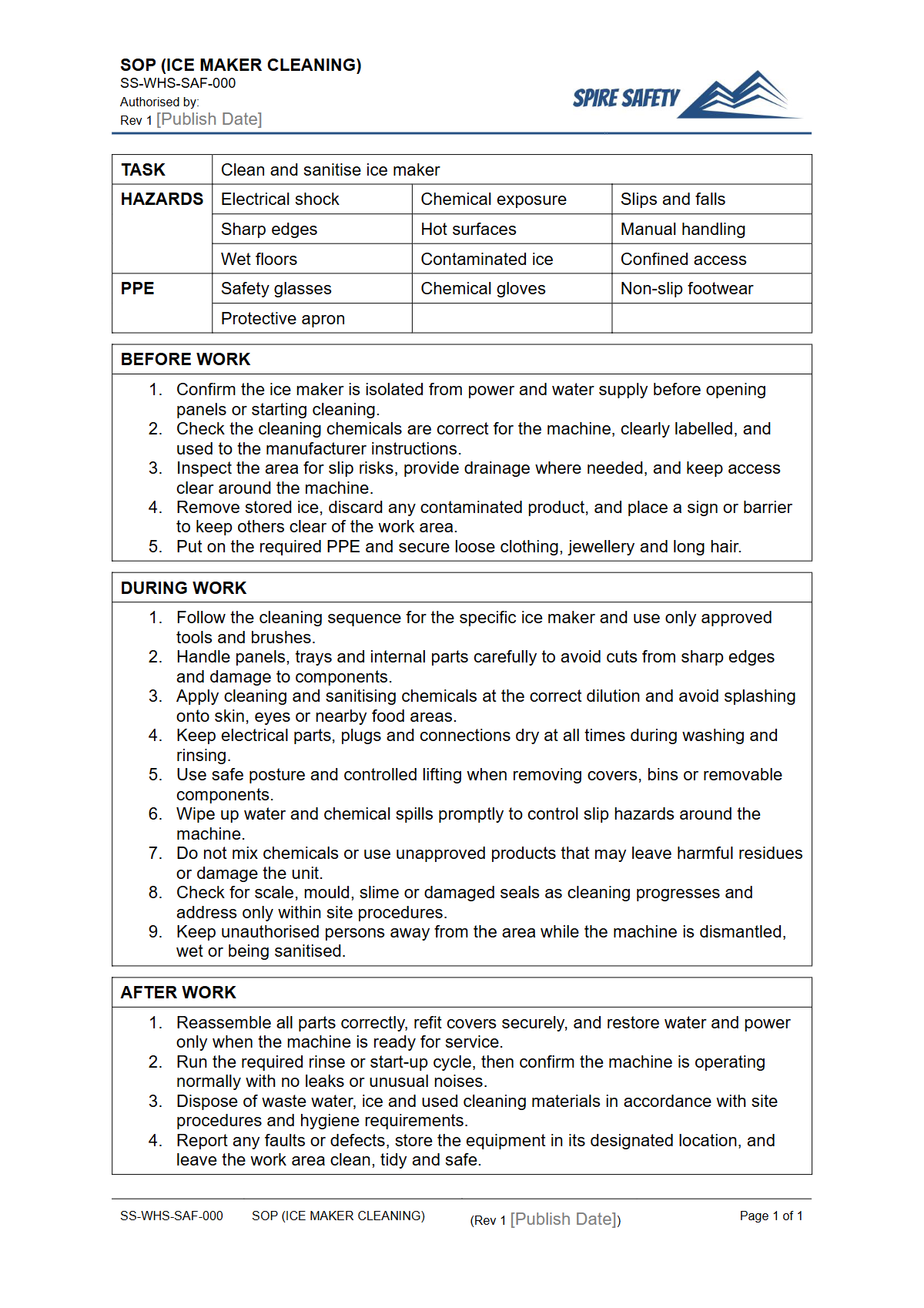
Purpose of the Free Safe Operating Procedure (Ice Maker Cleaning) Template
Maintaining a commercial ice maker is crucial for both food safety and workplace health and safety. This Free Safe Operating Procedure (Ice Maker Cleaning) Template provides a structured framework for documenting the specific steps to clean and sanitise your equipment safely.
Using an SOP helps to control hazards such as electrical shock, chemical exposure, slips, trips, and falls, and ergonomic injuries. By formalising your cleaning process, you create a consistent, repeatable, and trainable method that minimises risks to workers and ensures the hygienic production of ice for customers.
A well-documented SOP is a key component of a proactive safety culture. It serves as a vital training tool for new employees and a reference for experienced staff, ensuring everyone follows the same safe work method.
This template is aligned with Australian WHS principles and is designed to be adapted for any commercial kitchen, hospitality venue, or healthcare facility. For other common kitchen tasks, a Safe Operating Procedure for deep fryer operation can also help standardise your safety documentation.
Video walkthrough
How to use the Free Safe Operating Procedure (Ice Maker Cleaning) Template
This resource is available as a fully editable DOCX file and a print-ready PDF. After downloading, you must review and customise the document to suit your specific operational needs.
Identify the make and model of your ice machine, the approved cleaning and sanitising chemicals used in your workplace, the required personal protective equipment (PPE), and the specific isolation points for electricity and water.
It is crucial that you customise this template to reflect the specific ice maker models, cleaning chemicals, and unique environmental factors of your workplace. We have provided a framework, but you must complete the site-specific details, including emergency procedures and responsibilities.
Once finalised, the SOP should be used as part of your training regime. For businesses looking to integrate such documents into a broader framework, our services in developing a complete WHS management system provide comprehensive support.
When to use this Safe Operating Procedure
The Ice Maker Cleaning SOP should be used every time the cleaning task is performed, in accordance with the manufacturer's recommendations and your organisation's hygiene schedule. It is a critical document for:
- Inducting and training new kitchen hands, cleaning staff, or maintenance personnel.
- Conducting periodic refresher training for all relevant workers to ensure ongoing competence.
- Supervisors to monitor and verify that the correct, safe procedures are being followed.
- Incident investigations, should an accident or near miss occur during the cleaning process.
For facilities with a wider range of maintenance tasks, documenting procedures for all equipment is best practice. You might find our free Air Compressor SOP useful for standardising other maintenance activities.
Who should use this document
This SOP is designed for a broad range of personnel who are responsible for, or oversee, the cleaning and maintenance of commercial ice machines. This includes:
- PCBU (Persons Conducting a Business or Undertaking): To meet their primary duty of care by providing safe systems of work.
- Managers and Supervisors: To train staff, enforce safe procedures, and manage workplace safety in kitchens and food service areas.
- Workers: Kitchen staff, cleaners, and maintenance teams who perform the cleaning task must follow the outlined steps to ensure their own safety and that of others.
- WHS Professionals: To incorporate into the organisation's overall safety management system and use as evidence of risk management.
In larger food processing or manufacturing environments where ice is produced on an industrial scale, other equipment procedures become equally important. A conveyer system SOP, for example, addresses risks associated with larger, more complex machinery.
If you require assistance tailoring this document or implementing broader safety initiatives, our team offers specialist WHS consulting to guide your organisation.
This document is just one of many templates we offer to help Australian businesses manage their WHS obligations. You can browse our complete free WHS resources library for more checklists, procedures, and policies to support your safety management system.
Common mistakes
Common mistakes to avoid
- Using incorrect or incompatible cleaning and sanitising chemicals.
- Failing to disconnect the machine from electrical and water sources before cleaning.
- Not allowing enough time for components to air-dry completely, promoting mould growth.
- Neglecting to document the cleaning process for compliance and training records.
Legal references
Legal considerations
The following legal requirements may be relevant to this type of work.
- Work Health and Safety Act (Harmonised) — Provides the primary duties for protecting workers and other people from work health and safety risks.
- Work Health and Safety Regulations (Harmonised) — Sets out requirements supporting the management of workplace hazards and risks.
The following codes may be relevant to this type of work.
- Managing WHS Risks Code of Practice — Provides practical guidance on identifying hazards, assessing risks and applying effective controls.
- Work Health and Safety Consultation, Cooperation and Coordination Code of Practice — Provides practical guidance on consulting workers and coordinating with other duty holders.
- Managing the Work Environment and Facilities Code of Practice — Provides practical guidance on safe work environments, workplace facilities and related controls.
Did you know
Hygiene Risk
Uncleaned ice machines can harbour mould, bacteria like Listeria and E. coli, and biofilm, posing a significant health risk to consumers.
Electrical Hazard
Many ice maker cleaning incidents involve electrical shocks because staff fail to properly isolate the power supply before starting work, a critical step detailed in any robust SOP.
FAQ
Frequently asked questions
01What hazards are involved in cleaning a commercial ice maker?
02How often should a commercial ice maker be cleaned according to this SOP?
03Does this template cover specific cleaning chemicals?
04Why is a Safe Operating Procedure better than just a cleaning checklist?
Share this resource
Free Safe Operating Procedure (Ice Maker Cleaning) Template
Browse Categories
How To Use It
- 1Download and open in Word or PDF.
- 2Replace the placeholders with your business details.
- 3Get it reviewed by a WHS specialist before rollout.
Need it customised?
Our WHS consultants can adapt this template to your site, run a gap analysis, or audit what you already have in place.
Book a Free Consultation WHS consulting servicesor call 1300 156 382
Related templates
- Free Safe Operating Procedure (Ice Scoop Handling) Template
- Free Safe Operating Procedure (Illegal Dump Cleanup) Template
- Free Safe Operating Procedure (Impact Crusher Clearing) Template
- Free Safe Operating Procedure (Impact Driver) Template
- Free Safe Operating Procedure (Impact Wrench) Template
- Free Safe Operating Procedure (Inboard Motor) Template