
Free Safe Operating Procedure (Ice Scoop Handling) Template
Streamline your food safety procedures with our free Safe Operating Procedure (Ice Scoop Handling) template. Download the customisable DOCX and PDF now.
Free Safe Operating Procedure (Ice Scoop Handling) Template
DOCX • 126 KB + PDF
Updated Oct 2026
No signup required
Purpose of the Free Safe Operating Procedure (Ice Scoop Handling) Template
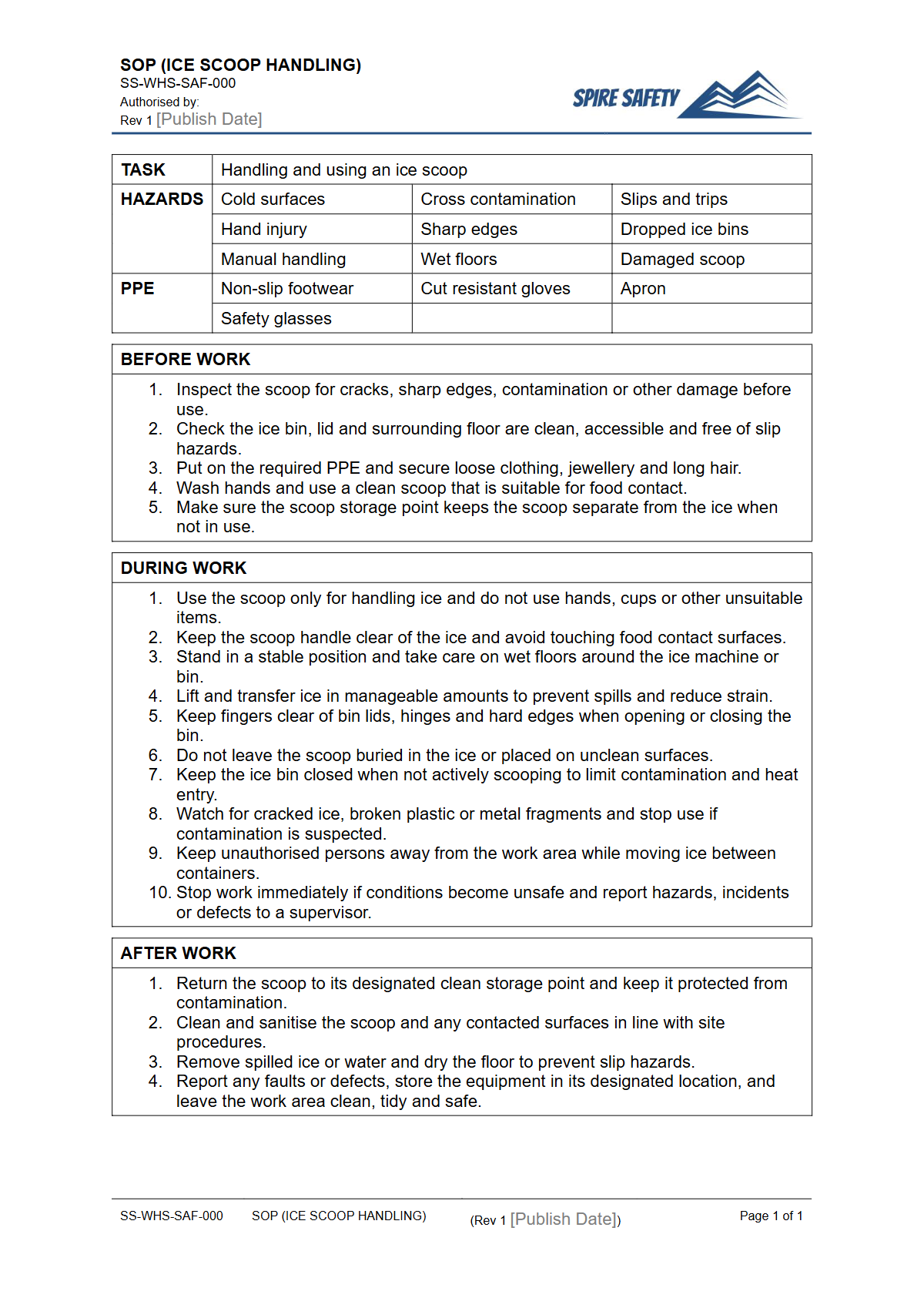
This Safe Operating Procedure (SOP) template provides a structured framework for outlining the safe handling of ice and ice scoops in a commercial environment. Using a dedicated free Safe Operating Procedure (Ice Scoop Handling) template ensures consistency in your processes, which is crucial for minimising two key risks: biological contamination of ice intended for consumption and musculoskeletal injuries from poor handling techniques.
It formally documents expectations for hygiene, scoop storage, ice machine use, and cleaning, helping your business meet its work health and safety obligations.
Properly implemented, this SOP helps control hazards such as:
- Biological hazards: Transfer of bacteria and viruses from hands, contaminated surfaces, or improper scoop storage to the ice supply.
- Physical hazards: Foreign bodies entering the ice, such as fragments from a broken scoop or other objects.
- Chemical hazards: Residue from incorrect or improperly rinsed cleaning agents contaminating the ice.
- Ergonomic hazards: Strains from repetitive scooping motions or awkward postures when accessing the ice machine.
- Slip, trip, and fall hazards: Spilled ice or water creating a slippery floor surface.
Documenting your process is a fundamental step in risk management. While handling ice is a specific task, it forms part of a broader set of kitchen safety protocols, similar to those you would establish with a free Safe Operating Procedure for deep fryers.
Video walkthrough
How to use the Free Safe Operating Procedure (Ice Scoop Handling) Template
This Safe Operating Procedure (Ice Scoop Handling) template is provided in both DOCX and PDF formats for your convenience. The DOCX file is fully editable, allowing you to adapt it to the unique circumstances of your workplace.
To use the template effectively, you should review each section and modify it to reflect your specific equipment, cleaning schedules, staff responsibilities, and site layout. It is essential to conduct a risk assessment for the task to ensure all potential hazards have been identified and controlled.
The document includes sections for:
- Required Personal Protective Equipment (PPE) like gloves.
- Pre-operational checks for the scoop and ice machine.
- A step-by-step procedure for safely scooping and dispensing ice.
- Rules for scoop storage and handling to prevent contamination.
- Cleaning and sanitising instructions.
Important: We have pre-filled this document with common steps and considerations based on Australian WHS principles. However, to ensure it is effective for your business, you MUST customise this template.
Every workplace is different. You need to consult with your team and add site-specific details to make it a practical and useful tool for your workers.
If you require expert guidance in customising this document, our WHS consulting services can provide tailored support.
When to use it
A Safe Operating Procedure for ice scoop handling should be a living document within your safety management system. It is not a set-and-forget tool.
It should be used consistently during key operational activities, including the initial induction and training for any new kitchen hands, bar staff, or food handlers. The SOP serves as a clear, authoritative reference for the correct procedure, reducing ambiguity and reinforcing safety standards.
Furthermore, it should be used for regular refresher training to prevent complacency among experienced staff. It also serves as a critical benchmark during workplace inspections, incident investigations, or procedural reviews.
Integrating this document into your broader WHS management system helps ensure that safe work practices are systematically applied and maintained across your organisation.
Who should use it
This SOP is intended for use by multiple roles within an organisation. Persons Conducting a Business or Undertaking (PCBUs) and management are responsible for ensuring the procedure is developed, implemented, and reviewed.
They must provide the necessary resources, training, and supervision to make it effective. Supervisors and team leaders should use the SOP as their primary tool for training workers and monitoring their day-to-day adherence to safe practices.
Workers who handle ice are the primary end-users of the procedure. They must understand and follow the documented steps to protect themselves, their colleagues, and customers.
Health and Safety Representatives (HSRs) should also be familiar with the SOP, as they may be involved in its development and review as part of their consultation duties. Regular reviews, often as part of internal WHS compliance auditing activities, ensure the procedure remains current and effective against emerging risks.
If you need more guidance or documents, you can explore our complete free WHS resources library for other useful templates.
Common mistakes
Common mistakes to avoid
- Leaving the ice scoop inside the ice bin between uses.
- Using a glass, cup, or hands to scoop ice instead of a dedicated scoop.
- Failing to wash hands before handling the ice scoop.
- Storing the scoop on an unsanitised surface or in a container that doesn't allow it to drain and dry.
- Neglecting the regular cleaning and sanitising schedule for both the scoop and the ice machine itself.
Legal references
Legal considerations
The following legal requirements may be relevant to this type of work.
- Work Health and Safety Act (Harmonised) — Provides the primary duties for protecting workers and other people from work health and safety risks.
- Work Health and Safety Regulations (Harmonised) — Sets out requirements supporting the management of workplace hazards and risks.
The following codes may be relevant to this type of work.
- Managing WHS Risks Code of Practice — Provides practical guidance on identifying hazards, assessing risks and applying effective controls.
- Work Health and Safety Consultation, Cooperation and Coordination Code of Practice — Provides practical guidance on consulting workers and coordinating with other duty holders.
- Managing the Work Environment and Facilities Code of Practice — Provides practical guidance on safe work environments, workplace facilities and related controls.
Did you know
Ice is Food
Under Australian food safety regulations, ice is legally classified as a food. This means it must be handled with the same level of care and hygiene as any other food product to prevent contamination and foodborne illness.
Biofilm Risk
Ice machines are a common breeding ground for 'biofilm', a slimy layer of bacteria and mould. If not cleaned regularly, biofilm can contaminate the entire ice supply, posing a health risk to consumers.
FAQ
Frequently asked questions
01Why can't staff just use a glass to scoop ice?
02Where is the correct place to store an ice scoop?
03How often do ice scoops and ice machines need to be cleaned?
04Is hand washing necessary if I'm using an ice scoop?
Share this resource
Free Safe Operating Procedure (Ice Scoop Handling) Template
Browse Categories
How To Use It
- 1Download and open in Word or PDF.
- 2Replace the placeholders with your business details.
- 3Get it reviewed by a WHS specialist before rollout.
Need it customised?
Our WHS consultants can adapt this template to your site, run a gap analysis, or audit what you already have in place.
Book a Free Consultation WHS consulting servicesor call 1300 156 382
Related templates
- Free Safe Operating Procedure (Illegal Dump Cleanup) Template
- Free Safe Operating Procedure (Impact Crusher Clearing) Template
- Free Safe Operating Procedure (Impact Driver) Template
- Free Safe Operating Procedure (Impact Wrench) Template
- Free Safe Operating Procedure (Inboard Motor) Template
- Free Safe Operating Procedure (Inbound Freight Check) Template