
Free Safe Operating Procedure (Ice Machine) Template
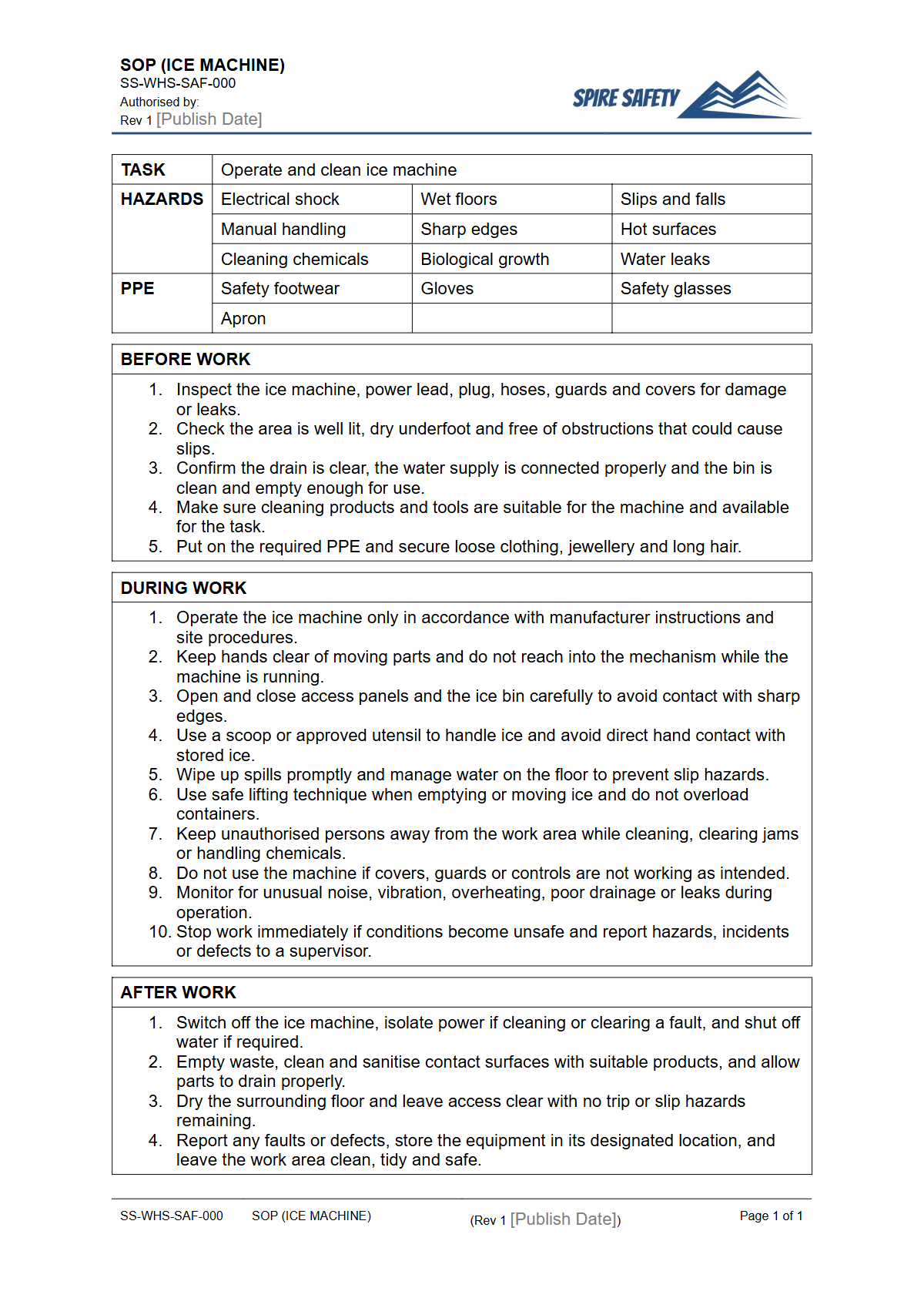
Download our free Safe Operating Procedure template for ice machines to outline key safety steps. This customisable DOCX and PDF helps formalise WHS processes.
Free Safe Operating Procedure (Ice Machine) Template
DOCX • 126 KB + PDF
Updated Oct 2026
No signup required
Purpose of the Free Safe Operating Procedure (Ice Machine) Template
This Free Safe Operating Procedure (Ice Machine) Template provides a structured framework for documenting the safe use of commercial ice machines in your workplace. Using an SOP is a fundamental part of managing health and safety risks associated with plant and equipment.
It outlines a step-by-step process that helps ensure workers operate machinery correctly, minimising the risk of injury, electrical shock, slips, or biological contamination. By formalising procedures, organisations can demonstrate a commitment to providing a safe system of work, which is a core duty for any Person Conducting a Business or Undertaking (PCBU) in Australia.
This document serves as a crucial training tool for new and existing employees, ensuring everyone understands the required safety controls. It details pre-operational checks, operational steps, cleaning protocols, and emergency procedures.
Implementing a clear SOP helps standardise behaviour, reduce equipment damage, and maintain hygiene standards critical in food service, healthcare, and hospitality environments. It forms an essential part of your overall safety management system and supports compliance with Australian WHS legislation.
Video walkthrough
How to use the Free Safe Operating Procedure (Ice Machine) Template
This template is provided as a starting point and must be adapted to your specific workplace. Download the file in your preferred format (DOCX or PDF) and customise it with details relevant to your site.
This includes adding the specific make and model of your ice machine, identifying workplace-specific hazards, and detailing your established control measures. A generic document is not sufficient; effective safety management requires procedures that are tailored to the actual environment where the work is performed.
For other common hospitality equipment, you might also find our free Safe Operating Procedure (Deep Fryer) template useful.
Customisation is Essential
Please note: We have created this template as a guide. It is your responsibility to ensure it is customised to reflect the specific hazards and controls in your workplace.
A competent person, such as a WHS manager or an experienced supervisor, should review and approve the final document before it is implemented. Simply downloading this document does not ensure your compliance or safety; active customisation and implementation are required.
When to use an Ice Machine Safe Operating Procedure
An SOP for an ice machine should be a living document that is integrated into daily operations. It is not a 'set and forget' policy.
- Worker Training and Induction: The SOP should be a primary reference when training new staff on how to use the ice machine safely. It should also be used for refresher training for existing employees.
- Before Every Use: Workers should be familiar with the pre-operational checks outlined in the SOP and perform them before starting the machine.
- During Cleaning and Maintenance: The SOP provides critical guidance on how to safely de-energise, clean, and sanitise the machine, including any required lockout/tagout procedures. The processes within this document are a key part of developing robust WHS management systems.
- Following an Incident: After any near miss or incident involving the ice machine, the SOP should be reviewed and updated to prevent a recurrence.
- During Audits and Inspections: A well-maintained SOP serves as evidence of your safety processes during internal or external audits. Regular WHS compliance auditing helps verify that these documented procedures are being followed correctly in practice.
Who should use this Safe Operating Procedure
This Safe Operating Procedure is intended for use by various personnel within an organisation to ensure a consistent approach to safety.
- Workers and Operators: The primary users are the individuals who operate, clean, and perform minor maintenance on the ice machine. The SOP gives them clear, authoritative instructions.
- Supervisors and Managers: Supervisors use the SOP to train staff, monitor safe work practices, and enforce safety standards. It provides a benchmark for correct performance.
- WHS and Safety Officers: Health and Safety Representatives (HSRs) and WHS professionals use the SOP as a tool for risk assessments, incident investigations, and demonstrating compliance.
- Maintenance Personnel: While they may have more detailed technical manuals, the SOP provides essential safety context, particularly regarding energy isolation before undertaking repair work. For other plant, our Free Air Compressor SOP offers a similar structure for maintenance and operational safety.
For organisations needing assistance in developing a comprehensive suite of safety documents, engaging with specialist WHS consulting services can provide expert guidance and support. You can also explore our full free WHS resources library for other templates and guides.
Common mistakes
Common mistakes to avoid
- Neglecting regular cleaning and sanitation schedules specified in the SOP.
- Failing to document pre-operational checks as having been completed.
- Not including specific lockout/tagout (LOTO) procedures for cleaning and maintenance.
- Using the SOP for initial training but failing to use it for refresher training or daily reference.
Legal references
Legal considerations
The following legal requirements may be relevant to this type of work.
- Work Health and Safety Act (Harmonised) — Provides the primary duties for protecting workers and other people from work health and safety risks.
- Work Health and Safety Regulations (Harmonised) — Sets out requirements supporting the management of workplace hazards and risks.
The following codes may be relevant to this type of work.
- Managing WHS Risks Code of Practice — Provides practical guidance on identifying hazards, assessing risks and applying effective controls.
- Work Health and Safety Consultation, Cooperation and Coordination Code of Practice — Provides practical guidance on consulting workers and coordinating with other duty holders.
- Managing the Work Environment and Facilities Code of Practice — Provides practical guidance on safe work environments, workplace facilities and related controls.
Did you know
Hygiene Risk
Poorly maintained ice machines are a known breeding ground for harmful bacteria and biofilm. Contaminated ice has been linked to outbreaks of norovirus, Salmonella, and E. coli in food service environments.
Slips, Trips & Falls
According to Safe Work Australia, slips, trips, and falls are a leading cause of serious injury. Spills from ice machines are a common and often underestimated contributor to these incidents in hospitality and healthcare settings.
FAQ
Frequently asked questions
01What are the main hazards of a commercial ice machine?
02Is an SOP for an ice machine a legal requirement in Australia?
03How often should an Ice Machine SOP be reviewed?
04Can I use this template without customising it?
Share this resource
Free Safe Operating Procedure (Ice Machine) Template
Browse Categories
How To Use It
- 1Download and open in Word or PDF.
- 2Replace the placeholders with your business details.
- 3Get it reviewed by a WHS specialist before rollout.
Need it customised?
Our WHS consultants can adapt this template to your site, run a gap analysis, or audit what you already have in place.
Book a Free Consultation WHS consulting servicesor call 1300 156 382
Related templates
- Free Safe Operating Procedure (Ice Maker Cleaning) Template
- Free Safe Operating Procedure (Ice Scoop Handling) Template
- Free Safe Operating Procedure (Illegal Dump Cleanup) Template
- Free Safe Operating Procedure (Impact Crusher Clearing) Template
- Free Safe Operating Procedure (Impact Driver) Template
- Free Safe Operating Procedure (Impact Wrench) Template