
Free Safe Operating Procedure (IBC Decanting) Template
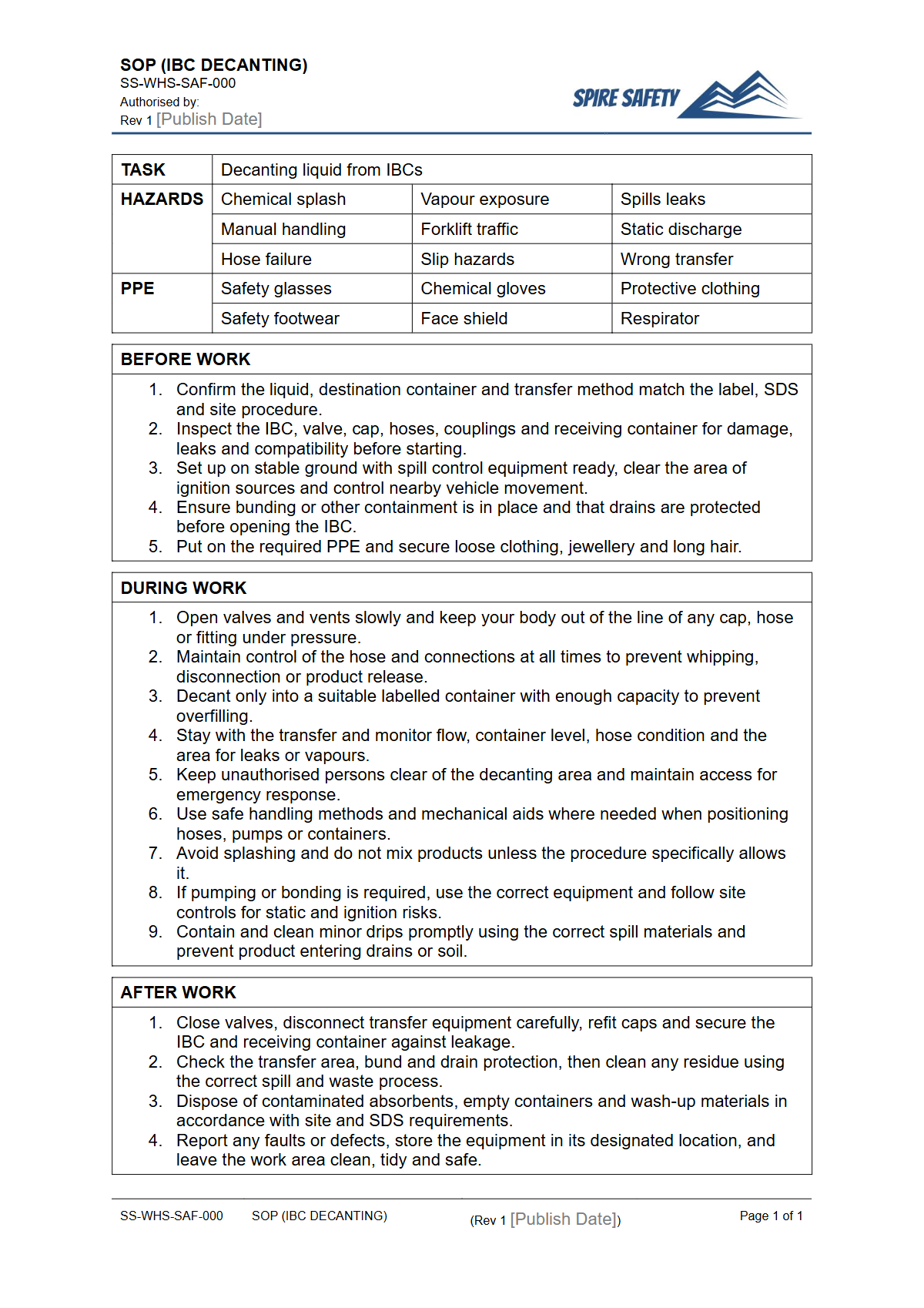
Download our free Safe Operating Procedure (IBC Decanting) template to manage risks associated with handling chemicals.
Free Safe Operating Procedure (IBC Decanting) Template
DOCX • 126 KB + PDF
Updated Oct 2026
No signup required
Purpose of the Free Safe Operating Procedure (IBC Decanting) Template
Effectively managing hazardous chemicals is a critical part of workplace safety. This free Safe Operating Procedure (IBC Decanting) template provides a structured framework for documenting the risks and controls associated with transferring liquids from Intermediate Bulk Containers (IBCs).
Decanting operations, if not properly managed, can expose workers to significant hazards, including chemical splashes, toxic fume inhalation, fire or explosion, and ergonomic injuries from manual handling.
Using a detailed SOP helps ensure tasks are performed consistently and safely by all personnel. It outlines the required personal protective equipment (PPE), emergency procedures, and step-by-step instructions for the task.
Implementing a clear procedure demonstrates a commitment to proactive risk management and is a fundamental component of a compliant safety system. Proper documentation supports worker training and provides a clear standard for supervision and performance assessment.
Video walkthrough
How to use the Free Safe Operating Procedure (IBC Decanting) Template
This template is provided in both DOCX and PDF formats for your convenience. The DOCX file is fully editable, allowing you to tailor it to the specific requirements of your site.
It is crucial to adapt the document to reflect the unique chemicals, equipment (pumps, hoses, valves), and environmental conditions present in your workplace. Information from the relevant Safety Data Sheet (SDS) for each chemical must be incorporated into the procedure.
Important: This document is a template only. We have provided a solid foundation based on Australian WHS principles, but it is your responsibility to customise it.
You must consult with your workers and other relevant stakeholders to ensure the final SOP is practical, comprehensive, and effectively controls all identified risks for your specific operations. Integrating such procedures is a cornerstone of developing robust WHS management systems.
When to Use This SOP
A Safe Operating Procedure for IBC decanting should be developed, implemented, and communicated before any worker is required to perform the task. It should be a core document used during new employee inductions and task-specific training.
The SOP serves as a constant on-the-job reference for workers and a tool for supervisors to monitor correct procedure.
The procedure should also be reviewed and updated regularly, typically on an annual basis. A review is also essential whenever there is a change in the process, such as the introduction of a new chemical, new equipment, or a change in the work environment.
Furthermore, the SOP must be reviewed as part of any incident investigation related to IBC decanting to identify and rectify procedural gaps.
Who Should Use It
This SOP template is designed for use by a range of personnel within an organisation. WHS managers, safety officers, and compliance managers can use it to establish a baseline for safe work practices.
Supervisors and team leaders are responsible for implementing the procedure, training their teams, and ensuring it is followed correctly. The end-users—the operators and workers who perform the decanting task—will rely on the finalised SOP as their guide to working safely and efficiently.
The equipment used to move and position IBCs, such as forklifts, must also be operated according to strict procedures. If your workplace uses versatile lifting equipment, consider documenting the process for operating a telehandler safely as well.
Integrating with Other Systems
An effective SOP does not exist in isolation. It should be integrated with your broader risk management framework, including your chemical register, risk assessments, and training records.
For example, if pressurised air is used to drive a pump for decanting, a separate procedure for using an air compressor may be required. This ensures all associated hazards are managed.
Regular reviews and checks ensure the SOP remains effective and is being followed correctly. This can be incorporated into routine workplace inspections and more formal WHS compliance auditing activities.
Similarly, consider the entire workflow. If decanted products are then moved via automated systems, referencing your conveyer system safe operating procedure ensures safety is maintained throughout the process from start to finish. For more templates and safety documents, browse our complete free WHS resources library.
Common mistakes
Common mistakes to avoid
- Failing to read and apply the precautions listed in the Safety Data Sheet (SDS).
- Using damaged or incompatible hoses, pumps, or seals, leading to leaks and spills.
- Not wearing the correct, chemical-specific Personal Protective Equipment (PPE).
- Working in a poorly ventilated area, allowing hazardous vapours to accumulate.
Legal references
Legal considerations
The following legal requirements may be relevant to this type of work.
- Work Health and Safety Act (Harmonised) — Provides the primary duties for protecting workers and other people from work health and safety risks.
- Work Health and Safety Regulations (Harmonised) — Sets out requirements supporting the management of workplace hazards and risks.
The following codes may be relevant to this type of work.
- Managing WHS Risks Code of Practice — Provides practical guidance on identifying hazards, assessing risks and applying effective controls.
- Work Health and Safety Consultation, Cooperation and Coordination Code of Practice — Provides practical guidance on consulting workers and coordinating with other duty holders.
- Managing the Work Environment and Facilities Code of Practice — Provides practical guidance on safe work environments, workplace facilities and related controls.
Did you know
IBC Capacity
The most common volume for an IBC is 1,000 litres, which is equivalent to approximately five 200-litre (44-gallon) drums, making them an efficient solution for storage and transport.
Grounding is Key
When decanting flammable or combustible liquids, static electricity can build up and create a spark, posing a serious ignition risk. Grounding and bonding the IBC and receiving container is a critical safety step.
FAQ
Frequently asked questions
01What is an Intermediate Bulk Container (IBC)?
02What PPE is required for decanting chemicals from an IBC?
03How often should a Safe Operating Procedure for IBC decanting be reviewed?
04Can this IBC decanting template be used for all types of chemicals?
Share this resource
Free Safe Operating Procedure (IBC Decanting) Template
Browse Categories
How To Use It
- 1Download and open in Word or PDF.
- 2Replace the placeholders with your business details.
- 3Get it reviewed by a WHS specialist before rollout.
Need it customised?
Our WHS consultants can adapt this template to your site, run a gap analysis, or audit what you already have in place.
Book a Free Consultation WHS consulting servicesor call 1300 156 382
Related templates
- Free Safe Operating Procedure (Ice Bin Cleaning) Template
- Free Safe Operating Procedure (Ice Crusher) Template
- Free Safe Operating Procedure (Ice Machine) Template
- Free Safe Operating Procedure (Ice Maker Cleaning) Template
- Free Safe Operating Procedure (Ice Scoop Handling) Template
- Free Safe Operating Procedure (Illegal Dump Cleanup) Template