
Free Safe Operating Procedure (IBC Cleaning) Template
Effectively manage the risks of cleaning Intermediate Bulk Containers (IBCs) with our comprehensive template. Download your free Safe Operating Procedure now.
Free Safe Operating Procedure (IBC Cleaning) Template
DOCX • 126 KB + PDF
Updated Oct 2026
No signup required
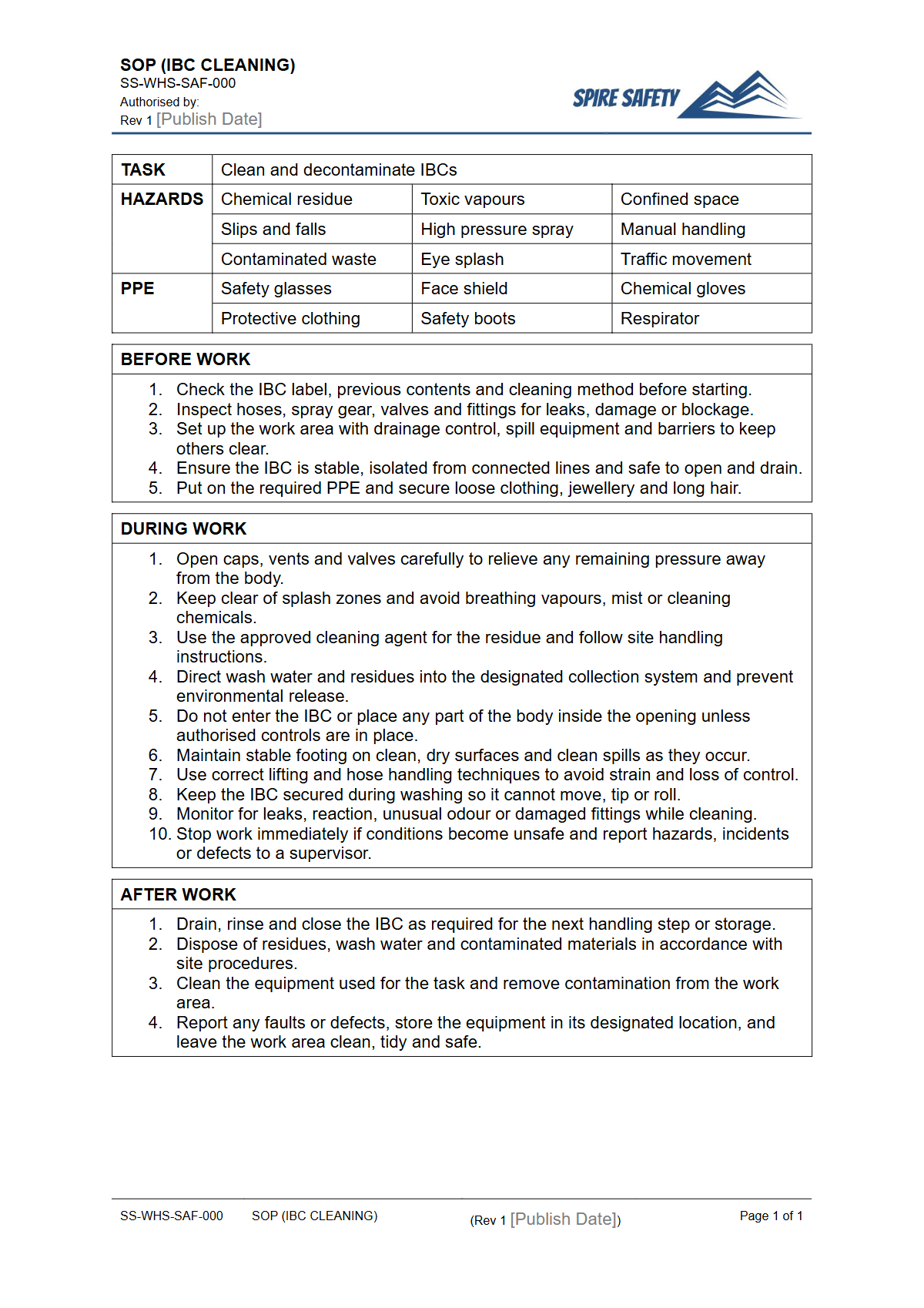
Purpose of the Free Safe Operating Procedure (IBC Cleaning) Template
Cleaning Intermediate Bulk Containers (IBCs) is a common industrial task that carries significant risks if not properly managed. This free Safe Operating Procedure (IBC Cleaning) template provides a structured framework for documenting the required steps to perform this task safely.
The process can involve hazardous chemicals, high-pressure equipment, manual handling, and potential confined space scenarios. Using a formal SOP helps your organisation standardise its approach, ensuring every worker understands the identified hazards and the control measures put in place to protect them.
A documented procedure is essential for maintaining a safe system of work. It serves as a vital training tool for new employees and a consistent reference point for experienced staff.
By clearly outlining the sequence of operations, required personal protective equipment (PPE), and emergency responses, this SOP helps minimise the risk of incidents, injuries, and exposure to harmful substances. Similar to our Free Air Compressor SOP Template, it focuses on breaking down a complex task into manageable, safety-focused steps to support your overall WHS program.
Video walkthrough
How to use the Free Safe Operating Procedure (IBC Cleaning) Template
This resource is available for download in both DOCX and PDF formats. The DOCX version is fully editable, allowing you to tailor it directly to the specific circumstances of your workplace.
While this document is aligned with Australian WHS principles, it is not a complete, out-of-the-box solution. It is crucial that you customise this template to reflect your unique operational environment, equipment, and chemical usage.
We have designed it to be a robust starting point, but the responsibility for ensuring its suitability and adequacy rests with the Person Conducting a Business or Undertaking (PCBU).
When customising the document, you must review and update every section. Pay close attention to specifying the exact types of IBCs used, the cleaning agents and their corresponding Safety Data Sheets (SDS), the specific models of cleaning equipment (e.g., pressure washers), and the emergency procedures relevant to your site.
This process of customisation is a critical part of developing effective WHS management systems that are practical and fit-for-purpose, rather than just generic documents.
When to use it
This Safe Operating Procedure must be used and referred to before and during any task involving the cleaning of IBCs. It should be a core component of worker training and induction for anyone assigned to this job.
It is also an excellent resource for pre-start meetings or toolbox talks to refresh workers' knowledge of the risks and safety controls. Documenting procedures for specific tasks, such as in our deep fryer SOP, ensures that even routine activities are performed with a consistent focus on safety.
An SOP should also be consulted and reviewed whenever there is a change in the work process. This includes the introduction of new cleaning chemicals, different types of IBCs, new equipment, or a change in the work location.
Proactive review ensures the procedure remains relevant and effective. Regular reviews and updates are key activities that form part of a robust schedule of WHS compliance auditing to verify that documented procedures match workplace practices.
Who should use it
This SOP is intended for use by several key roles within an organisation. Workers who perform IBC cleaning tasks must be trained in and follow the procedure meticulously.
Supervisors and managers are responsible for ensuring the SOP is implemented correctly, that workers are adequately trained, and that the specified control measures (like PPE and ventilation) are available and used.
Work Health and Safety (WHS) managers, advisors, and Health and Safety Representatives (HSRs) will also use this document. They can use it to conduct risk assessments, review the effectiveness of existing controls, and guide continuous improvement initiatives.
Having a library of task-specific SOPs, from IBC cleaning to a free Circular Saw SOP, empowers your safety team to build a comprehensive and practical safety framework. For further guidance on developing and implementing your safety systems, consider engaging our specialist WHS consulting team.
Common mistakes
Common mistakes to avoid
- Using generic PPE instead of selecting it based on the specific chemical's Safety Data Sheet (SDS).
- Failing to properly ventilate the cleaning area, leading to the build-up of hazardous vapours.
- Neglecting to positively identify the previous contents of the IBC before starting to clean.
- Assuming an IBC is clean enough for a new substance without proper verification and documentation.
Legal references
Legal considerations
The following legal requirements may be relevant to this type of work.
- Work Health and Safety Act (Harmonised) — Provides the primary duties for protecting workers and other people from work health and safety risks.
- Work Health and Safety Regulations (Harmonised) — Sets out requirements supporting the management of workplace hazards and risks.
The following codes may be relevant to this type of work.
- Managing WHS Risks Code of Practice — Provides practical guidance on identifying hazards, assessing risks and applying effective controls.
- Work Health and Safety Consultation, Cooperation and Coordination Code of Practice — Provides practical guidance on consulting workers and coordinating with other duty holders.
- Managing the Work Environment and Facilities Code of Practice — Provides practical guidance on safe work environments, workplace facilities and related controls.
Did you know
Chemical Residue Risk
An "empty" IBC can still contain up to 2.5% of its previous contents as residue, posing a significant chemical exposure risk to workers during cleaning if not handled correctly.
Manual Handling Strain
A standard 1000-litre IBC can weigh over 60kg when empty, making manual handling a key risk factor for musculoskeletal injuries if mechanical aids are not used.
FAQ
Frequently asked questions
01What are the main hazards associated with cleaning IBCs?
02Is a Safe Operating Procedure a legal requirement for IBC cleaning?
03How often should an SOP for IBC cleaning be reviewed?
04Can I use this template for cleaning all types of IBCs?
Share this resource
Free Safe Operating Procedure (IBC Cleaning) Template
Browse Categories
How To Use It
- 1Download and open in Word or PDF.
- 2Replace the placeholders with your business details.
- 3Get it reviewed by a WHS specialist before rollout.
Need it customised?
Our WHS consultants can adapt this template to your site, run a gap analysis, or audit what you already have in place.
Book a Free Consultation WHS consulting servicesor call 1300 156 382
Related templates
- Free Safe Operating Procedure (IBC Decanting) Template
- Free Safe Operating Procedure (Ice Bin Cleaning) Template
- Free Safe Operating Procedure (Ice Crusher) Template
- Free Safe Operating Procedure (Ice Machine) Template
- Free Safe Operating Procedure (Ice Maker Cleaning) Template
- Free Safe Operating Procedure (Ice Scoop Handling) Template