
Free Safe Operating Procedure (Hydraulic Torque Tool) Template
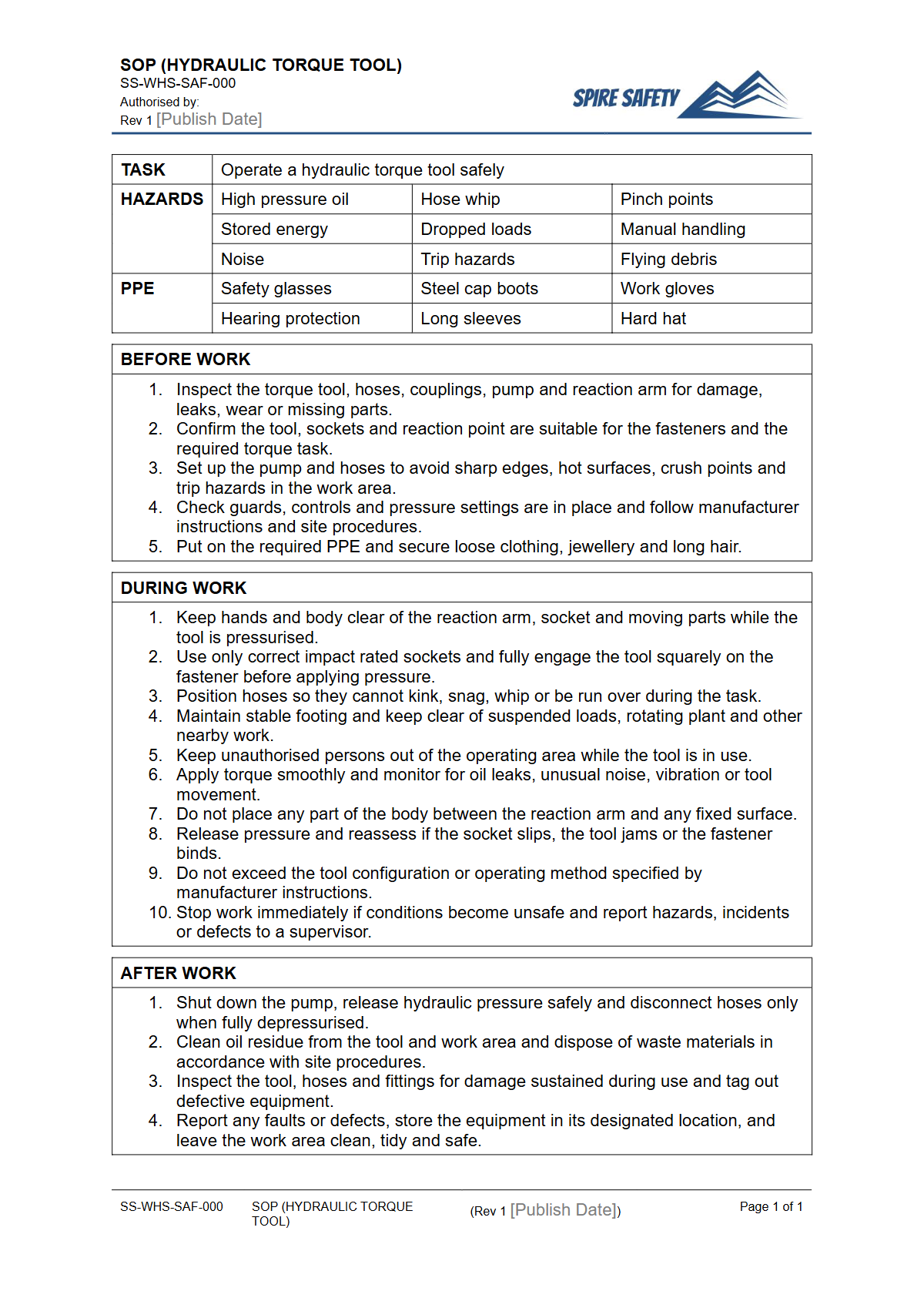
Download our free Safe Operating Procedure (Hydraulic Torque Tool) Template. This structured DOCX and PDF helps you outline safe work systems for your team.
Free Safe Operating Procedure (Hydraulic Torque Tool) Template
DOCX • 126 KB + PDF
Updated Oct 2026
No signup required
Purpose of the Free Safe Operating Procedure (Hydraulic Torque Tool) Template
Operating high-powered equipment like hydraulic torque tools requires clear, consistent guidance to prevent serious incidents. This free Safe Operating Procedure (Hydraulic Torque Tool) template provides a structured starting point for documenting the step-by-step process for the safe use of this equipment in your workplace.
A well-drafted SOP is a critical tool for managing risks such as high-pressure fluid injection, crush injuries from reaction arms, and unexpected energy release. By formalising your process, you create a clear standard for training, supervision, and performance, ensuring every operator understands the required safety controls.
It serves as a fundamental building block within broader WHS management systems, demonstrating a commitment to proactive risk management.
Video walkthrough
How to use the Free Safe Operating Procedure (Hydraulic Torque Tool) Template
This template is available for instant download in both DOCX and PDF formats. The DOCX file is fully editable, allowing you to tailor the content to your specific operational needs.
You can add your company branding, insert site-specific details, and modify procedures to match the exact models of hydraulic torque wrenches and power packs your team uses.
Important: This document is a template, not a finished legal or safety document. It provides a framework aligned with Australian WHS practice, but it must be customised to your workplace.
You are responsible for ensuring the final SOP accurately reflects your specific equipment, tasks, risk assessments, and control measures. We recommend engaging a qualified person to review the final document.
If you need assistance, our WHS consulting team can help develop bespoke safety documents for your business.
When to use a Hydraulic Torque Tool Safe Operating Procedure
A Safe Operating Procedure for hydraulic torque tools should be a central part of your daily operations and safety management. It is used to train and assess the competency of new operators before they are authorised to use the equipment.
It should also be a key reference during job planning, pre-start meetings, and for any non-routine tasks involving the tool. Regular review of the SOP, especially after an incident or when new equipment is introduced, ensures it remains a relevant and effective safety tool. The principles outlined are similar to those for other high-force equipment, as seen in our FREE Hydraulic Press SOP (Safe Operating Procedure) Template.
Who should use this Safe Operating Procedure
This Safe Operating Procedure is intended for a range of personnel within an organisation. Machine operators must use it as their primary guide for safe operation, following every step in the pre-start, operational, and shutdown phases.
Supervisors and managers are responsible for enforcing the SOP, ensuring workers are trained on its contents, and verifying that procedures are being followed correctly on the job. Maintenance personnel should also refer to the SOP to understand operational hazards before conducting inspection, repair, or servicing tasks.
Finally, the document is a key piece of evidence during safety reviews and WHS compliance auditing to demonstrate that formalised safety processes are in place.
Key Sections in the Template
Our template provides a comprehensive structure to guide your documentation process. Key sections include:
- Associated Risks and Hazards: Prompts you to list specific dangers like hydraulic fluid injection, pinch points, and ergonomic strains.
- Required Personal Protective Equipment (PPE): A checklist for mandatory PPE such as impact-resistant gloves, safety glasses, and protective footwear.
- Pre-Operational Checks: A step-by-step inspection list for hoses, fittings, pump, and the tool itself to ensure it is fit for use. Identifying and rectifying faults with ancillary equipment, such as that detailed in our Free Air Compressor SOP (Safe Operating Procedure) Template, is also a critical pre-start activity.
- Operating Procedure: A detailed sequence for setting up, operating, and completing the task safely.
- Emergency Shutdown and First Aid: Clear instructions for handling emergencies, including equipment shutdown and specific first aid for injuries like hydraulic fluid injection.
By thoroughly completing each section, you create a robust procedure that helps protect your workers and your business. Explore our complete free WHS resources library for more templates to support your safety management system.
Common mistakes
Common mistakes to avoid
- Using an incorrect or poorly positioned reaction arm, leading to tool kickback and loss of control.
- Failing to conduct thorough pre-start inspections of hydraulic hoses and couplings for leaks or damage.
- Neglecting to depressurise the system before disconnecting hoses, risking high-pressure fluid release.
- Using the SOP as a 'tick-and-flick' exercise without ensuring operators fully understand and follow the procedures.
Legal references
Legal considerations
The following legal requirements may be relevant to this type of work.
- Work Health and Safety Act (Harmonised) — Provides the primary duties for protecting workers and other people from work health and safety risks.
- Work Health and Safety Regulations (Harmonised) — Sets out requirements supporting the management of workplace hazards and risks.
The following codes may be relevant to this type of work.
- Managing WHS Risks Code of Practice — Provides practical guidance on identifying hazards, assessing risks and applying effective controls.
- Work Health and Safety Consultation, Cooperation and Coordination Code of Practice — Provides practical guidance on consulting workers and coordinating with other duty holders.
- Managing the Work Environment and Facilities Code of Practice — Provides practical guidance on safe work environments, workplace facilities and related controls.
Did you know
High-Pressure Hazard
Hydraulic systems on torque tools can operate at pressures exceeding 10,000 psi. A pinhole leak in a hose at this pressure can release fluid at a velocity over 600 ft/s, capable of penetrating skin and causing catastrophic injury.
Torque and Force
The term 'torque' is a measure of rotational force. A hydraulic torque tool allows a single operator to apply a precise and immense amount of torque that would be impossible manually, ensuring bolts are tightened to exact engineering specifications.
FAQ
Frequently asked questions
01What are the main hazards of using a hydraulic torque tool?
02Does a Safe Operating Procedure replace a risk assessment?
03How often should I review my Hydraulic Torque Tool SOP?
04Is operator training required in addition to having an SOP?
Share this resource
Free Safe Operating Procedure (Hydraulic Torque Tool) Template
Browse Categories
How To Use It
- 1Download and open in Word or PDF.
- 2Replace the placeholders with your business details.
- 3Get it reviewed by a WHS specialist before rollout.
Need it customised?
Our WHS consultants can adapt this template to your site, run a gap analysis, or audit what you already have in place.
Book a Free Consultation WHS consulting servicesor call 1300 156 382
Related templates
- Free Safe Operating Procedure (Hydro Excavation) Template
- Free Safe Operating Procedure (Hydroponic Cleaning) Template
- Free Safe Operating Procedure (Hydroponic Mixing) Template
- Free Safe Operating Procedure (Hygrometer) Template
- Free Safe Operating Procedure (IBC Cleaning) Template
- Free Safe Operating Procedure (IBC Decanting) Template