
Free Safe Operating Procedure (Hydro Excavation) Template
Manage hydro excavation risks with our free Safe Operating Procedure template. Download the DOCX or PDF to outline key safety controls for your worksite.
Free Safe Operating Procedure (Hydro Excavation) Template
DOCX • 126 KB + PDF
Updated Oct 2026
No signup required
Purpose of the Free Safe Operating Procedure (Hydro Excavation) Template
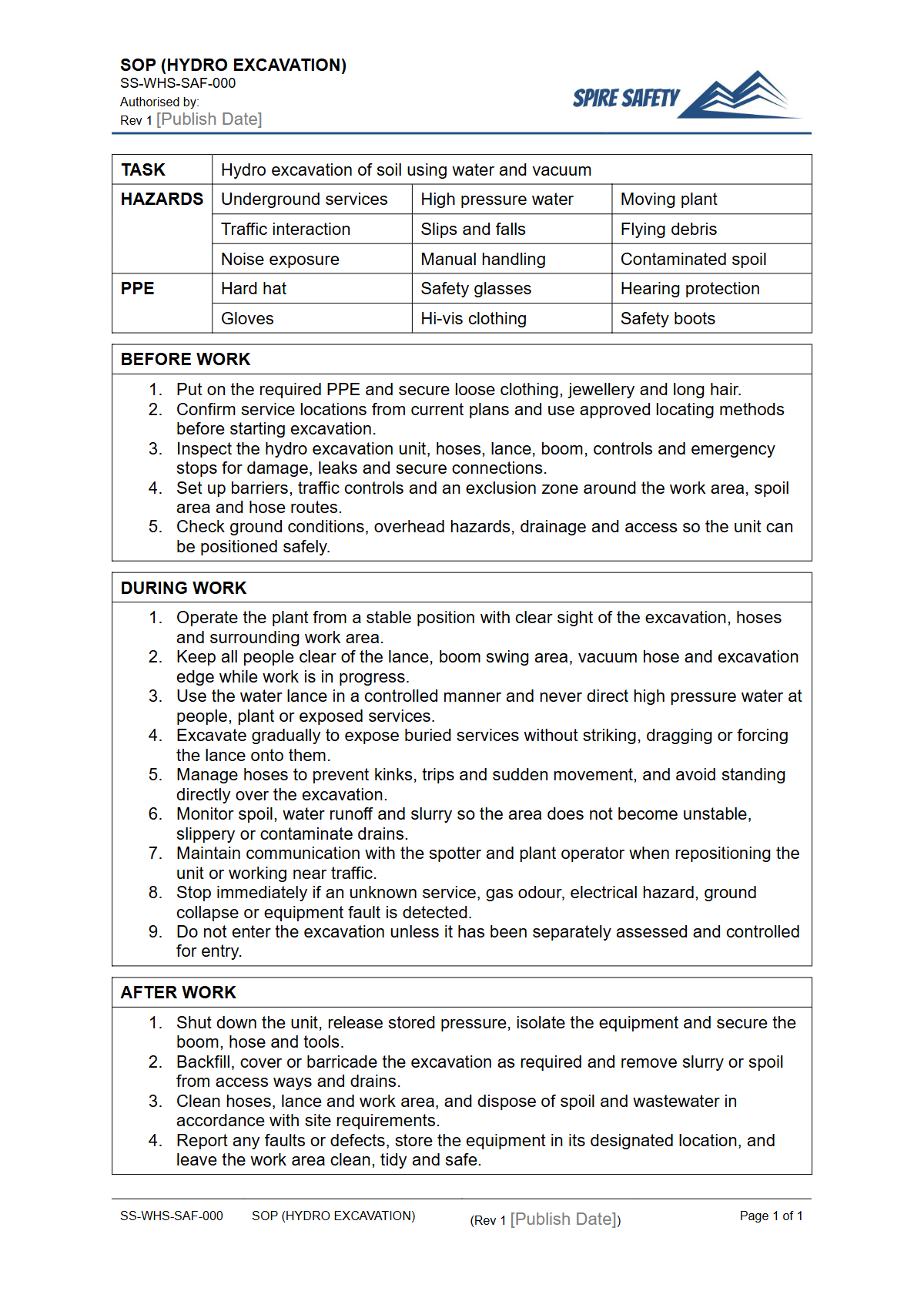
This Free Safe Operating Procedure (Hydro Excavation) Template provides a structured starting point for businesses to document the process for non-destructive digging. Hydro excavation is a high-risk activity that involves pressurised water and a powerful vacuum to excavate soil, primarily to locate and expose underground utilities.
The key risks include striking buried electrical cables or gas lines, worker injury from high-pressure water jets, trench collapse, and environmental contamination.
Using a detailed Safe Operating Procedure (SOP) is crucial for managing these hazards. It provides workers with clear, step-by-step instructions on how to perform the task safely, from initial site assessment and utility location to final backfilling and site clean-up.
This template is designed to help your organisation meet its primary duty of care under Australian WHS legislation by formalising safety protocols and ensuring a consistent approach to risk management for hydro excavation tasks.
Video walkthrough
How to use the Free Safe Operating Procedure (Hydro Excavation) Template
This document is a template and must be customised to suit the specific needs of your workplace. After downloading the DOCX or PDF file, you should consult with your workers and other stakeholders to tailor the content.
This involves incorporating details about your specific hydro excavation unit, the types of ground conditions you typically encounter, and the particular hazards present at your worksites. A generic procedure is not enough; it must reflect the reality of your operations.
For the procedure to be effective, it should be integrated into your broader WHS management systems. This means linking it to your risk assessments, incident reporting processes, and worker training programs. Ensure all operators are trained on the final, approved version of the SOP and that their understanding is verified before they undertake any work.
The goal is to create a practical, living document that genuinely improves safety outcomes on the ground.
When to use a Hydro Excavation Safe Operating Procedure
A Safe Operating Procedure for hydro excavation should be developed, implemented, and referenced before any such work begins. It is a critical planning document that forms the basis of pre-start meetings and toolbox talks.
The SOP should be readily available on-site for workers and supervisors to consult whenever they are performing or overseeing the task. It is particularly important to review the SOP when there are changes to the work environment, equipment, or personnel, or following any near miss or incident.
This procedure should also be used as a core training document for new operators and for refresher training for experienced staff. Similar to how a business might use our FREE Trencher SOP Template for mechanical digging, this SOP provides a benchmark for expected safe behaviour and performance specific to non-destructive hydro excavation methods.
Who should use this Safe Operating Procedure
This Safe Operating Procedure is intended for use by a range of personnel within an organisation. The Person Conducting a Business or Undertaking (PCBU) is ultimately responsible for ensuring safe systems of work are in place.
Site supervisors and project managers must use the SOP to plan, instruct, and supervise hydro excavation activities. They are responsible for ensuring all controls outlined in the document are implemented and effective.
Operators of the hydro excavation equipment are the primary end-users of the SOP. They must follow the outlined steps to ensure their own safety and the safety of those around them.
Safety officers and WHS advisors can use the SOP as a reference for safety inspections, incident investigations, and continuous improvement initiatives. A regular review of operational procedures, potentially through a structured WHS compliance auditing program, helps ensure the SOP remains relevant and effective.
Just as an equipment-specific procedure like our Free Air Compressor SOP (Safe Operating Procedure) Template is vital for safe plant operation, this hydro excavation SOP is essential for managing the unique risks of this specialised task. By involving all relevant parties in its development and use, organisations can foster a stronger safety culture and reduce the likelihood of serious incidents.
You can find more templates like this in our free WHS resources library to build out your safety documentation.
Common mistakes
Common mistakes to avoid
- Failing to identify all underground services by not consulting official plans or using an electronic locator.
- Using incorrect water pressure, which can either be ineffective or damage sensitive assets like fibre optic cables.
- Neglecting to establish proper exclusion zones, allowing unauthorised personnel to enter the immediate work area.
- Inadequate shoring or benching for deeper excavations, creating a significant risk of trench collapse.
Legal references
Legal considerations
The following legal requirements may be relevant to this type of work.
- Work Health and Safety Act (Harmonised) — Provides the primary duties for protecting workers and other people from work health and safety risks.
- Work Health and Safety Regulations (Harmonised) — Sets out requirements supporting the management of workplace hazards and risks.
The following codes may be relevant to this type of work.
- Managing WHS Risks Code of Practice — Provides practical guidance on identifying hazards, assessing risks and applying effective controls.
- Work Health and Safety Consultation, Cooperation and Coordination Code of Practice — Provides practical guidance on consulting workers and coordinating with other duty holders.
- Managing the Work Environment and Facilities Code of Practice — Provides practical guidance on safe work environments, workplace facilities and related controls.
Did you know
Dial Before You Dig
In Australia, it is a mandatory requirement to consult 'Dial Before You Dig' (now known as Before You Dig Australia) services before any excavation to obtain plans for underground utilities like gas, water, and electricity.
Non-Destructive by Design
Hydro excavation is often called 'non-destructive digging' because it uses pressurised water and a vacuum system to move soil, significantly reducing the risk of damaging underground pipes and cables compared to mechanical excavators.
FAQ
Frequently asked questions
01What is a Safe Operating Procedure for hydro excavation?
02Is hydro excavation considered high-risk construction work?
03Who needs to be trained on this Safe Operating Procedure?
04How often should a hydro excavation SOP be reviewed?
Share this resource
Free Safe Operating Procedure (Hydro Excavation) Template
Browse Categories
How To Use It
- 1Download and open in Word or PDF.
- 2Replace the placeholders with your business details.
- 3Get it reviewed by a WHS specialist before rollout.
Need it customised?
Our WHS consultants can adapt this template to your site, run a gap analysis, or audit what you already have in place.
Book a Free Consultation WHS consulting servicesor call 1300 156 382
Related templates
- Free Safe Operating Procedure (Hydroponic Cleaning) Template
- Free Safe Operating Procedure (Hydroponic Mixing) Template
- Free Safe Operating Procedure (Hygrometer) Template
- Free Safe Operating Procedure (IBC Cleaning) Template
- Free Safe Operating Procedure (IBC Decanting) Template
- Free Safe Operating Procedure (Ice Bin Cleaning) Template