
Free Safe Operating Procedure (Hydroponic Mixing) Template
Manage hydroponic mixing risks with our free Safe Operating Procedure template. This customisable document helps you formalise your safety processes.
Free Safe Operating Procedure (Hydroponic Mixing) Template
DOCX • 126 KB + PDF
Updated Oct 2026
No signup required
Purpose of the Free Safe Operating Procedure (Hydroponic Mixing) Template
Hydroponic mixing, while essential for modern agriculture and horticulture, introduces specific workplace hazards. The process involves handling concentrated chemical nutrients, pH adjusters, and additives, which can pose risks of chemical exposure, splashes, and ergonomic injuries from manual handling.
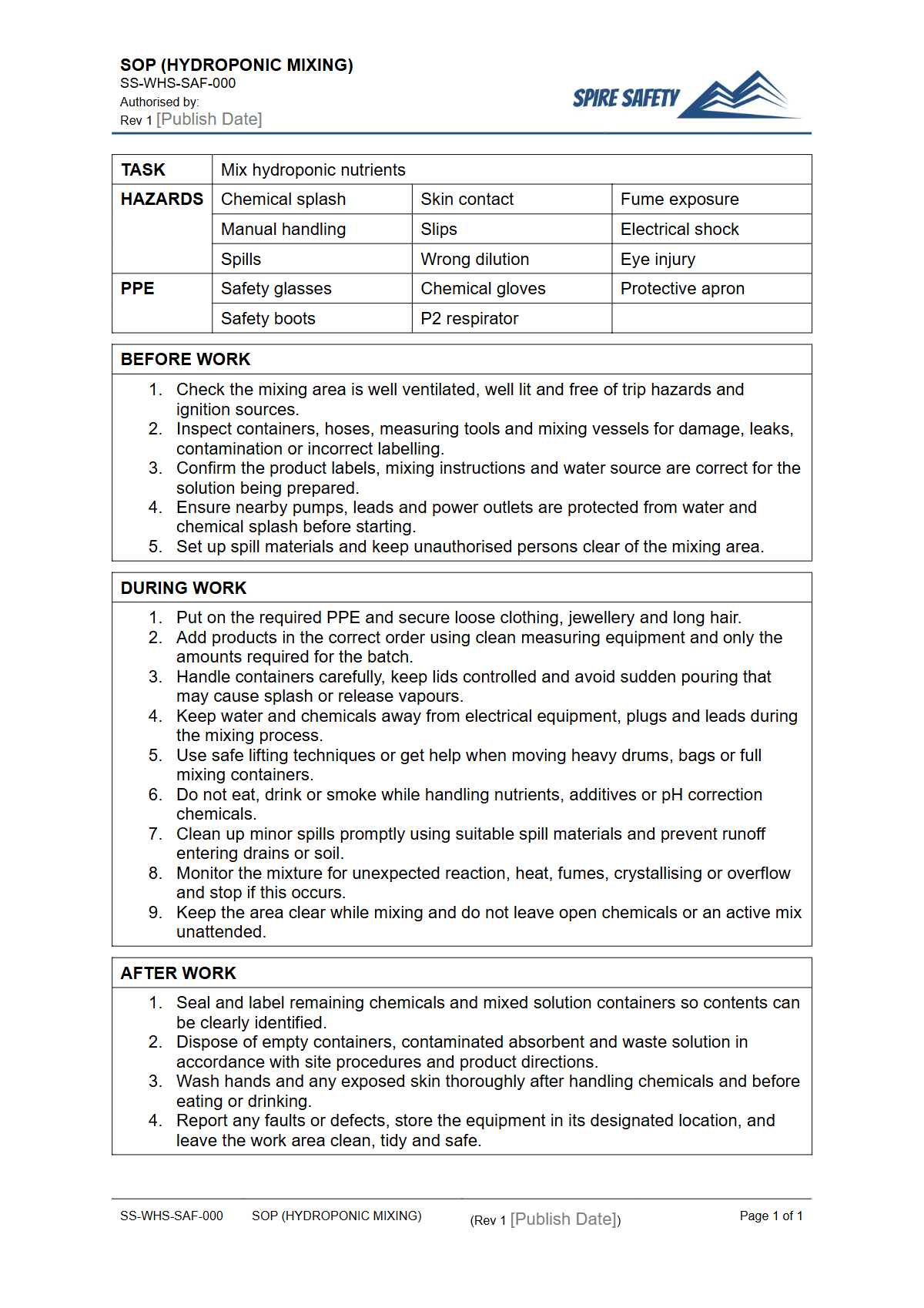
This Free Safe Operating Procedure (Hydroponic Mixing) Template provides a structured framework for documenting the key steps, hazards, and safety controls required to perform this task safely.
By implementing a formal SOP, you create a consistent, repeatable process that minimises the chance of error and protects your workers. This document serves as an excellent starting point, aligned with Australian WHS principles, for defining safe work methods.
A robust SOP is a fundamental part of effective WHS management systems, demonstrating a commitment to proactive risk management and worker safety. It outlines critical information such as required Personal Protective Equipment (PPE), correct chemical handling techniques, and emergency spill response procedures.
Video walkthrough
How to use the Free Safe Operating Procedure (Hydroponic Mixing) Template
This Safe Operating Procedure for hydroponic mixing is provided as a DOCX file for easy editing and a PDF for quick printing and reference. To effectively use this resource, you must adapt it to your specific operational context.
This involves a thorough assessment of your own equipment, the specific chemicals you use, and the environment where mixing occurs. The template includes sections for you to detail these site-specific factors.
You should review the document and fill in the blank sections with information relevant to your workplace. This includes listing the exact brand and type of nutrients, the models of any pumps or mixing equipment used, and the location of safety showers and eyewash stations.
For other specialised tasks in your operation, you might also require documents like our FREE Spreader SOP (Safe Operating Procedure) Template to ensure all procedures are clearly documented.
Important Customisation Note
This is a template only. We have developed it as a starting point, and you must customise it to reflect the specific hazards, equipment, chemicals, and control measures present in your workplace.
A generic procedure is not sufficient to ensure safety; effective risk control depends on a procedure tailored to your unique circumstances. It is crucial to consult with your workers during the customisation process, as they have direct experience with the task and can provide invaluable feedback on what is practical and effective.
When to use it
A Safe Operating Procedure for hydroponic mixing should be in place and readily accessible before any worker is permitted to perform the task. It forms a critical part of the induction and training process for new employees and serves as an ongoing reference for experienced staff.
The SOP should be consulted as a step-by-step guide every time mixing is performed to ensure consistency and adherence to safety protocols.
Furthermore, the SOP should be a live document, subject to regular review. We recommend reviewing it at least annually, or more frequently if there are changes to your process.
This includes introducing new chemical products, acquiring new mixing equipment, or altering the layout of the work area. It should also be immediately reviewed following any incident, near miss, or safety observation related to the mixing task.
This ensures it remains relevant and effective, much like you would review a FREE Planter SOP (Safe Operating Procedure) Template after modifying your planting equipment.
Who should use it
This SOP is designed for use by multiple people within an organisation:
- Workers: Operators performing the hydroponic mixing task should use the SOP as their primary guide to ensure they follow the correct, safe sequence of actions every time.
- Supervisors and Managers: Team leaders and managers use the SOP as a tool for training, competency assessment, and workplace inspections. It provides a clear benchmark against which to measure safe work performance.
- WHS Personnel: Safety officers and advisors use the SOP as part of the broader risk management framework. It serves as documented evidence of risk assessment and control measures for a specific hazardous task.
For businesses unsure how to effectively implement SOPs or integrate them into daily operations, engaging professional advice can be beneficial. Expert WHS consulting can help bridge the gap between documentation and practical application.
Whether it's for chemical handling or operating machinery as outlined in our Free Air Compressor SOP (Safe Operating Procedure) Template, a well-implemented procedure is key. To discover more templates and checklists, explore our complete free WHS resources library.
Common mistakes
Common mistakes to avoid
- Mixing nutrients or additives in the wrong order, causing chemical precipitation and making them unavailable to plants.
- Failing to wear appropriate PPE, especially safety glasses and chemical-resistant gloves, when handling concentrates.
- Using uncalibrated or dirty measuring equipment, leading to incorrect nutrient solution strength or pH levels.
- Neglecting to properly label and store mixed nutrient solutions and concentrated chemicals.
Legal references
Legal considerations
The following legal requirements may be relevant to this type of work.
- Work Health and Safety Act (Harmonised) — Provides the primary duties for protecting workers and other people from work health and safety risks.
- Work Health and Safety Regulations (Harmonised) — Sets out requirements supporting the management of workplace hazards and risks.
The following codes may be relevant to this type of work.
- Managing WHS Risks Code of Practice — Provides practical guidance on identifying hazards, assessing risks and applying effective controls.
- Work Health and Safety Consultation, Cooperation and Coordination Code of Practice — Provides practical guidance on consulting workers and coordinating with other duty holders.
- Managing the Work Environment and Facilities Code of Practice — Provides practical guidance on safe work environments, workplace facilities and related controls.
Did you know
The Risk of Nutrient Lockout
Nutrient lockout occurs when plants can't absorb nutrients from the solution, often due to incorrect pH levels. This highlights the importance of precise mixing procedures, as incorrect chemical addition can ruin an entire crop.
pH Adjusters are Caustic
Many common 'pH Up' and 'pH Down' solutions are highly caustic (like potassium hydroxide) or acidic (like phosphoric acid). Even small splashes can cause serious chemical burns, making gloves and protective eyewear non-negotiable PPE.
FAQ
Frequently asked questions
01What are the main hazards in hydroponic mixing?
02Why is a specific SOP for hydroponic mixing necessary?
03How often should a Hydroponic Mixing SOP be reviewed?
04Do I need to train my workers on this SOP?
Share this resource
Free Safe Operating Procedure (Hydroponic Mixing) Template
Browse Categories
How To Use It
- 1Download and open in Word or PDF.
- 2Replace the placeholders with your business details.
- 3Get it reviewed by a WHS specialist before rollout.
Need it customised?
Our WHS consultants can adapt this template to your site, run a gap analysis, or audit what you already have in place.
Book a Free Consultation WHS consulting servicesor call 1300 156 382
Related templates
- Free Safe Operating Procedure (Hygrometer) Template
- Free Safe Operating Procedure (IBC Cleaning) Template
- Free Safe Operating Procedure (IBC Decanting) Template
- Free Safe Operating Procedure (Ice Bin Cleaning) Template
- Free Safe Operating Procedure (Ice Crusher) Template
- Free Safe Operating Procedure (Ice Machine) Template